



AMD Radeon HD 7970 Review: 28nm And Graphics Core Next, Together As One
by Ryan Smith on December 22, 2011 12:00 AM EST- Posted in
- GPUs
- AMD
- Radeon
- ATI
- Radeon HD 7000
Display Tech: HD3D Eyefinity, MST Hubs, & DDM Audio
With the launch of the HD 5000 series back in 2009 AMD managed to get the drop on everyone, press and NVIDIA alike. Eyefinity, AMD’s Single Large Surface technology, came out of virtually nowhere thanks to a carefully orchestrated development plan that ensured very few people even within AMD knew about it. As a result of everything that was leaked ahead of time Eyefinity was not, making it AMD’s big eye catcher for the 5000 series.
As what was to be the first piece of the much dreamed about holodeck, AMD has been steadily working on it since 2009 in order to improve the experience even within their existing hardware by adding support for such features as bezel compensation and combining CrossFire with Eyefinity. For AMD it’s a feature of great importance even if end user adoption is still limited.
For the Southern Islands family AMD isn’t going to be pulling quite the rabbit out of their hat this time when it comes to displays. Southern Islands’ new display feature will be Discrete Digital Multi-Point Audio (which we’ll get to in a moment), but this doesn’t mean that AMD hasn’t continued to work on Eyefinity. Since October AMD has been engaged in an initiative they’re calling “Eyefinity Technology 2.0”, which is going to be pushed as a big part of the Southern Islands launch even though these are software improvements that will benefit all cards.
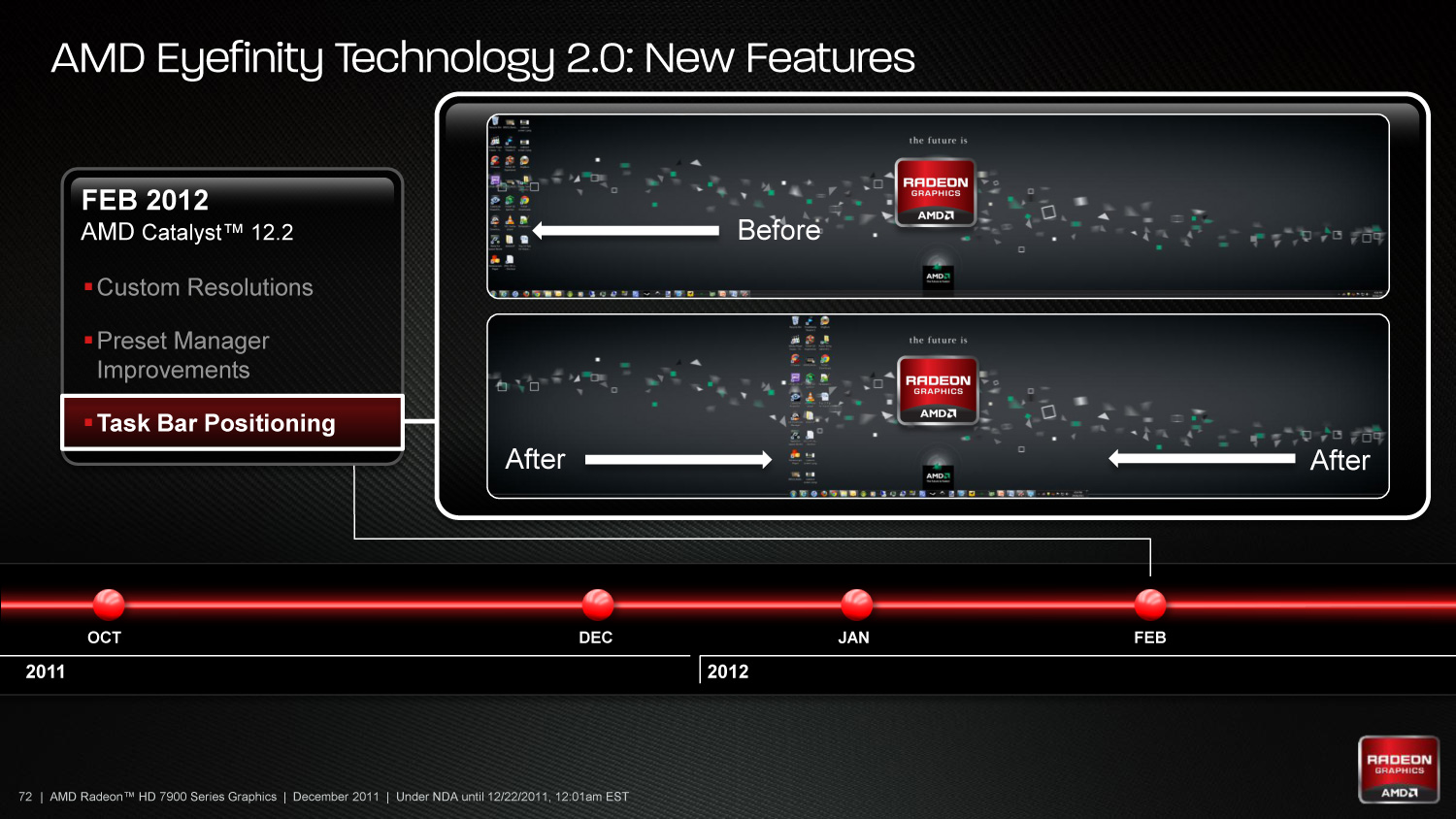
So what is Eyefinity Technology 2.0 composed of? We’ve already seen several new features starting with Catalyst 11.10, such as 5x1 portrait and landscape support and flexible bezel compensation support. The next step is going to be integrating Stereo 3D (or as AMD likes to call it, HD3D) into the mix, similar to how NVIDIA has 3D Vision Surround. Catalyst 11.12 introduced the ability to use HD3D with an Eyefinity display setup, and Catalyst 12.1 (preview out now) added support to do that in a CrossFire configuration. The final step is going to be with Catalyst 12.2 in February, which will add support for custom resolutions and the ability to relocate the Windows task bar to an arbitrary screen, two features that users have been asking about for quite some time. Again, all of these improvements are driver side, but they are a major component of AMD’s marketing for Southern Islands.
Speaking about Eyefinity, one issue that comes up time and time again is Multi Stream Transport (MST) hubs. We were introduced to MST hubs back with the launch of the 6800 series, which allowed a single DP 1.2 port to drive up to 4 monitors by taking advantage of the high bandwidth of DP1.2 and embedding transport streams for several monitors into the signal. The purpose of MST hubs was so that users could use several monitors with a regular Radeon card, rather than needing an exotic all-DisplayPort “Eyefinity edition” card as they need now.
But as many of you have asked me about, several deadlines for MST hubs have come and gone, including the latest deadline which was supposed to be by the end of this year. As with active DP adaptors this is largely out of AMD’s hands since they don’t produce the hardware, but they have been continuing to prod their partners on the issue. The latest deadline from AMD isn’t rosy – summer of 2012 – but they seem more confident of this deadline than deadlines in the past. Not that another half-year wait will be of any comfort for users who have been looking for MST hubs for the better part of the year, but at least it provides some idea on when to expect them.
Last, but certainly not least on the display technologies front is AMD’s new feature for Southern Islands, Discrete Digital Multi-Point Audio (DDMA). It’s a mouthful of a name but the concept is rather simple: it’s the next step in audio output from a video card. Video cards have been able to output audio for a few years now via HDMI, and more recently DisplayPort gained the ability. However GPUs have been limited to streaming audio to a single device, be it a monitor, TV, or receiver. With DDMA GPUs can send audio to multiple devices, and AMD is looking at how to put that ability to work.
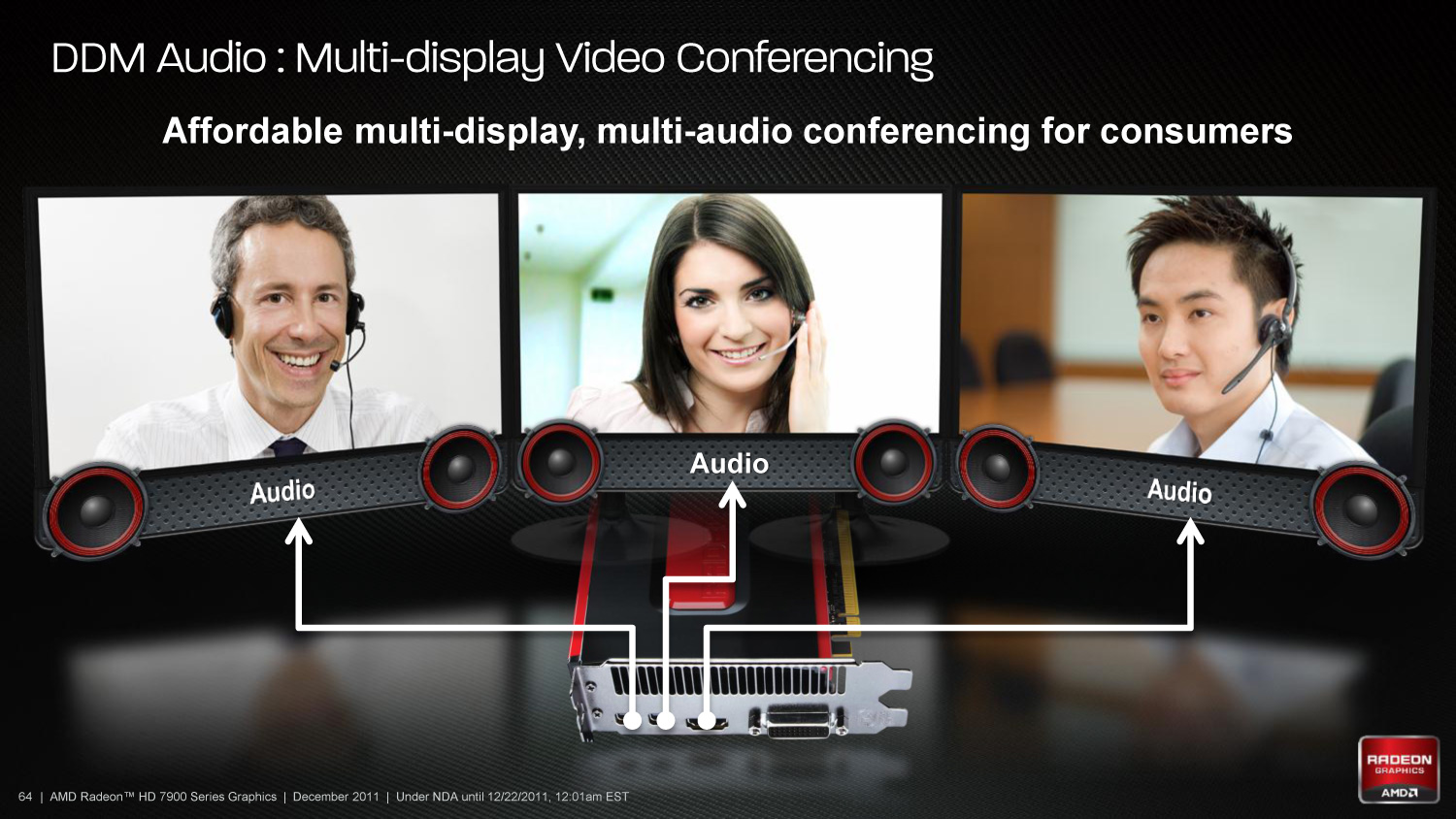
The most basic use for being able to send audio to multiple devices is to individually address the speakers of each device, which is the cornerstone of AMD’s proposed use cases. Fundamentally AMD is looking at applications that involve matching audio streams to the monitor the relevant application is on – move a video player from your center monitor to your left monitor, and the audio from that video player should also move from the speakers on the middle monitor to the speakers on the left monitor. What can you do with speakers that are mapped to monitors? That’s what AMD wants to find out.
Being realistic for a moment, the 7970 isn’t going to be the card that sells this feature, as it’s a $550 gamer video card. Gamers are using dedicated 2.1/5.1/7.1 audio systems or headphones for surround sound, and while AMD does have a proposed multi-tasking use case for this it’s not very convincing. DDMA will become much more important on future lower end cards as those are the cards that go into family desktops, workstations, and the like. Thus the killer app for this feature (and certainly AMD’s best prepared scenario) is for video conferencing where each attendee is mapped to a monitor, and with DDMA a set of speakers on that monitor. AMD’s partner Oovoo is working on just such a system though it’s still early in development.


 Facebook
 Twitter
 RSS
RSS


292 Comments
View All Comments
Wreckage - Thursday, December 22, 2011 - link
That's kind of disappointing.atticus14 - Thursday, December 22, 2011 - link
oh look its that guy that was banned from the forums for being an overboard nvidia zealot.medi01 - Tuesday, January 3, 2012 - link
Maybe he meant "somebody @ anandtech is again pissing on AMDs cookies"?I mean "oh, it's fastest and coolest single GPU card on the market, it is slightly more expensive than competitor's, but it kinda sucks since AMD didn't go "significantly cheaper than nVidia" route" is hard to call unbiased, eh?
Kind of disappointing conclusion, indeed.
ddarko - Thursday, December 22, 2011 - link
To each their own but I think this is undeniable impressive:"Even with the same number of ROPs and a similar theoretical performance limit (29.6 vs 28.16), 7970 is pushing 51% more pixels than 6970 is" and
"it’s clear that AMD’s tessellation efficiency improvements are quite real, and that with Tahiti AMD can deliver much better tessellation performance than Cayman even at virtually the same theoretical triangle throughput rate."
Samus - Thursday, December 22, 2011 - link
I prefer nVidia products, mostly because the games I play (EA/DICE Battlefield-series) are heavily sponsered by nVidia, giving them a developement-edge.That out of the way, nVidia has had their problems just like this card is going to experience. Remember when Fermi came out, it was a performance joke, not because it was slow, but because it used a ridiculous amount of power to do the same thing as an ATI card while costing substantially more.
Fermi wasn't successful until second-generation products were released, most obviously the GTX460 and GT430, reasonably priced cards with quality drivers and low power consumption. But it took over a year for nVidia to release those, and it will take over a year for ATI to make this architecture shine.
kyuu - Thursday, December 22, 2011 - link
Wat? The only thing there might be an issue with is drivers. As far as power consumption goes, this should be better than Cayman.CeriseCogburn - Sunday, March 11, 2012 - link
He's saying the 28mn node will have further power improvements. Take it as an amd compliment - rather you should have.StriderTR - Thursday, December 22, 2011 - link
EA/Dice are just as heavily sponsored by AMD, more in fact. Not sure where your getting your information, but its .. well ... wrong. Nvidia bought the rights to advertize the game with their hardware, AMD is heavily sponsoring BF3 and related material. Example, The Controller.Also, the GTX 580 and HD 6970 perform within a few FPS of each other on BF3. I run dual 6970's, by buddy runs dual 580's, we are almost always within 2 FPS of one and other at any given time.
AMD will have the new architecture "shining" in far under a year. They have been focused on it for a long time already.
Simple bottom line, both Nvidia and AMD make world class cards these days. No matter your preference, you have cards to choose from that will rock any games on the planet for a long time to come.
deaner - Thursday, December 22, 2011 - link
Umm, yea no. Not so much with nvidia and EA/DICE Batttlefield series giving nvidia a development edge. (if it does, the results are yet to be seen)Facts are facts, the 5 series to our current review today, the 7970, do and again continue to edge the Nvidia lines. The AMD Catalyst performance of particular note, BF3, has been far superior.
RussianSensation - Thursday, December 22, 2011 - link
."..most obviously the GTX460 and GT430, reasonably priced cards with quality drivers and low power consumption. But it took over a year for nVidia to release those"GTX470/480 launched March 26, 2010
GTX460 launched July 12, 2010
GT430 launched October 11, 2010
Also, Fermi's performance at launch was not a joke. GTX470 delivered performance between HD5850 and HD5870, priced in the middle. Looking now, GTX480 ~ HD6970. So again, both of those cards did relatively well at the time. Once you consider overclocking of the 470/480, they did extremely well, both easily surprassing the 5870 in performance in overclocked states.
Sure power consumption was high, but that's the nature of the game for highest-end GPUs.