



NVIDIA's Project Denver: NV Designed, High Performance ARM Core: Updated!
by Brian Klug on January 5, 2011 4:00 PM EST- Posted in
- Smartphones
- Arm
- Project Denver
- Mobile
- SoCs
- NVIDIA
NVIDIA's CEO, Jen-Hsun Huang just announced Project Denver - its first CPU architecture design ever, based on ARM's ISA. This is a custom design done by NVIDIA in conjunction with ARM and targeted at the high performance computing (HPC) market.
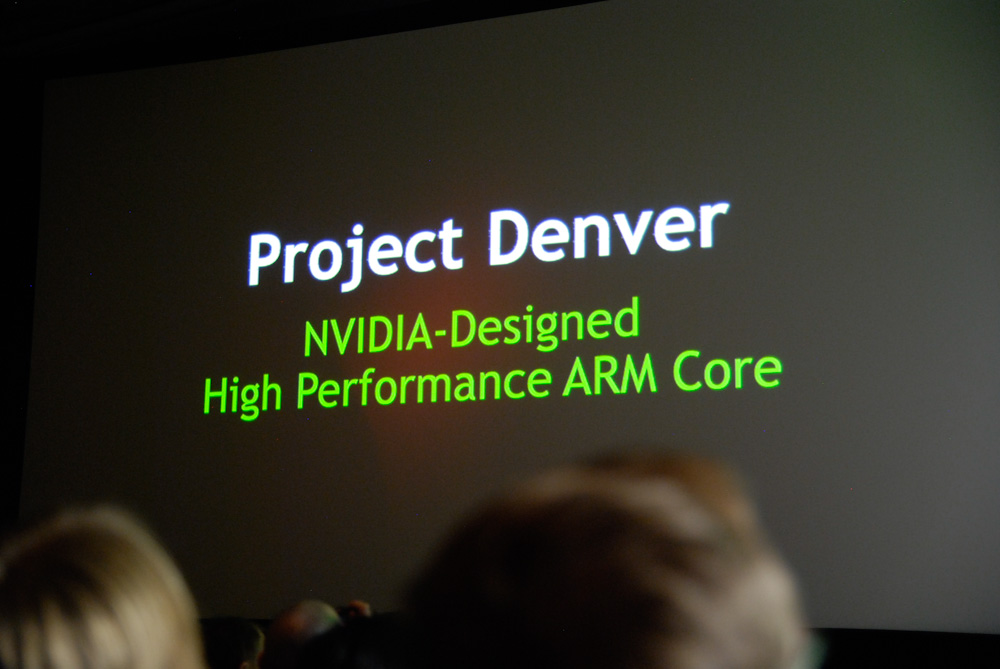
This is a huge announcement from NVIDIA, but not entirely unexpected. Prior to Project Denver NVIDIA licensed ARM IP but developed its own IP everywhere else for use in Tegra. Going forward, NVIDIA is turning into a full fledged SoC architecture company. This is a huge step in NVIDIA becoming a major player in the SoC evolution going forward.
Update: NVIDIA provided some more details on the announcement. Project Denver is targeted at everything from PCs to HPC/servers. This is completely a high end play going after the x86 stronghold. Project Denver ties in completely with Microsoft's announcement to bring Windows 8 to ARM next year.
NVIDIA also announced that it will be licensing ARM's Cortex A15 core, presumably for use in lower end devices (e.g. smartphones). I wouldn't be surprised if NVIDIA eventually moves to its own architecture based on ARM across the board.


 Facebook
 Twitter
 RSS
RSS


47 Comments
View All Comments
LeftSide - Wednesday, January 5, 2011 - link
I'm still surprised that nvidia hasn't tried to merge with Via. It would get them into the x86 space.AmdInside - Wednesday, January 5, 2011 - link
X86 is pretty old and its hard competing against a monopoly. Just ask AMD.MonkeyPaw - Wednesday, January 5, 2011 - link
x86 definitely has a future (the K8 Opteron really helped steer Intel away from IA32/64), but x86 is much closer to saturation. The MID market, however, is still wide open. We still see competition in architecture, OS, form factor, and use/application. The margins are pretty weak though. One high-end server chip brings big revenue, well more than what an entire MID sells for. Also, I'm just not sure bringing ARM up to a high-power environment will ever be worth it. x86 has simply soared well past what the average user needs, and now lesser architectures like ARM are finally becoming able to sufficiently run things like iPads. That's what will be so big for Zacate--it will make netbooks and bargain notebooks beyond sufficient for a large portion of the market. nVidia wouldn't have enough time to produce sufficient competition from buying Via. It would be 5 years or more before a useful product came from such a purchase. Think where AMD and Intel will be then.mino - Wednesday, January 5, 2011 - link
NV was (supposed) to get VIA around the time AMD merged with ATI - 4 yrs ago ...But they decided to go at it the hard, er, the nVidia way.
marc1000 - Thursday, January 6, 2011 - link
agreed! it would make sense back then... but not now. this is definetively a high stake NV is doing....michael2k - Wednesday, January 5, 2011 - link
It looks like NVIDIA is trying to obsolete x86 entirely, here. A single large win, like Apple or Motorola, would be huge.Guspaz - Thursday, January 6, 2011 - link
Apple could certainly migrate from high-end x86 processors to high-end ARM processors without too much trouble. They've done it twice before, from 68K to PPC, and from PPC to x86. If they really wanted to migrate to ARM with emulation supporting legacy software, they can do it. It'd be a big win for nVidia, but it would have zero impact whatsoever on the x86 market beyond the lost Apple sales. Windows users don't care what architecture OS X users are on, and Linux users don't care what architecture anybody (including themselves) are on.nafhan - Thursday, January 6, 2011 - link
Apple could do it easier than some, but it'd still be a big deal.It'd be interesting to see someone like Dell/HP do a Windows 8 + Denver notebook.
Marburg U - Thursday, January 6, 2011 - link
Apple has the resorces and the knowhow to make its cpu\soc by itserlfs. And apple does not need HPC cpu.halcyon - Thursday, January 6, 2011 - link
I seriously doubt that.Just by buying one chip designer and another chip optimizer doesn't make them a full-fledged SoC-design/integration company.