



ATI Radeon HD 3870 X2: 2 GPUs 1 Card, A Return to the High End
by Anand Lal Shimpi on January 28, 2008 12:00 AM EST- Posted in
- GPUs
Last May, AMD introduced its much delayed Radeon HD 2900 XT at $399. In a highly unexpected move, AMD indicated that it would not be introducing any higher end graphics cards. We discussed this in our original 2900 XT review:
"In another unique move, there is no high end part in AMD's R600 lineup. The Radeon HD 2900 XT is the highest end graphics card in the lineup and it's priced at $399. While we appreciate AMD's intent to keep prices in check, the justification is what we have an issue with. According to AMD, it loses money on high end parts which is why we won't see anything more expensive than the 2900 XT this time around. The real story is that AMD would lose money on a high end part if it wasn't competitive, which is why we feel that there's nothing more expensive than the 2900 XT. It's not a huge deal because the number of people buying > $399 graphics cards is limited, but before we've started the review AMD is already giving up ground to NVIDIA, which isn't a good sign."
AMD has since released even more graphics cards, including the competitive Radeon HD 3870 and 3850, but it still lacked a high end offering. The end of 2007 saw a slew of graphics cards released that brought GeForce 8800 GTX performance to the masses at lower price points, but nothing any faster. Considering we have yet to achieve visual perfection in PC games, there's still a need for even faster hardware.
At the end of last year both AMD and NVIDIA hinted at bringing back multi-GPU cards to help round out the high end. The idea is simple: take two fast GPUs, put them together on a single card and sell them as a single faster video card.
These dual GPU designs are even more important today because of the SLI/CrossFire limitations that exist on various chipsets. With few exceptions, you can't run SLI on anything other than a NVIDIA chipset; and unless you're running an AMD or Intel chipset, you can't run CrossFire. These self-contained SLI/CrossFire graphics cards will work on anything however.
AMD is the first out of the gates with the Radeon HD 3870 X2, based on what AMD is calling its R680 GPU. Despite the codename, the product name tells the entire story: the Radeon HD 3870 X2 is made up of two 3870s on a single card.
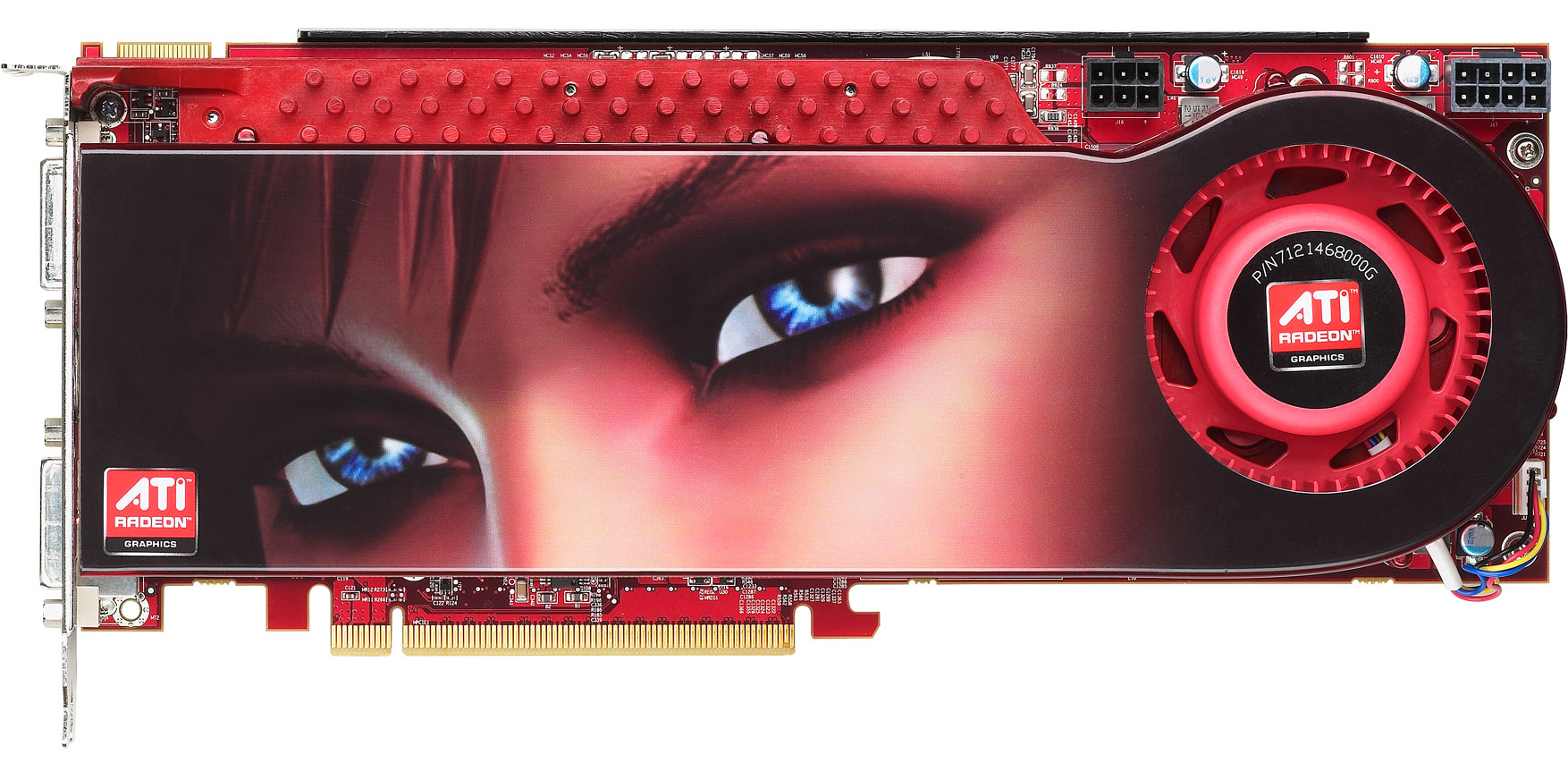
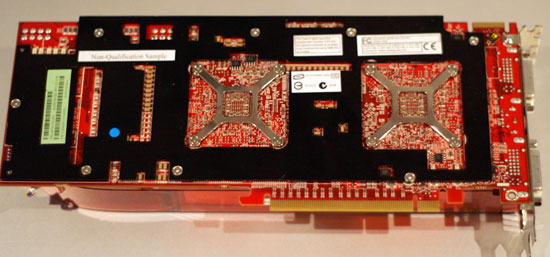
The card is long, measuring 10.5" it's the same length as a GeForce 8800 GTX or Ultra. AMD is particularly proud of its PCB design which is admittedly quite compact despite featuring more than twice the silicon of a single Radeon HD 3870.
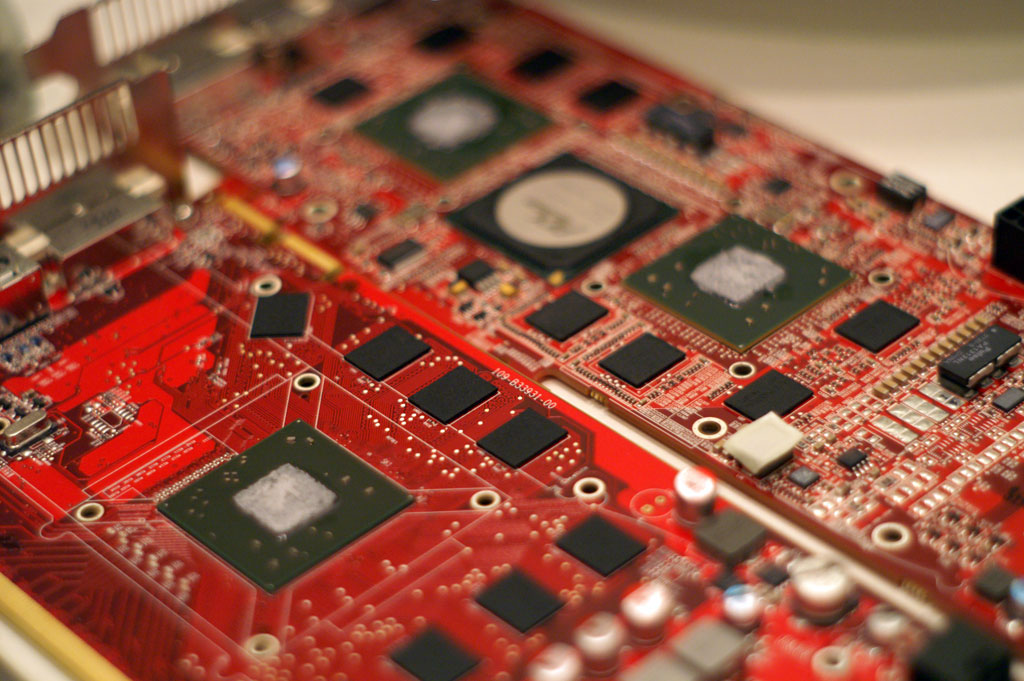
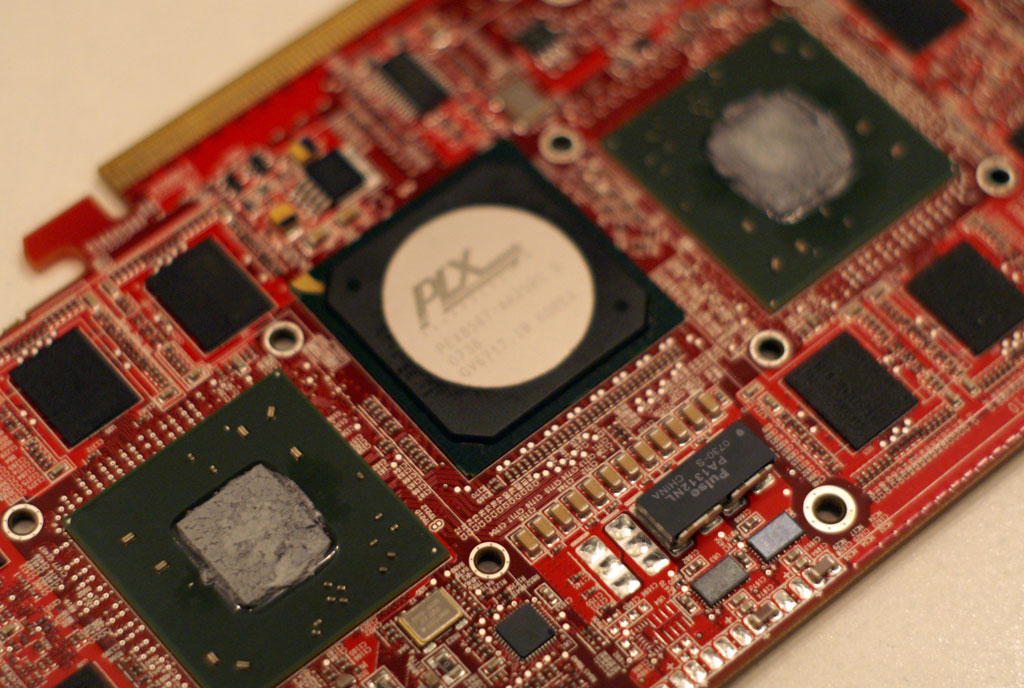
On the board we've got two 3870 GPUs, separated by a 48-lane PCIe 1.1 bridge (no 2.0 support here guys). Each GPU has 16 lanes going to it, and then the final 16 lanes head directly to the PCIe connector and out to the motherboard's chipset.
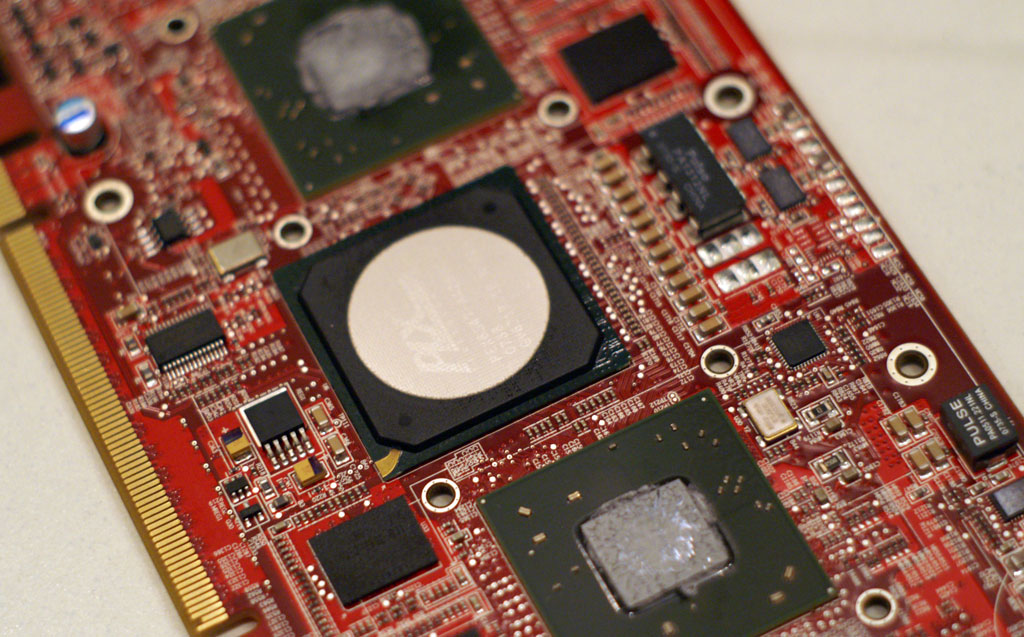
Two RV670 GPUs surround the PCIe bridge chip - Click to Enlarge
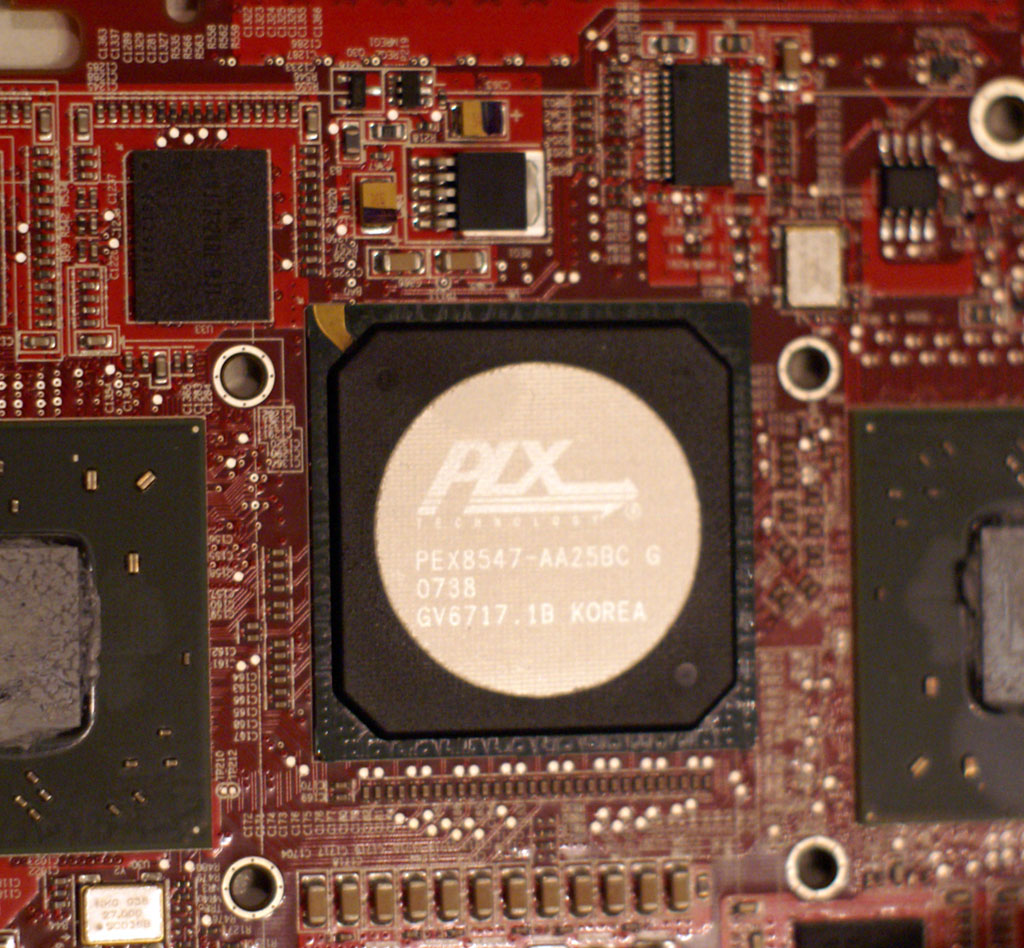
Thanks to the point-to-point nature of the PCI Express interface, that's all you need for this elegant design to work.
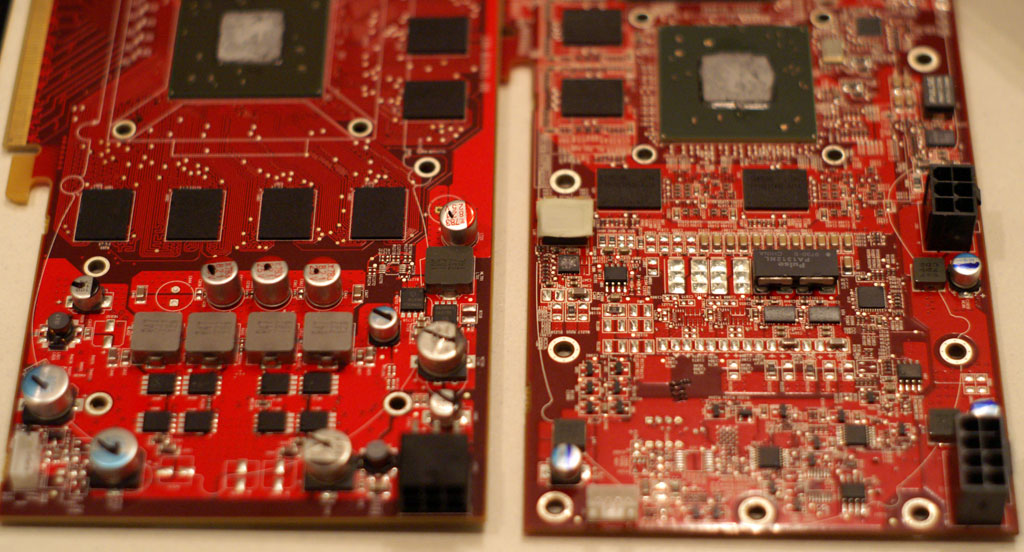
Each GPU has its own 512MB frame buffer, but the power delivery on the board has been reworked to deal with supplying two 3870 GPUs.
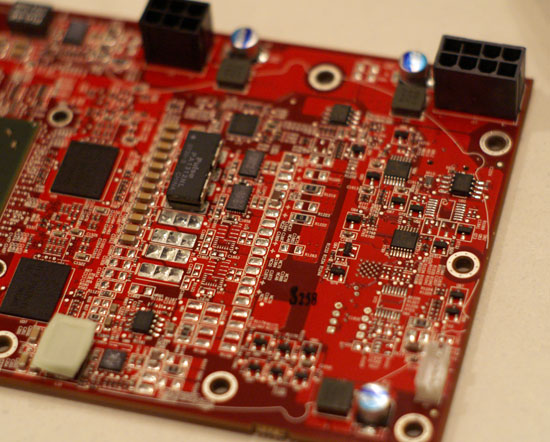
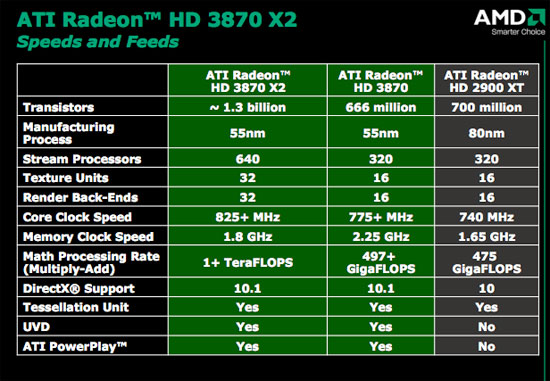
The Radeon HD 3870 X2 is built on a 12-layer PCB, compared to the 8-layer design used by the standard 3870. The more layers you have on a PCB the easier routing and ground/power isolation becomes, AMD says that this is the reason it is able to run the GPUs on the X2 faster than on the single GPU board. A standard 3870 runs its GPU at 775MHz, while both GPUs on the X2 run at 825MHz.
Memory speed is reduced however; the Radeon HD 3870 X2 uses slower, more available GDDR3 in order to keep board cost under control. While the standard 3870 uses 2.25GHz data rate GDDR4, the X2 runs its GDDR3 at a 1.8GHz data rate.
AMD expects the Radeon HD 3870 X2 to be priced at $449, which is actually cheaper than a pair of 3870s - making it sort of a bargain high end product. We reviewed so many sub-$300 cards at the end of last year that we were a bit put off by the $500 pricetag at first; then we remembered how things used to be, and it seems that the 3870 X2 will be the beginning of a return to normalcy in the graphics industry.
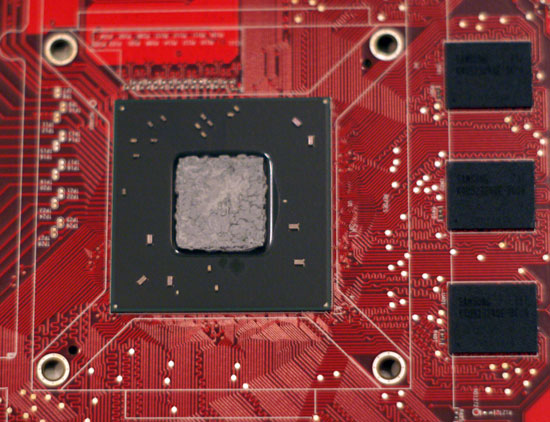
One GPU on the Radeon HD 3870


 Facebook
 Twitter
 RSS
RSS


74 Comments
View All Comments
Cyspeth - Thursday, February 21, 2008 - link
At last a return to multi-processor graphics acceleration. More power for the simple expedient of more GPUs. I look forward to getting two of these babies and setting them up for crossfire mode. Quad GPU FTW.This card seems to check out pretty nicely, and I haven't heard of many problems as yet. I've heard of only one really bad X2 horror story, which was a DOA, and ATI happily replaced the defective card. Anyone who would rather an nvidia 8800 is out of their mind. Not only is it less powerful and less value for money, but nvidia is really stingy about replacement of defects, not to mention they don't have one reliable third party manufacturer, in the face of ATI's 2 really good ones (Sapphire and HIS).
I've never had a problem with any ATI card I've owned, but every single nvidia one has had some horrible design flaw leading to it's horrible, crippling failure, usually through overheating.
It's good to see an honest company making some headway in the market. I would hope that ATI can keep up their lead over nvidia with this (or another) series of card, but that doesn't seem likely with their comparative lack of market share
MadBoris - Saturday, February 2, 2008 - link
While it's good to see AMD do something decent that performs well finally, I'm not so sure it's enough at this stage. AMD needs all the good press they can get but $450 seems a bit much when comparing it to the 8800GT @ $250 without a large towering lead. Furthermore the 8800 GT SLI gives it a pretty good stomping @ $500. Hopefully the multi-gpu solution is more painless and driver bugs get worked out soon.Also, it would be a big disappointment and misstep for Nvidia not to produce a single GPU real soon that ties or supersedes 8800 ultra SLI performance. It's been 15 months since 8800 ultra came out, that's normal time for a generation leap (6800,7800,8800). So unless Nvidia has been resting on it's laurels it should produce a killer GPU, and then if they make it a multi-GPU solution it should by all means smoke this card. Here's hoping Nvidia hasn't been sleeping and just make another minor 8800 revision and call it next gen, then by all means ATI will be a competitor.
MadBoris - Saturday, February 2, 2008 - link
Also from a price/performance ratio it would be nice to see how it performs against a 8800GT SLI 256MB in current games. 8800 GT 256MB SLI can be had for $430 and I would guess it would perform better at low-med resolutions than this x2.Giacomo - Saturday, February 2, 2008 - link
I wouldn't spend four hundred bucks for gaming at 1280x*, one single 512MB GT or GTS is more than enough for that.And as you scale up to 1680*1050, I personally believe that buying 2x256MB is silly. Therefore, I believe that the 512MB one is the only reasonable 8800GT.
Your plan sounds like low-res overdriving and doesn't seem wise to me.
Giacomo
MadBoris - Saturday, February 2, 2008 - link
It's not my plan, I just said it would be good for a price/performance comparison for something like a future review.Although I no longer game at 1280, doesn't mean others don't and 2-8800gt's with more performance and less price may be beneficial for them. Personally I think SLI is a waste anyway, but if you are considering an X2, 8800 SLI is an affordable comparison whether at 256 or 512.
Aver - Friday, February 1, 2008 - link
I have searched through anand's archive but I couldn't find the command line parameters used for testing Unreal Tournament 3 in these reviews. Can anybody help?tshen83 - Thursday, January 31, 2008 - link
That PLX bridge chip is PCI-Express 1.1, not 2.0. Using a PCI-Express 1.1 splitter to split 16x 1.1 bandwidth into 8x 1.1 bandwidth to feed two PCI-Express 2.0 capable Radeon HD3870 chips shows AMD's lack of engineering efforts. They basically glued two HD3870 chips together. Talking about the HD3870, it is basically HD2900XT on 55nm process with a beat up 256bit memory bus. Not exactly good engineering if you ask me.(props to TSMC, definitely not to ATI)Scaling is ok, but not great. The review failed to review dual HD3870x2s in Crossfire, basically to show the 4 Radeon HD3870s in Crossfire mode. I have seen reports say that 4 way scaling is even worse than 2 way. It is scaling in Lg(n) mode. Adding 2 more of the Radeon 3870s is only 40% faster than two way HD3870.
Giacomo - Thursday, January 31, 2008 - link
That's always curious to see users talking about "lacking of engineering efforts" and so on, as if they can teach Intel/AMD/nVIDIA how they should implement their technologies. PCI-X 2.0 is now out, and then we start seeing people who look at the previous version as it definitely should be dismissed. Folks, maybe we should at least consider that the 3870 design simply doesn't generate so much bandwidth to justify a PCI-X 2.0 bridge, don't we?Sorry, but I kinda laugh when I read "engineering" suggestions from users, supposedly like me, independently from how good their knowledge is. We're not talking about a Do-It-Yourself piece of silicon, we are talking about the last AMD/ATi card. And the same, of course, would apply to an nVIDIA one, to Intel stuff, and so on. The most correct approach I think it would be something like this: "Oh, see, they put a PCI-X 1 bridge in there, and look at the performance, when it's not cut by bad driver support, the scaling is amazing... So it's true that PCI-X 2.0 is still overkill, for nowadays cards".
That one sounds rationale to me.
About Crossfire, CrossfireX is needed for two 3870X2 to work together, and I've read in more than one place on the web that drivers for that aren't ready yet. Apart from this, before spitting on scaling and so on, don't forget that all these reviews are done with very early beta drivers...
Giacomo
Axbattler - Tuesday, January 29, 2008 - link
I seem to remember at least one review pointing out some fairly dire minimum frame rates. Basically, the high and impressive maximum frame rate allowed the card to have more a very good average frame rate despite a few instance of very dire minimum frame rate (if I remember correctly, it sometime dips below that of a single core card).Did Anand notice anything like this during the test?
Giacomo - Wednesday, January 30, 2008 - link
That's not exactly right. I mean, the average is not pulled up by any incredible maximum, it works in a different way: the maximum are nothing incredibly higher than the normal average, simply those minimum are rare, due to particular circumstances in which the application (the game) loads up stuff in the card while it's rendering, and it shouldn't do. This is the juice of an ATi's answer posted in the review by DriverHeaven. They told ATi about these instantaneous drops and that was the answer.Of course, remaining the fact that other cards didn't show similar problems, I believe that the problem is more driver-related, and ATi should really work fast to fix issues like this one.
However, DriverHeaven reported that this issue showed up mostly in scenario-loadings indeed, and therefore wasn't too annoying.
For what I've understood.
My two cents,
Giacomo