



HDMI
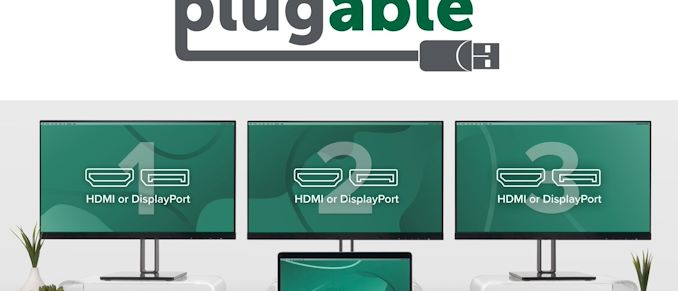
Plugable is introducing two new products at the 2022 CES - the UD-6950PDZ docking station, and the USB4-HUB3A USB4 hub. The docking station is technically the more interesting one, enabling three different 4K display outputs with a choice of either a HDMI connection or DisplayPort one on each. The docking station has a Type-C port for uplink, providing up to 60W for host charging. It is bundled with a 110W power brick. On the downstream side, the UD-6950PDZ has 6 USB 3.2 Gen 1 Type-A ports (four in the rear, and two in front), a combo audio jack in front, and a gigabit Ethernet port. The key differentiating aspect of the product is that the docking station supports multiple display outputs even if the host...
LG’s E9, C9 & B9 OLED TVs to Get NVIDIA G-Sync via Firmware Update
Back in September, LG and NVIDIA teamed up to enable G-Sync variable refresh rate support on select OLED televisions. Starting this week and before the end of the year...
37 by Anton Shilov on 11/1/2019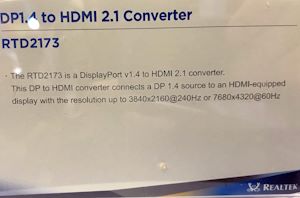
Realtek Demonstrates RTD2173 DisplayPort 1.4 to HDMI 2.1 Converter
Realtek is working on a chip that will convert DisplayPort 1.4 signals to HDMI 2.1 signals. The RTD2173 converter will enable makers of notebooks, motherboards, docks, and other applications...
31 by Anton Shilov on 6/13/2019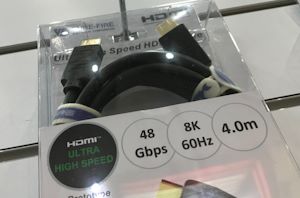
HDMI Forum: Certification Program for Ultra High Speed HDMI 48G Incoming
While the first HDMI 2.1 48G-branded cables were announced back in late 2018, they were not formally certified by the HDMI Forum for one reason: the certification program for...
24 by Anton Shilov on 6/13/2019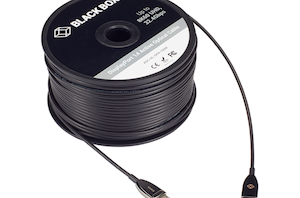
Black Box Announces Active Optical DP & HDMI Cables up to 100m
Black Box, a leading maker of pro AV cables and equipment, has unveiled active optical cables that can extend DisplayPort 1.4 or HDMI 2.0 signals for more than 200...
17 by Anton Shilov on 3/27/2019
Xilinx Introduces HDMI 2.1 IP with 8K Support
Xilinx this week introduced a comprehensive HDMI 2.1 IP subsystem for its various cores. The IP subsustem supports resolutions of up to 8K along with other features of the...
6 by Anton Shilov on 2/8/2019
HDMI 2.1 Nears Release: Club3D Announces Ultra-High Speed 48G Cable
As the first HDMI 2.1-enabled TVs are approaching release, we're finally seeing the market for HDMI 2.1 accessories fall into place to support those products. To that end, Club3D...
25 by Anton Shilov on 11/29/2018
HDMI Forum Demonstrates HDMI 2.1 VRR Capabilities on Samsung TV
Dynamic refresh rate technologies like AMD’s FreeSync and NVIDIA’s G-Sync have become de-facto standards for gaming PCs and displays. Last year the HDMI Forum introduced a more industry-standard approach...
46 by Anton Shilov on 6/20/2018
VESA and MIPI Announce VDC-M 1.1: Display Compression Standard for Mobile Devices
As of late, the pursuit for higher resolutions, faster refresh rates, better contrasts, higher brightness, and more colors in displays, has created bandwidth demands that are pushing the limits...
17 by Nate Oh on 5/15/2018
HDMI 2.1 Specification Released: Variable Refresh, Dynamic HDR, & More In 2018
Earlier this week, the HDMI Forum, the open industry consortium for developing the HDMI specification, officially finalized and released the HDMI 2.1 specification. Previously announced in January HDMI 2.1...
26 by Nate Oh on 11/29/2017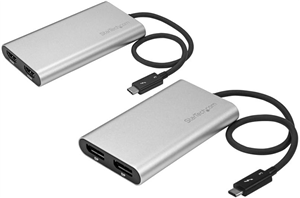
StarTech's Thunderbolt 3 to Dual 4Kp60 Display Adapters Now Available
StarTech's new family of Thunderbolt 3 adapters that let one TB3 port to drive two 4K 60Hz displays are now available for sale. One of the adapters supports two...
7 by Anton Shilov on 9/2/2017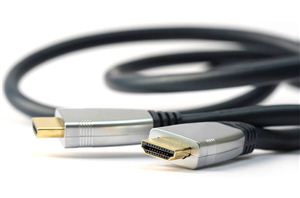
HDMI 2.1 Announced: Supports 8Kp60, Dynamic HDR, New Color Spaces, New 48G Cable
Update 1/6: HDMI Forum has notified us that the HDMI 2.1 uses DSC 1.2 compression for everything higher than 8K with 4:2:0 chroma sub sampling. The story was updated...
40 by Anton Shilov on 1/5/2017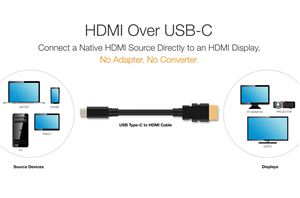
HDMI Alt Mode for USB Type-C Announced
Over the past year we have seen an increasingly number of vendors, associations, and consortiums lay their support behind the USB Type-C port and take advantage of its alternate...
68 by Ryan Smith on 9/2/2016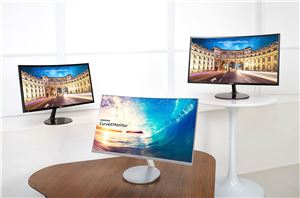
FreeSync-over-HDMI: Samsung Launches 1800R Curved FHD Monitors in the CF591 and CF390
One of the big things to come out of Computex last year was our exclusive preview of a new project by AMD: being able to bring variable refresh rate...
38 by Ian Cutress on 2/29/2016
Club3D Releases Their DisplayPort 1.2 to HDMI 2.0 Adapter: The Real McCoy
Though we don't typically cover adapter news, this one is worth a special exception. Late last month Club3D announced their DisplayPort 1.2 to HDMI 2.0 adapter, and since then...
28 by Daniel Williams on 12/22/2015
AMD Discusses 2016 Radeon Visual Technologies Roadmap
This is something that initially caught me off-guard when I first realized it, but AMD historically hasn’t liked to talk about their GPU plans much in advance. On the...
99 by Ryan Smith on 12/8/2015
Intel's Skylake GPU - Analyzing the Media Capabilities
At IDF in San Francisco last week, Intel provided us with lots of insights into Skylake, the microarchitecture behind the 6th generation Core series processors. Skylake marks the introduction...
37 by Ganesh T S on 8/26/2015
AMD Demonstrates FreeSync-over-HDMI Concept Hardware at Computex 2015
While AMD wasn’t the first GPU vendor to implement a system for variable refresh, the company has made up for lost time with zeal. Since demonstrating their FreeSync proof-of-concept...
91 by Ian Cutress & Ryan Smith on 6/3/2015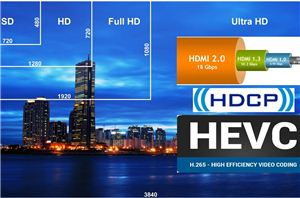
Future-proofing HTPCs for the 4K Era: HDMI, HDCP and HEVC
4K (Ultra High Definition / UHD) has matured far more rapidly compared to the transition from standard definition to HD (720p) / FHD (1080p). This can be attributed to...
98 by Ganesh T S on 4/10/2015
IOGEAR Updates A/V & Digital Home Solutions for 4K
We visited IOGEAR's booth at CES 2015 to take a look at the new products on display. The most striking was the DisplayLink-based products. Similar to Diamond Multimedia, we...
2 by Ganesh T S on 1/14/2015
 Facebook
 Twitter
 RSS
RSS


