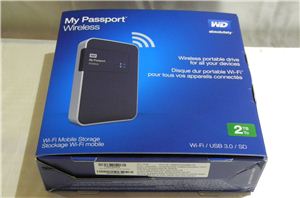
Let me pose a hypothetical situation: say you bought an iPhone or iPad, but cheaped out and got a 16GB model. You’ve got around 10GB worth of music, a few gigs in photos and applications, and you lose the rest to formatting and the OS itself. Basically, you’re maxed on capacity. Day-to-day, this isn’t a huge issue, but let’s say you’re going on vacation and want to have some movies to watch so that you can avoid the customary in-flight chick flick [or replace with whatever type of movies you dislike]. HD movies aren’t storage friendly, they take a solid chunk of storage space, and you don’t want gut your portable music library for the sake of watching a couple of decent movies on the plane. So what do you do?
Fret not, there is now a solution to that dilemma by way of Kingston and Seagate, among others. Both have recently launched wireless storage devices, streaming your media files to your mobile device via WiFi. Now, both of these are non-ideal solutions to a relatively marginal problem, but that’s to be expected in any newly conceived market. With the shift to cloud-based data and media streaming for mobile devices, there is going to be a gradual de-emphasizing of local device storage. We’re already seeing that in a big way with Google’s Cloud OS and Apple’s iCloud service, so wireless storage technologies are going to play an important role in handling media streaming for the future. The two devices we’re looking at today are pricey and aren’t perfect by any means, but they point the way to what the future of local media storage might look like. Interested? Keep reading to find out more.
In a private media event this week Corsair unveiled its latest contribution to the PC industry: gaming keyboards, mice and headsets. All of these new peripherals fall under the Vengeance brand. The motivation behind this move is simple: starting with memory and eventually expanding into power supplies, SSDs and cases, ...
Once in a while, we encounter a gadget performing a niche, yet handy function. A month or so back, we received a pitch for the portable SATA duplicator (with eSATA / USB dock) from StarTech.com.
My interest was piqued enough to request a review unit. Read on to find out how this nifty little gadget fared.
It’s that time of year again, when thousands of wide-eyed 17- and 18-year-olds will be setting foot on college campuses for the first time. Many more students will be returning for their second, third, or fourth (or fifth or sixth or…) fall semester. Whether you’re a student yourself, parent, other relative, or friend, this guide covers many aspects of college computing. From DIY and retail desktops to laptops to peripherals to gadgets like ereaders to software, we discuss how students use technology and recommend many products, from budget offerings to more powerful gear that will hopefully make higher education more productive and enjoyable!
Given the rise in prevalence of USB 3.0-enabled computer systems and maturation of the USB 3.0 flash drive market, we provide here benchmarks and real-world performance tests of USB 3.0 portable storage devices. How much faster are USB 3.0 flash drives compared to their USB 2.0 predecessors? Are they worth the cost premium? Does using a USB 3.0 flash drive in a USB 2.0 port yield better results than native use of a USB 2.0 flash drive? Do USB 2.0 flash drives benefit from being plugged into USB 3.0 ports? To find out the answers to these questions, read on!
Surveillance cameras are increasingly moving away from the analog to the digital domain. Advances in image and video processing silicon, emergence of efficient video compression standards and abundance of cheap storage have all contributed to bringing surveillance cameras to the consumer mainstream. As connected homes become more ubiquitous, surveillance cameras are tending to become network enabled. These IP cameras are used to record surveillance videos while also finding application for casual home monitoring, baby monitors etc. Their networked nature enables users to keep track of the video over the Internet (at work and on-the-go).
We have already reviewed a couple of IP cameras at AnandTech. The Dropcam Echo came across as very consumer friendly, while the Compro IP540 with the Pan-Tilt-Zoom feature was more professional and catered towards businesses.
Today, we will be reviewing Compro's entry level offering, the IP 70. While the hardware itself has been around for quite some time, firmware updates were provided recently to bring support for Seedonk. This is supposed to make the camera more consumer friendly. How good is the Compro IP 70, and what sort of usage scenarios is it suitable for? Read on to find out.
It's been a busy yet incredibly productive second day at CTIA 2011, and we've been getting hands on with all the latest and greatest from LG, HTC, and Samsung. We've seen a few familiar faces since MWC getting more polished and closer to launch, like the LG Optimus 3D and 2X - turned G2x. We've also gotten hands on with a few more devices that we didn't make it to last time at MWC, including the HTC Flyer and some physical prototypes of the Galaxy Tab 10.1 and 8.9
Read on for our impressions of all these devices.
The media streamer market is a highly competitive one, where you have the big players like Western Digital and Netgear, and the really small ones like Micca. None of these companies have media players as their sole product, because it is quite difficult to differentiate yourself from the rest of the pack in that market. We were surprised to learn of Nixeus, a Los Angeles based company, that was founded in 2010 with the purpose of bringing multimedia solutions to the market.
Nixeus introduced their first media player, the Nixeus Fusion HD, towards the middle of 2010. It made a big splash online, and there were many people on AVSForum singing its praise. The support was great, and reported bugs were looked into quickly. This encouraged us to get hold of a review sample. Read on to find out how the Nixeus Fusion HD fares in our stringent review.
Today, Steve Jobs took a sabbatical from his sabbatical to hop up on stage and tell us all about the iPad 2, the next revision of Apple’s wildly popular tablet PC. The announcement concerned both hardware and software – the iPad 2 is coming to the US on March 11, and ...
The two biggest announcements at CES 2011? Intel’s Sandy Bridge and pretty much everything NVIDIA talked about at its press conference (as well as the MS Windows 8/ARM announcement which I’ll discuss later).
NVIDIA finally got to talk about Project Denver as well as show off its first Tegra 2 based smartphones. The LG Optimus 2X, Motorola Atrix 4G and Droid Bionic will all be shipping in the next 2 months and all of them use NVIDIA’s Tegra 2 SoC.
The Android tablet market is another focus for Tegra 2. A little known fact is that Tegra 2 is the reference SoC for Honeycomb, the official Android release for tablets. Being selected by Google is another huge boon for NVIDIA’s Tegra business, although from the looks of it we’ll still see more Qualcomm based Honeycomb tablets than Tegra 2 solutions by the end of the year.
We're going to be touring pre-CES and CES show floors looking for interesting things to make note of, and already found something that piqued our attention. While walking around CES Unveiled, one device which caught our eye was the Parrot Asteroid, a single DIN sized head unit for vehicles - ...
The iPad started shipping in April, and since then it has basically had the tablet market to itself. Literally, in the six months after the iPad’s release, it didn’t have a single direct competitor. Dell launched the Streak shortly after the iPad, but the Streak was a 5” unit that was significantly smaller than the iPad. In the 7-11” tablet market, Apple has been the only real player.
But that all changed when Samsung launched its 7” Galaxy Tab last month. On paper, the Galaxy Tab is essentially a jumbo-sized implementation of the Galaxy S smartphone platform. You’re looking at the same A8-based 1 GHz Hummingbird processor and PowerVR SGX 540 graphics chip, the same 512MB RAM, the same lightweight plastic build, and pretty similar industrial design. The screen has been upsized, from the 4” WVGA unit in the Galaxy S to a 7” WSVGA panel. As the first Android-based slate to come from a major manufacturer, it’s a very important device, and not just to test Android’s viability as a tablet platform.
So in the first of our Android tablet reviews, we have Samsung’s Galaxy Tab. Read on to find out how it stacks up against the iPad and whether it can put a dent into Apple’s current domination of the tablet market.
For better or worse, new user interfaces are all the rage right now in the console gaming scene. Nintendo was first to the block in 2006 with 3D motion-controlled user interfaces, leveraging a unique combination of IR sensors and 6-axis MEMS accelerometers in a handheld remote. The motion-controlled Wii has enjoyed a nice long run being the sole platform for motion-assisted gaming. Flash forward to late 2010, and Microsoft and Sony both have readied their response to the Wii - the Microsoft Kinect and Sony Move, respectively.
The slate computing market is about to explode, with a literal flood of new tablets releasing over the coming months. Many of them will be Android based, running NVIDIA’s Tegra 2 SoC. NVIDIA made a big deal about Tegra 2 back at CES 2010, but for some reason, it’s taken quite a bit of time for anything running the platform to hit the market. Finally, we have one - the Viewsonic G Tablet. The G Tablet is a 10" slate running Android 2.2 on top of Tegra 2 and a $399 pricetag. For the money, it's packing a lot of power and features. But the real question is how Tegra 2 stacks up against Hummingbird and Snapdragon, along with how much faster the dual-core A9 is than the A8-based SoCs.
So, what's the performance like? Read on to see our impressions and benchmarks.
Content aggregation has been instrumental in the development of the web. In the early days of the web, destinations held all the power. If you wanted news or reviews you went to news and review sites, consuming the content they had to offer at each individual website. Email newsletters were the first to really change the manner in which content was consumed online. Instead of visiting a website to read the latest it had to offer, you got an email in your inbox with either complete content or enough of a teaser for you to decide whether or not you were interested in it.
These days we have many more ways to get access to written content on the web than a simple newsletter. There’s RSS, Twitter and Instapaper among others. It generally works well. RSS didn’t stop users from visiting websites, neither did Twitter and Instapaper hasn’t spelled the end of the front page either. If anything all of these technologies have helped make consuming content online easier. While the front page of any website today isn’t quite as big of an example of prime real estate as it was 10 years ago, it’s still quite valuable.
I mention this history for one important reason: we haven’t seen the same progress with aggregating and distributing television content on the web. These days you can find a lot of cable TV content on the web, usually posted the day after the shows air live on cable TV. All of the major networks support it. Visit Fox.com, NBC.com or CBS.com and you’ll be greeted with ways to watch all of the shows they air via the web. The content is all out there, and it wouldn’t be too difficult to aggregate it all into one cable-TV-like interface. In theory, with what’s posted online already, you could pull the plug on cable and just rely on video over the web without missing much. It’s just not quite as easy as a cable subscription with a DVR. This is where Boxee comes in.
Today I have in my hands the Netgear Roku XD media streamer, the latest media streaming solution for the living room to get retail store distribution by allying itself with a company best known for networking solutions. Does the Netgear Roku HD have what it takes to compete with the likes of D-link's Boxee Box or Logitech's Revue? What are the limitations and benefits of this particular media streamer? Let's find out.
At the risk of sounding like a puff piece and marketing drivel, Corsair has been essentially synonymous with quality hardware for a while now. If you were having trouble with cheaper RAM and just wanted to save yourself a headache, or if you wanted kit that you could push as hard as your wallet would allow, you'd buy Corsair. When Corsair jumped into the power supply market, there was another big splash. Cases? The Obsidian series isn't cheap but it's reviewed well the world over. So now what are we to make of Corsair's first stab into the consumer audio world, the HS1 gaming headset?