



Sony VAIO S Series: All Day Consumer Computing
by Dustin Sklavos on September 9, 2011 12:00 AM EST- Posted in
- Laptops
- AMD
- Intel
- Sony
- Sandy Bridge
- 6000M
- VAIO S
- Switchable Graphics
Introducing the Sony VAIO S
You asked for it, you got it: in house, a review of Sony's longstanding 13.3" road warrior S series. It's light, has a matte screen, switchable graphics, a mainstream Sandy Bridge processor, and the potential to last all day (and then some) on the battery. From the outside, at least, the Sony VAIO S looks like a winner at nearly any level. But did Sony cut any corners to get the VAIO S' price down, or should it be on any traveller's short list?
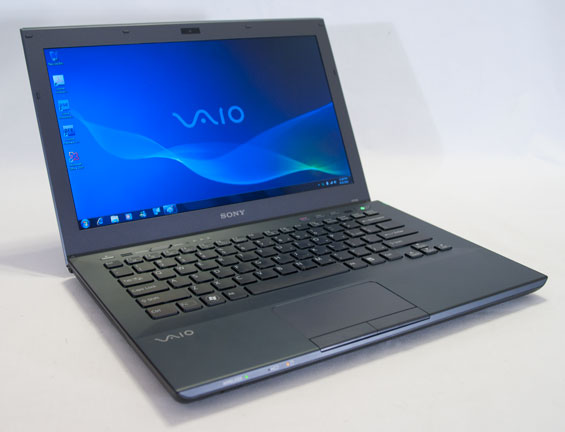
Before we get to the meat of the review, first a word about naming conventions. The actual laptop we're reviewing is technically the Sony VAIO VPCSB190X CTO (CTO = Configure To Order), but it's part of the VAIO S line and so we'll simply call it the VAIO S. There are lower end models (usually SB) and higher end offerings (SA), so bear in mind that what we're reviewing may have the same shell as other VAIO S laptops, but the LCD and other components (and thus performance) can vary.
Say what you will, I've always been a fan of Sony's styling and it's a rare pleasure to get one of their more portable VAIO notebooks in house for review. This may not be the Z series you were hoping for (we're working hard to get one of those in), but the S series has an awful lot to recommend it in and of itself. The svelte 13.3" chassis boasts an internal battery (user-replaceable), new Sandy Bridge graphics, and Sony continues to employ switchable graphics, this time with an AMD Radeon HD 6470M. To top it all off, you can even get the VAIO S with a matte screen. Here's how our specific test sample came equipped.
| Sony VAIO SB Specifications | |
| Processor |
Intel Core i5-2410M (2x2.3GHz + HTT, 32nm, 3MB L3, Turbo to 2.9GHz, 35W) |
| Chipset | Intel HM65 |
| Memory | 4GB DDR3-1333 soldered to motherboard, one empty DIMM slot |
| Graphics |
AMD Radeon HD 6470M 512MB DDR3 (switchable with Intel HD 3000) (160 stream processors, 800MHz/1.8GHz core/memory clocks, 64-bit memory bus) |
| Display |
13.3" Matte 16:9 1366x768 (SNY05FA Panel) |
| Hard Drive(s) | Hitachi Travelstar 5K500.B 500GB 5400RPM HDD |
| Optical Drive | Matshita DVD-RAM |
| Networking |
Realtek PCIe Gigabit Ethernet Intel Wi-Fi Link 1000 802.11b/g/n Bluetooth v2.1 + EDR |
| Audio |
Realtek ALC275 HD Audio Stereo speakers Headphone jacks |
| Battery |
6-Cell, 11.1V, 49Wh battery Optional sheet battery: 6-Cell, 11.1V, 49Wh battery |
| Front Side | Wireless toggle |
| Left Side |
Headphone jack Optical drive |
| Right Side |
MS/MSPro reader SD reader Kensington lock VGA HDMI UVAIO S 3.0 2x UVAIO S 2.0 Ethernet AC adaptor |
| Back Side | Exhaust vent |
| Operating System | Windows 7 Home Premium 64-bit SP1 |
| Dimensions | 13.04" x 8.84" x 0.95" (WxDxH) |
| Weight | 3.8 lbs. (5 lbs. with sheet battery) |
| Extras |
Webcam Backlit keyboard Flash reader (SD/Mini SD, MS/Duo/Pro/Pro Duo) Switchable graphics Extended sheet battery |
| Warranty | 1-year limited warranty |
| Pricing |
Starting at $899 Priced as configured: $1,134 |
The configuration for the Sony VAIO S that Sony sent us is actually pretty close to their entry level; only the processor and hard drive have been upgraded (barely), and they opted to include the sheet battery for us to test as well.
By now Sandy Bridge processors should be pretty familiar to you; our VAIO includes the lowest i5 chip, the Intel Core i5-2410M, but it's still a beefy processor, sporting two Hyper-Threaded cores running at 2.3GHz and capable of turbo'ing up to 2.6GHz on both or 2.9GHz on a single core. That's certainly more than adequate for most tasks. Alongside it is one of the more interesting parts of the VAIO S' design: there's only one DIMM slot in the notebook, and it's open. The other memory channel is occupied by 4GB of DDR3-1333 soldered to the motherboard. In fact, you can actually see the RAM chips right below the open slot. This means that our review unit is running at a slight disadvantage, with only a single memory channel populated instead of running dual-channel.
Where things get a little perplexing is the AMD Radeon HD 6470M with 512MB of DDR3. Even 1GB of video memory would be excessive for this GPU, with just a 64-bit memory bus and 160 shaders. The 800MHz core clock and 1.8GHz effective memory clock help even things out a little, but this is still one of AMD's weakest GPUs. Sony also doesn't use AMD's troubled dynamic switchable graphics technology (we'll have a look at that in the near future), opting instead to use what seems to be a mux-based hardware switch to toggle the dedicated graphics on and off. Given what we already know of the 6470M's performance, it really bears asking...what's the point? Intel's HD 3000 graphics are roughly 70% as fast in most games, and we're at the entry level anyhow. Sony does offer an upgrade to the AMD Radeon HD 6630M with 1GB of DDR3, though I have concerns about just how well a chassis this thin can handle a GPU like that.
Unfortunately, where things get pretty dire is the hard drive: it's not a bottom rung Toshiba or Fujitsu, but as you'll see later the 5400RPM Hitachi Travelstar really bogs this system down. You can upgrade to a 7200RPM drive (or even an SSD in the premium model) and I can't stress this enough: pay for the upgrade.
Finally, our review unit also included the extra sheet battery which plugs snugly into the bottom of the notebook and adds a little more than a pound of heft, bumping the VAIO S up to a still reasonable five pounds. In exchange, you get basically double the battery capacity, a development that gets all the more impressive later on when you see our battery life results. Sony was only willing to lend us the VAIO for two weeks, and about a day into my battery testing I began to feel...a little rushed.


 Facebook
 Twitter
 RSS
RSS


70 Comments
View All Comments
Brad4 - Friday, September 9, 2011 - link
Thanks for the news update. I also like Sony products, but I'm going to pass on this one. The first thing I scanned for was the display, and I was disappointed to see yet another 16:9 monitor. This would be a nice portable dvd player, but horrible for real productive work.tmensonides - Friday, September 9, 2011 - link
Is there anyone out there now doing differently? I think alienware, hp, dell, lenovo all dropped their 1920*1200 options from their laptop lineups...their might be a few 1440*900 left but i haven't looked.....and certainly not on a 13....I agree though, 16:9 is not great for working....i wonder at the engineers who design these things and then have to actually use them....must be a marketing dept mandate or something
Dustin Sklavos - Friday, September 9, 2011 - link
Honestly, good luck with that. 16:10 is dead. At some point you're just going to have to suck it up, buttercup, and either buy a used 16:10 notebook with outdated hardware, an Apple MacBook Pro for as long as those 16:10 panels last (hint: probably not long), or cope with having ONLY 1600x900 available in a 13.3" form factor, which in my experience is still the highest resolution I've ever seen on a 13" notebook.quillaja - Friday, September 9, 2011 - link
You forgot the 1920x1080 13.3" screen on the Sony Z series. I wish that screen was an option on the S.bennyg - Thursday, September 15, 2011 - link
I would love to see a good hi res screen on a 12/13/14 incher. And a sane one not the Veyron of laptops (Vaio Z) - "spec to the max price bedamned". Can't understand why Asus haven't offered the high-end SKUs of the U36 models with high-res screens.---
Having used both WUXGA and 1080p on my last two 15 inch lappys, aspect doesn't mean anything, screen quality is much more important than 120 vertical pixels.
sferrin - Saturday, September 10, 2011 - link
The OP has a point and it's not so much the resolution as it is the ratio. I have a 790Z with the 1600 x 900 screen and it's a pain in the ass for some work as it's like looking through a slot. I hadn't really noticed how bad it was until I had my dinosaur Sony Z1 with a 1400 x 1050 screen out at it felt like I had a TON more space. I love that thing (if it had updated guts and say a 2000 x 1500 display, or even 1600 x 1200 I'd prefer it over my 790z for everyday stuff).seapeople - Wednesday, September 14, 2011 - link
Honestly I would prefer the 1600x900 over a 1400x1050 if I'm using just one screen. With 1600x900 you can actually put more than one thing on the screen side by side, while with the 1400x1050 you're pretty much stuck using just one application (albeit with more vertical space).Ushio01 - Friday, September 9, 2011 - link
Then get the 1600x900 upgrade 100 more vertical pixels than the old 16:10 1280x800 used to offer.retrospooty - Friday, September 9, 2011 - link
"Then get the 1600x900 upgrade 100 more vertical pixels than the old 16:10 1280x800 used to offer. "1600x900 is better than 1280x800, but in the marketplace its really replacing the 1680x1050 res. Still a step down. Especially vertically (particularly)
Ushio01 - Friday, September 9, 2011 - link
Please point me to a 13" laptop that ever had a 1680x1050 display?If you mean desktop monitors it's 1920x1080 that are replacing 1680x1050 with IPS screens to boot.