



The Sandy Bridge Review: Intel Core i7-2600K, i5-2500K and Core i3-2100 Tested
by Anand Lal Shimpi on January 3, 2011 12:01 AM ESTGeneral Performance: SYSMark 2007
Our journey starts with SYSMark 2007, the only all-encompassing performance suite in our review today. The idea here is simple: one benchmark to indicate the overall performance of your machine. SYSMark 2007 ends up being more of a dual-core benchmark as the applications/workload show minimal use of more than two threads.
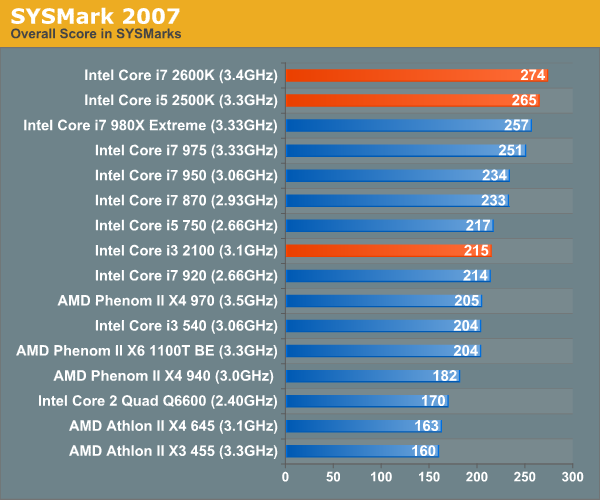
The 2600K is our new champion, the $317 chip is faster than Intel's Core i7 980X here as SYSMark 2007 doesn't really do much with the latter's extra 2 cores. Even the 2500K is a hair faster than the 980X. Compared to the Core i5 750, the upgrade is a no brainer - Sandy Bridge is around 20% faster at the same price point as Lynnfield.
Compared to Clarkdale, the Core i3 2100 only manages a 5% advantage howeer.
Adobe Photoshop CS4 Performance
To measure performance under Photoshop CS4 we turn to the Retouch Artists’ Speed Test. The test does basic photo editing; there are a couple of color space conversions, many layer creations, color curve adjustment, image and canvas size adjustment, unsharp mask, and finally a gaussian blur performed on the entire image.
The whole process is timed and thanks to the use of Intel's X25-M SSD as our test bed hard drive, performance is far more predictable than back when we used to test on mechanical disks.
Time is reported in seconds and the lower numbers mean better performance. The test is multithreaded and can hit all four cores in a quad-core machine.
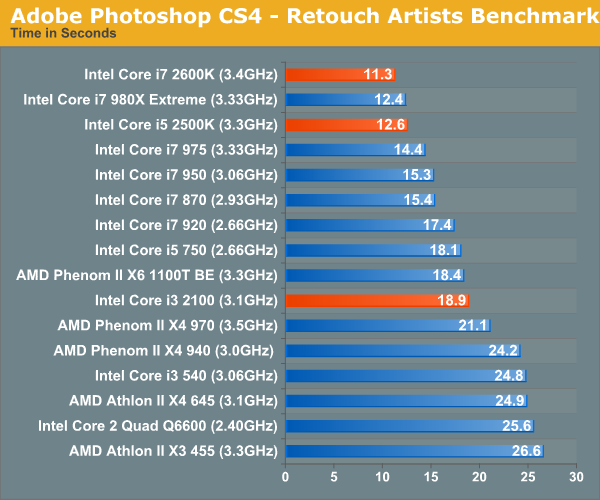
Once again, we have a new king - the 2600K is 9.7% faster than the 980X in our Photoshop CS4 test and the 2500K is just about equal to it. The Core i3 2100 does much better compared to the i3 540, outpacing it by around 30% and nearly equaling the performance of AMD's Phenom II X6 1100T.


 Facebook
 Twitter
 RSS
RSS


283 Comments
View All Comments
RMSe17 - Monday, January 3, 2011 - link
Time for an upgrade :)marc1000 - Monday, January 3, 2011 - link
I decided to jump the first core-i lineup, and sitck to an old core2duo for some more time... now seems the wait was worth it!I just hope the prices outside US/Europe will be reasonable..
thanks Anand,
vol7ron - Monday, January 3, 2011 - link
I think there are many of us that had the same idea. Unless needing to upgrade due to malfunction or new laptop purchase, holding C2D til past the i-Series was the best move to make; whereas buying into C2D asap was the best move at the time.Still going to wait for prices to fall and more USB3 adoption. Expected new purchase: mid-2011-mid 2012
vol7ron - Monday, January 3, 2011 - link
by "i-Series" it should have said "1st gen. i-Series"CptTripps - Tuesday, January 4, 2011 - link
Ya know I usually do as you are but was an early adopter of the i7 920. Looking now it seems I made the right choice. I have had 2 years of kickassery and my processor still holds up rather well in this article.hogey74 - Thursday, January 6, 2011 - link
Me too! I've got an e8400 running at 3.9 with almost zero OC know-how and its done me well. I might snap up an i7 if they and their mobos get cheap when sandy bridge has been out a few months... but may well skip that generation all together.Einy0 - Monday, January 3, 2011 - link
Holy crapola AMD really needs Bulldozer now. Even in heavily threaded video encoding the 2600K at $300 is blowing the 1100T x6 out of the water. This is the the Core 2 Duo vs. A64 X2 all over again. Will Bulldozer be another Phenom, a day late and a dollar short? TLB bug anyone? As a PC enthusiast I really want to see competition to keep prices in check. If I had to upgrade today, I can't see how I could turn down the 2600K...medi01 - Monday, January 3, 2011 - link
Did you add mobo price into equation?I don't get all the excitement, really. If anything, Intel's anti-overclocking moves
MonkeyPaw - Monday, January 3, 2011 - link
Yeah, new Intel motherboard models are never cheap. I don't understand why the price remains so high when more an more functionality is moving to the CPU. The other killer is that you need a new board for every Intel CPU update.Lastly, it's hard to throw the "buy now" tag on it with AMD's new architecture over the horizon. Sure, AMD has a tough act to follow, but it's still an unknown that I think is worth waiting for (if it's a dog, you can still buy Intel). Keep in mind that Bulldozer will have a pretty strong IGP, one that may make decent IGP gaming a reality. It will become a matter of how powerful the x86 portion of the Bulldozer is, and they are trying a considerably different approach. Considering the amount of money you'll be paying, you might as well see how AMD shakes out. I guess it just depends on if what you have today can get you by just a little longer.
dertechie - Monday, January 3, 2011 - link
You're conflating Bulldozer and Llano there. Bulldozer is the new architecture, coming to the desktop as an 8-core throughput monster. Llano is the first desktop APU, cramming 4 32nm K10.5 cores and a Redwood class GPU onto the die. The next generation of desktop APUs will be using Bulldozer cores.