



The Sprint HTC EVO 4G Review
by Anand Lal Shimpi on June 28, 2010 6:04 PM ESTDeath to Physical Buttons
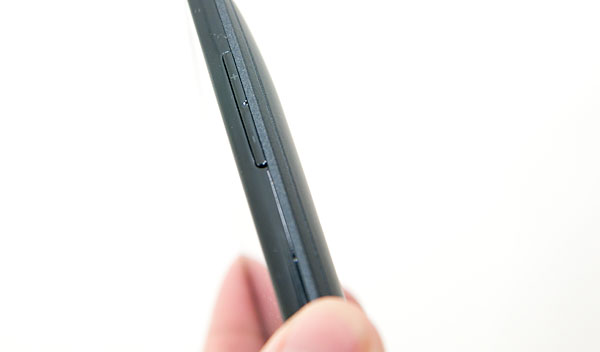
Along the top of the EVO 4G, just to the right of center is a power/lock button. It barely protrudes from the chassis which makes it difficult to hit both on accident and on purpose. On the right side of the phone is a volume rocker switch, which squeaked on my review sample. Those three are the only physical buttons on the device. The EVO 4G is all about its screen and HTC did nothing to detract from that.
The line of capacitive touch buttons along the bottom of the screen are responsive and by default have haptic feedback enabled (the phone vibrates slightly when you hit one of them). Unlike the Incredible I reviewed, the back of the phone didn’t rattle whenever the phone vibrated.
The touch buttons themselves are just as responsive as on the Incredible, which also means they are much better than those on the Nexus One.
The EVO 4G feels pretty solid. The front is nearly all screen (minus the row of touch buttons at the bottom), the border of the phone is glossy black plastic and the back is a very soft feeling plastic that’s wonderful to pet. The device doesn’t feel fragile.
Since there’s very little border around the screen and buttons I found myself accidentally triggering the quick search and sometimes the camera app with my palm while holding the phone.
Getting the back cover off is simple enough: just stick your finger nail in the opening at the top and pull it off. It snaps back on just as easily. I found that in general the EVO 4G seemed to be better built than the Incredible but not quite as solid as the Nexus One.
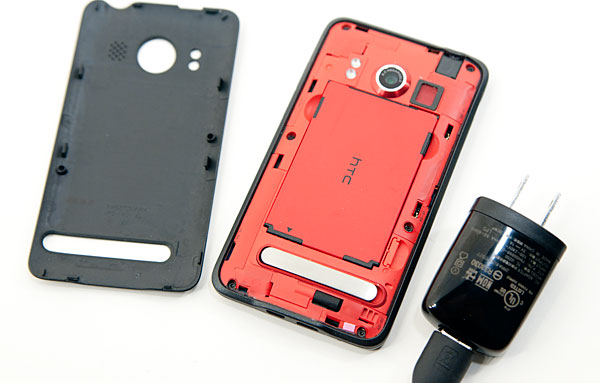
Beneath the rear cover you’ve got the now typical HTC arrangement. A beefy 5.5Whr battery and a microSD card slot for media (and eventually app) storage. The phone ships with a 8GB microSD card by default.
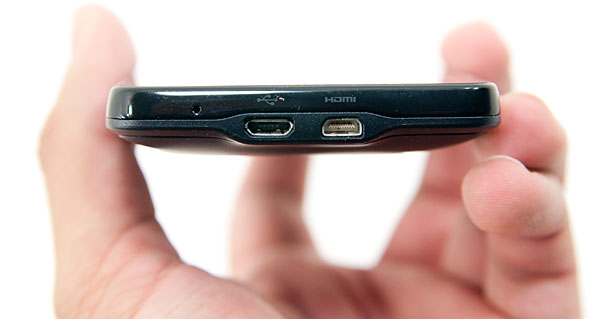
Along the bottom of the phone you’ve got a micro USB connector and a mini HDMI connector. The latter can only be used while playing back videos; it won’t mirror the EVO’s display to your TV unfortunately.
The phone comes with a USB cable and USB power adapter. The HDMI cable is sold separately.
Let’s Get Chippy
Inside the HTC EVO 4G is a Qualcomm Snapdragon QSD8650 SoC. This, unlike the Snapdragon in the Nexus One, supports both GSM and CDMA networks, which is what lets this phone work on Sprint.
The Snapdragon SoC has an amazing amount of integration that brings the CPU, GPU, video encoder, decoder, camera processor and modem all onto a single piece of silicon. To enable WiMAX support HTC turned to Sequans and used its SQN1210 WiMAX radio; this is what gives the EVO its 4G network support.
The 4G radio has an easily accessible on/off widget on one of the home screens by default, but honestly the Sequans chip appears to do a good job of being power efficient. I didn’t see a substantial difference in battery life with 4G enabled or disabled as long as the workload remained the same. Obviously with a faster connection you’re more likely to surf and download more, which will in turn kill your battery quicker but from what I’ve seen 4G battery life is roughly the same as 3G battery life for an identical workload (more on this later).
A Broadcom BCM4329 controller enables 802.11n support as well as Bluetooth and FM Radio tuning. Yes, the HTC EVO 4G can function as a high priced alarm clock radio if you want it to.


 Facebook
 Twitter
 RSS
RSS


97 Comments
View All Comments
DaveGirard - Monday, June 28, 2010 - link
you're missing the iPhone 4 in the battery life and there is only one phone in the H.264 page.And I think you need to set your white point properly for the iPhone 4 pics. Saying that's the best picture you can produce is not accurate.
Anand Lal Shimpi - Monday, June 28, 2010 - link
The iPhone 4 review is next, and the white balance was actually a problem for the iPhone 4 - regardless of where I tapped to sample the white balance pretty much came out that way.More on this tomorrow...
Take care,
Anand
SandmanWN - Monday, June 28, 2010 - link
"The size of the screen is really what sets the EVO 4G apart from the competition, and honestly I couldn’t think of a better phone for browsing the web. Loading full websites is a pleasure and the screen is large enough where you can actually read a lot of content, even while zoomed in. I’d be willing to go as far as to say that it is almost too small for the ideal web browsing experience."This whole paragraph is confusing and contradicting. You say you couldn't think of a better phone for web browsing. Then say you you can read a lot even while zoomed in, which I think you meant to say out there. Then you contradict the first sentence and say it is almost too small for web browsing.
I think that paragraph needs a mulligan.
Anand Lal Shimpi - Monday, June 28, 2010 - link
I've cleared it up a bit :)tipoo - Monday, June 28, 2010 - link
It would be great if you could include Evo 4G benchies in the iPhone 4 review.rf40928 - Friday, July 2, 2010 - link
Yeah, I guess u saw the Evo benchmarks.I have an Evo and Im considering a Iphone 4 ( my cousin got one )..
I posted above the following: ... funny how the Iphone 4 review that Anand did proves Iphone 4 on a "slower" 3g network is consistantly faster then the Evo on a 4G network when it comes to the web .. I guess 4G's Peak performance is theoretically better.. but are Sprints 4G average 4g Speed numbers better then ATT's avg 3g speeds?? ..it would seem not.."
yibrushn - Monday, June 28, 2010 - link
Sorry just gotta make 2 corrections. The front camera is 1.3 mp and the screen is TFT not AMOLED.Anand Lal Shimpi - Monday, June 28, 2010 - link
Fixed and fixed :)Hmm that was actually a bit confusing, Sprint lists it as an OLED screen and it is very similar to the OLEDs we've used in terms of color calibration but all the data I can find points to a TFT display.
DigitalFreak - Monday, June 28, 2010 - link
I thought the screen thing might have been a typo, until I saw there was an entire paragraph describing the "AMOLED" screen. :-/Anand Lal Shimpi - Monday, June 28, 2010 - link
That was absolutely my bad. HTC appears to have calibrated the screen to mimic the other OLEDs, it's overly red. Combine that with the OLED listing here http://shopamerica.htc.com/cell-phones/productdeta... and it resulted in my mistake. I was wondering why viewing angle was so bad for OLED, I should've been more careful in my research there instead of just making an assumption. I will be more careful in the future.Thanks again for catching the error early on.
Take care,
Anand