



A Taste of Froyo: Google Android 2.2 Explored
by Saumitra Bhagwat on June 23, 2010 1:03 AM ESTFinal Words
Don’t be fooled by the minor 0.1 bump in the version number; Froyo is a massive update that brings a lot to the table. With Froyo, Google has focused on improving the overall fit and finish of the OS. There are numerous speed improvements like the new JIT compiler and the V8 Javascript Engine, small fixes and UI tweaks and some big ticket features like Flash support and Wi-Fi Hotspot that make Froyo feel much more refined and usable.
Although there are times when the Android’s UI does seem inconsistent and clumsy. The Music player for instance definitely needs a better UI. Google Talk for instance, does not let you switch accounts; you can only sign in to the Google account used to set up the phone. So if you need to use multiple accounts, you’ll have to turn to Meebo or other similar apps. The favorites section of the dialer only arranges contacts alphabetically, there’s no way to customize the order of that list. While nagging, these issues can be easily fixed via a software update. The keyboard in Froyo is still a disappointment, but this is largely attributable to the responsiveness of the screens being used in many Android devices. One of the main reasons why navigating the iPhone is a pleasure is because of the incongruously more accurate and responsive capacitive display. It will be interesting to see how the keyboard performs when paired with a display that matches the iPhone’s caliber.
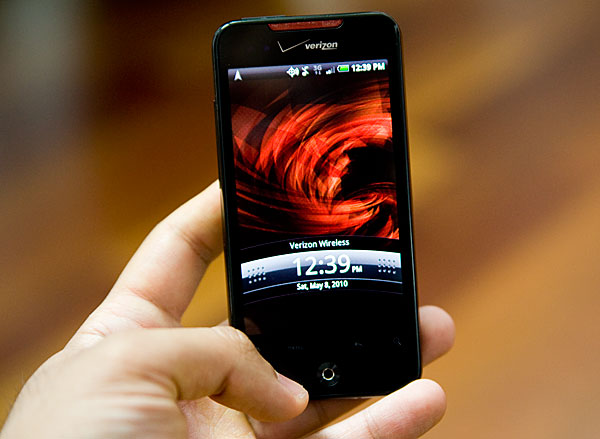
When oh when will you get to have some Froyo dear Incredible?
But, Android as a platform suffers from some outstanding issues as well. First and foremost is platform fragmentation. Froyo is the 4th update to Android in the past year, but hardly any devices (with the exception of the Nexus One) are actually running on v2.2. The nature of the Android ecosystem is like a double-edged sword. While it allows handset manufacturers the leeway to design custom UIs and choose underlying hardware configurations to cater to a wide price band, it also makes adopting the latest updates that much harder.
Therefore Google, as the promoter of the Android OS cannot guarantee a consistent user experience from one manufacturer to another. Once you bring tablets into the equation, you’re looking at an even bigger mess. Google’s partly addressed this issue by decoupling certain components of the OS and making them available as standalone downloads, such as Google Maps. In the long run though, Google needs to aggressively pursue this policy to at least bring about a semblance of a consistent user experience across its devices. Andy Rubin, Android’s platform head recently announced that they would be adopting a, “one major release per year” cycle. This will allow Google and handset manufacturers some time to prepare their devices and upgrade their custom UIs, but more importantly, maintain a certain baseline user experience that can be guaranteed to all users.
I’m sure Google will address a lot of these issues in the upcoming releases, but till that time, Froyo makes the case for the Android platform as one of its best releases to date.


 Facebook
 Twitter
 RSS
RSS


55 Comments
View All Comments
gayannr - Wednesday, June 23, 2010 - link
'Since I’m not important enough to have an exchange account, "is that sarcasm . lol
Saumitra - Wednesday, June 23, 2010 - link
No no, no sarcasm intended. I had an Exchange account briefly while I was in school, but that was a year ago. I'm really not important enough to have one ... ;)glynor - Wednesday, June 23, 2010 - link
You could test most of the Exchange features using a Gmail account and Google Sync.EricC - Wednesday, June 23, 2010 - link
" I'm really not important enough to have one ... ;) "Since I know the author, I can vouch for him on this one :D
Saumitra - Wednesday, June 23, 2010 - link
Hehe, Tim just sent me an email about this! :P5150Joker - Wednesday, June 23, 2010 - link
iPhone 4G or Sprint Evo 4G with Froyo on it?add119 - Wednesday, June 23, 2010 - link
You apple fan boy one android 2.1 came out in january 5th.. google release it with nexus one. Two android 2.0 came out in november with update 2.0.1 in december.Android 1.5 came out in may 2009 plz don't come mentioning phones without researching because all verizon phones has 2.1 os with sprint as well even htc hero and sammy moment has 2.1 os. T-mobile has mytouch3g slide with 2.1 os and cliq and cliq qt with be both getting 2.1 os next week. The only phone left behind is google g1 with 1.6 os and behold 2 with 1.6 os just released this week with that os changing from 1.5 os to 1.6 to behold 2. People if you going to buy any phoone don't go a&tt they suck like changing google option and take features away go with t-mobile or verizon. And, sprint sucks because they don't do ota they like giving update online with manuel. Personally that like rooting the phone it can mess your phone up.
whatthehey - Wednesday, June 23, 2010 - link
If you're going to be a tool and criticize an article, try learning how to speak and write intelligently first. Your rant is full of a list of phones and supposed release dates, but it has nothing to back it up other than the mindless diarrhea of the mouth that you spewed out. I don't care if the various releases of Android came out a month or two earlier than what was listed; what matters is whether the current 2.2 release is better, and that's what this article tries to cover.Saumitra - Wednesday, June 23, 2010 - link
Thanks for pointing that out. But, Eclair released on October 26th 2009, which is why I said November 2009 as a more general estimate. And yes, add119 learn to put down your thoughts a little more cogently.jasperjones - Wednesday, June 23, 2010 - link
Nice write-up, I've been running FRF50 on my Nexus One for the last few weeks and my experience has been similar.However, I feel the articles in the smartphone section could be more rigorous. I realize that we're dealing with different OSes as well as different devices at the same time. This makes comparisons and benchmarking harder. You cannot just throw out an NVIDIA card and put in an ATI card. But just because it's harder to line up various devices/software against each other doesn't mean you shouldn't try.