



Intel Core 2 CULV Roundup: Who Needs Atom?
by Jarred Walton on February 4, 2010 4:00 AM ESTA couple years back, ASUS released the first netbook on an unsuspecting world. Compared to the UMPCs and other tiny handhelds that preceded it, the Eee PC offered more in some areas and cost a lot less - and compared to ultraportables, it was smaller and cost about one fifth as much! Many consumers fell in love with the netbook, and now every major laptop company has some form of netbook. Intel just released the Pine Trail platform that updates Atom in a few areas, but Pine Trail is less about improving performance and more about reducing costs - mostly Intel's costs, as the new netbooks all cost the same or slightly more than preceding models. So yes, Atom is undoubtedly a success, but are Atom-based netbooks truly good are they just a current fad? To answer that question, we need to look at the next step up the mobile ladder: Intel's CULV platform.
CULV (Consumer Ultra Low Voltage) processors have been around for a while, but where formerly they were the domain of $1500+ ultraportables, netbooks have forced them into much lower price brackets. If the choice is between a $330 Pine Trail unit and a $1500 CULV, few would opt for the latter; today, the difference is a lot less, with some CULV designs starting as low as $400. It's no surprise that the least expensive models are more difficult to find in stock, and we're left to wonder if the problem is inadequate production or if the manufacturers are intentionally producing low volumes with the hope of getting more users to spring for higher cost offerings. Realistically, you're far more likely to find CULV laptops priced around $600, but a quick search turns up quite a few priced under $450 (though admittedly many vendors are backordered). Even at twice the cost of a netbook you should give them serious consideration, and in this roundup we'll show you why.
When you get right down to it, most CULV laptops are very similar. The slowest dual-core CULV CPU is a Celeron SU2300, clocked at 1.2GHz and with 1MB of shared L2 cache on an 800FSB; meanwhile the fastest CULV option right now is the Core 2 Duo SU9600, clocked at 1.6GHz and with 3MB of shared L2, but still on an 800FSB. With triple the L2 cache, the typical performance boost at the same clock speed would be ~10%, and the raw clock speed advantage and higher FSB would give the SU9600 another 33% advantage for a total performance increase of up to ~50%. However, not many companies ship laptops with the SU9000 CPUs and they're priced at $1500+. For those interested in affordable CULV, the "high-end" CULV CPU is going to be the Core 2 Duo SU7300, clocked at 1.3GHz and with 3MB L2. That CPU is only up to ~20% faster than the SU2300, and if you drop down to the most common Pentium SU4100 you're down to 1.3GHz with 2MB L2, or closer to a 15% performance improvement. What that means is that raw performance among most CULV laptops is going to be close enough that most people won't notice the difference.
There are a few other items to note. First, of the current CULV processors, only the Pentium SU4100 and SU2700 lack virtualization (VT-x) hardware support. Most users are unlikely to need the feature, unless they plan on installing Windows 7 Professional and running the XP virtual machine. Oddly enough, the Core 2 Solo SU3300 includes VT-x but skips xD (Execute Disable). The single-core Solo CPUs also have a lower TDP of just 5.5W, putting them in direct competition with Atom; they'll be faster in single-threaded tasks and very similar in multi-threaded tasks. Given the pricing, however, we recommend against buying any of the Core 2 Solo solutions; the jump to dual-core is definitely noticeable and the price of the CPUs actually makes many of the Core 2 Solo laptops as expensive as SU2300/SU4100 offerings.
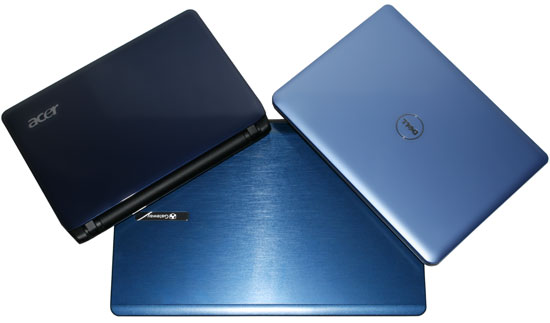
If performance isn't going to be the big differentiator (with some exceptions like high-end laptops with SU9000 CPUs and SSDs in place of hard drives), what you really need to pay attention to are the other features and the overall design. Specifically, we'll look at the keyboard, touchpad, LCD, and battery life in our roundup of CULV laptops today. We'll also look at other features that differentiate the laptops. We've got three models from Acer, Dell, and Gateway, and as you'll see performance is very much a wash between them.
These laptops are representative of what you'll find with most other CULV offerings, but you can still decide between a larger or smaller chassis and some other items. Some of the differences are easy to analyze even without using a laptop in person: a larger chassis will weigh slightly more and you might get an optical drive, or you might find a few select companies offering a higher resolution LCD. What we can't say is whether these other laptops have better LCDs or not (most likely not, though the higher resolution would still be a benefit), how the keyboard and touchpad feel, or if there are other useful features that aren't immediately visible. Ultimately, price is often the biggest factor, with entry-level CULV designs starting at around $400 (if you can find them in stock) and most ranging up to $650. Beyond that, there are designer CULV laptops and business tablets that can push pricing into the $1500+ range, but we aren't looking at that category in this roundup.


 Facebook
 Twitter
 RSS
RSS


62 Comments
View All Comments
diego10arg - Monday, March 15, 2010 - link
Hi all,I am trying to upgrade my Atom 270N netbook and my primary and only concern is FullHD Playback through HDMI. I will be using an external harddrive for backup and storage purposes, so HD does not matter.
After looking for a while I found several laptops with Celeron ULV 723, Athlon Neo MV-40, SU4100 and SU7300.
So far I got this prices (I live in Argentina, prices are in USD)
. MSI Wind 210-050AR, Athlon Neo MV-40, 2GB RAM, HD250Gb > 609 USD
. MSI X340-241AR, Celeron ULV 723 1.2Ghz, 2GB RAM, HD320Gb > 699 USD
. Dell Inspiron 11z, ULV SU4100, 2Gb RAM, HD160Gb > 709 USD
. ASUS AU UL30A-QX050D, ULV SU7300, 4Gb RAM, HD320GB > 915 USD
What differences are between CULV 723 and SU4100?
What would you buy? Why?
Thanks all!
Regards,
DiEGO
Daeros - Monday, March 1, 2010 - link
Any word on how something like the 1201n will perform with the new GPU-accelerated versions of Firefox and IE? I feel the current-gen Intel graphics are just unacceptable, so the Ion and AMD laptops are more attractive, but I don't want to feel like I'm trapped in molasses when I browse the interwebs.fwacct4 - Monday, February 15, 2010 - link
I would like to see noise levels tested for laptops. The thing with desktops is that you can actually hide them some place where noise doesn't bother people, but laptops are always right in front of you, and some laptops have a very annoying high-pitch noise that is noticeable because they are so close to the user.I'm sure there are a lot of people interested in having quiet laptops, so I hope that noise level can be compared among laptops as well, and especially with CULV processors which are low voltage, there is an opportunity to present a particular model as being particularly quiet, which would really be a selling point for some.
JarredWalton - Tuesday, February 16, 2010 - link
All of the CULV laptops tend to run very quiet, to the point where my SPL meter has trouble detecting the noise level over the background noise in the room (around 30dB). Even under a heavy stress test like CINEBENCH, the fans rarely reach a level that I would consider distracting (so typically under 35dB). When you're not running a stress test, the fans are often stopped. Out of the three, the Gateway EC5409u seems to be a bit quieter, likely because it's larger and has even more room inside to dissipate heat, but the others weren't loud by any stretch.viewwin - Tuesday, February 9, 2010 - link
I would like to see the next version of Ion mixed with a CULV CPU for a decently powerful HTPC.acron1 - Tuesday, February 9, 2010 - link
A couple of weeks ago I was looking to replace my Toshiba NB205 with something small but with a bit more punch. I ended up with the Toshiba Satellite T115D-S1125 primarily because of the HD3200 graphics. I knew that in terms of battery life the Intel based solutions are better choices but I wanted the extra graphics power available from ATI. Battery life while browsing the web, some flash and email is just over 5 hours...Hrel - Saturday, February 6, 2010 - link
I'm still waiting for a CULV laptop with a screen of AT LEAST 1600x900 and a dedicated GPU that's about equivalent to the GT240 from Nvidia; I'd prefer it be from Nvidia but since I want DX11 AMD will do fine; the 5series really steps it up. Asus has what I agree is the best CULV laptop, I just want the CPU overclocked to 2GHz, a screen with a resolution of 1600x900 and a GPU about as powerful as a GT240 for 1000 bucks or less. That's totally reasonable. And I want it NOW! 15" chassis too, btw.Schugy - Friday, February 5, 2010 - link
I don't think that I care about the time I can wait in front of my Netbook but I need to know whether the battery can encode xxx thousand frames to complete the task.JarredWalton - Friday, February 5, 2010 - link
In that case, FPS is a more useful figure than the time taken, since you don't know how many frames are in the video we choose to test. (For reference, we use a 1080p MPEG2 video for the DivX test with 719 frames.) You would also need to know how long the battery lasts under a heavier CPU load, which I haven't shown here. If you look at the "100% CPU power draw" figure and divide the battery capacity by that amount, you can get an estimate... but the power settings will definitely come into play.Let's see if I can help: a 90 minute DVD as an example encoded into DivX would require the encoding of approximately 162000 frames. Now our test results show 5.14 FPS, but that's a far more complex 1080p encode. DVD quality should be a lot faster. A quick test of a 3978 frame chapter of a DVD yields an encode rate of 43.71 FPS (91.0 seconds) on the Gateway EC5409u. That means for a 90 minute 30 FPS DVD (like my test video), you'd need at least 61.77 minutes of battery life. I don't even need to run a test to say that it wouldn't be a problem for CULV on that sort of encode. Atom N450 would still take about 40~50% longer, but again that's not a problem.
Then again, the default settings result in a low quality encode. If you do a 2-pass DivX encode targeting better quality, total time required increases over two-fold. I just tried it out and the EC5409u managed to encode the same 3987 frame DVD chapter in 237s, or 16.83 FPS. That means roughly 2.7 hours for a 90 minute DVD, or over 3.5 hours for a two hour DVD encode. If that's what you're trying to do, it's unlikely you'll manage the entire encode while on battery.
buzznut - Thursday, February 4, 2010 - link
I have the 8200M chipset, I really wouldn't recommend it for gaming. As the article suggests, a discrete graphics option would be better. I think the chipsets that allow the discrete card to turn off when not needed to save battery life are the best options.My laptop has a 2.1 Ghz dual core and 4 gigs of ram, with 4 gigs ready boost. It can't game very well, its heavy and the battery life is atrocious. It gets quite hot while watching video, probably the cpu while using flash, and struggles with hidef.
Given today's options, I would not have gone with the notebook I currently have, as it is too big to carry with the addition of my enormous and heavy chem and bio books. Why drag it along when the battery will die after 2 hours? Most days it sits on a bed side table. I think I would go for a culv with the switchable chipset I mentioned. I am quite jealous of my wife's netbook and 8 hour battery life.
Nice article, it would be nice to visit again in 6 months to see how the mobile market changes.