



Ultra High-End PSU Roundup
by Christoph Katzer on October 22, 2007 6:00 AM EST- Posted in
- Cases/Cooling/PSUs
Introduction
As PC systems are demanding more and more power, the power supply manufacturers are reacting by releasing units rated for higher power output. We can all thank NVIDIA and ATI, among others, for this trend, as we have seen an escalation in ridiculously high demands for power supplies with the latest graphics chips. That this power is in most cases unnecessary should be clear to everyone who owns such a card or wants to buy one.
One reason such requirements are overkill is that the resolution you are running is largely responsible for higher GPU requirements, which in turn leads to more power hungry systems. If you are running a top-end video card (or two) at just 1280x1024, much of the performance potential is going to waste. Still, multiple GPUs under load will still require a beefy PSU, generally starting at 400W and going up from there, depending on the rest of the system. If you're running a 30" LCD on the other hand - particularly with overclocking - we have seen power requirements break 600W in worst-case scenarios.
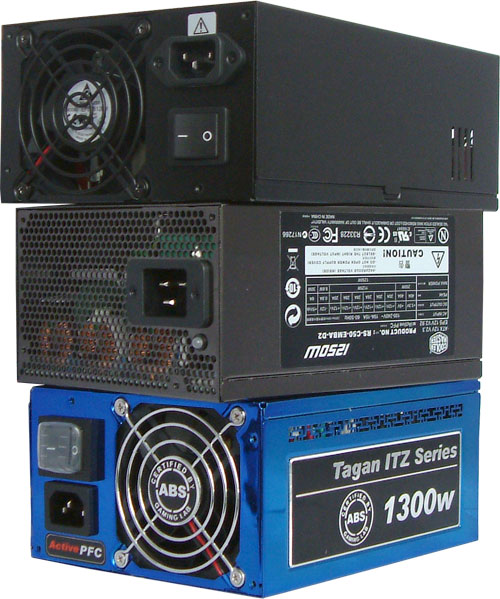
For those people who still believe the marketing hype - or for the extremely rare exceptions where you might actually run a system that needs 800W or more of power on a regular basis (feel free to let us know what you're doing that requires that much power!) - if you're thinking about buying this kind of power supply we are presenting today three of the highest rated power supplies on the market. In increasing overall wattage rankings, we start with the PC Power & Cooling Turbo Cool 1200W. Next is the Cooler Master Real Power Pro 1250W. Finally, we have the new ITZ 1300W PSU from Tagan.
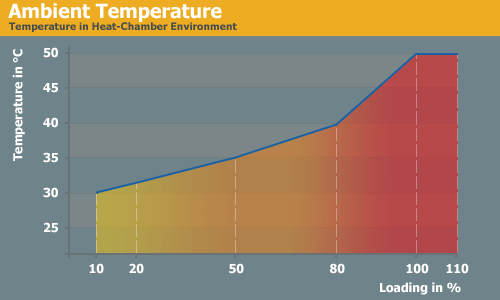
As usual we are testing with our Chroma programmable loads to fully load each rail to a specific amount. This is important to get truly accurate results and not merely approximate values. The tests are conducted in two different temperature environments. One is normal room temperature of 25-26°C, while the second environment goes from room temperature and increases steadily up to 50°C. Especially during the higher temperatures we will see how good the power supplies are and what they're really made of. Components inside will perform much worse at higher temperatures, but we expect any good quality PSU to deal with such test conditions without failing.
On the DC output graphics we show the range of highest and lowest voltage. There is usually a bit of variance, particularly with multiple 12V rails, but with a PSU roundup we want to convey as much information as possible without simply bombarding our readers with graphs and charts. In essence, we will show the voltage range on each rail at various load points. This is especially easier to read and understand if you have more than four 12V rails since we will show them all in one graph together.
Note: If you would like to know more about our testing methodology, equipment, and environment, please read our PSU testing overview.
In a change from previous testing, we have added an additional 10% on the highest load to see how the units perform at overload levels. This test will be performed in all future reviews. The overload test will be performed at room temperature, but experience shows that many units can stand the overload in room temperature but will show problems at higher temperatures when overloaded. To verify this, we will also test in our stress 50°C environment. We don't want to be too cruel with the power supplies, so we will make sure we keep the ambient temperature at 50°C in the worst-case overload testing. Only the best PSUs will survive this sort of testing... but then anyone looking at 1200W+ PSUs is probably interested in exactly that sort of unit.
As PC systems are demanding more and more power, the power supply manufacturers are reacting by releasing units rated for higher power output. We can all thank NVIDIA and ATI, among others, for this trend, as we have seen an escalation in ridiculously high demands for power supplies with the latest graphics chips. That this power is in most cases unnecessary should be clear to everyone who owns such a card or wants to buy one.
One reason such requirements are overkill is that the resolution you are running is largely responsible for higher GPU requirements, which in turn leads to more power hungry systems. If you are running a top-end video card (or two) at just 1280x1024, much of the performance potential is going to waste. Still, multiple GPUs under load will still require a beefy PSU, generally starting at 400W and going up from there, depending on the rest of the system. If you're running a 30" LCD on the other hand - particularly with overclocking - we have seen power requirements break 600W in worst-case scenarios.
For those people who still believe the marketing hype - or for the extremely rare exceptions where you might actually run a system that needs 800W or more of power on a regular basis (feel free to let us know what you're doing that requires that much power!) - if you're thinking about buying this kind of power supply we are presenting today three of the highest rated power supplies on the market. In increasing overall wattage rankings, we start with the PC Power & Cooling Turbo Cool 1200W. Next is the Cooler Master Real Power Pro 1250W. Finally, we have the new ITZ 1300W PSU from Tagan.
As usual we are testing with our Chroma programmable loads to fully load each rail to a specific amount. This is important to get truly accurate results and not merely approximate values. The tests are conducted in two different temperature environments. One is normal room temperature of 25-26°C, while the second environment goes from room temperature and increases steadily up to 50°C. Especially during the higher temperatures we will see how good the power supplies are and what they're really made of. Components inside will perform much worse at higher temperatures, but we expect any good quality PSU to deal with such test conditions without failing.
On the DC output graphics we show the range of highest and lowest voltage. There is usually a bit of variance, particularly with multiple 12V rails, but with a PSU roundup we want to convey as much information as possible without simply bombarding our readers with graphs and charts. In essence, we will show the voltage range on each rail at various load points. This is especially easier to read and understand if you have more than four 12V rails since we will show them all in one graph together.
Note: If you would like to know more about our testing methodology, equipment, and environment, please read our PSU testing overview.
In a change from previous testing, we have added an additional 10% on the highest load to see how the units perform at overload levels. This test will be performed in all future reviews. The overload test will be performed at room temperature, but experience shows that many units can stand the overload in room temperature but will show problems at higher temperatures when overloaded. To verify this, we will also test in our stress 50°C environment. We don't want to be too cruel with the power supplies, so we will make sure we keep the ambient temperature at 50°C in the worst-case overload testing. Only the best PSUs will survive this sort of testing... but then anyone looking at 1200W+ PSUs is probably interested in exactly that sort of unit.


 Facebook
 Twitter
 RSS
RSS


27 Comments
View All Comments
alilxmas - Sunday, May 10, 2009 - link
At the end the reviewer had no personal preference, kinda left it off in mid sentence there... at least to me.Anyway some people do have to get the latest and do need a i7 CPU, multiple GPU's, slight OC, 6 hard drives, 3 monitors, etc.
Heres some things I do besides gaming,
Encoding videos from about 6-8 hours a day recorded footage sent from people who drop off anything from their safari trip to a wedding converted to dvd, formatted for their DSi or i-touch.
Processing RAW files (about 20mb per pic)
3-D Animation and models
Also for the air problem a slight mod can fix almost anything.
alilxmas - Sunday, May 10, 2009 - link
At the end the reviewer had no personal preference, kinda left it off in mid sentence there... at least to me.Anyway some people do have to get the latest and do need a i7 CPU, multiple GPU's, slight OC, 6 hard drives, 3 monitors, etc.
Heres some things I do besides gaming,
Encoding videos from about 6-8 hours a day recorded footage sent from people who drop off anything from their safari trip to converted to dvd, formatted for their DSi or i-touch.
Processing RAW files
3-D Animation and models
Also for the air problem a slight mod can fix almost anything.
Christoph Katzer - Tuesday, November 6, 2007 - link
Housten: We have Ripple, please confirm we have Ripple... the world makes sense again!TheOtherRizzo - Tuesday, October 30, 2007 - link
The efficiency graphs don't start before 20%. 20% is 250W. That's a lot more than an average computer uses on idle. So the tests don't tell me what these "Hi end" PSU's will do to my power bill and heat/noise output.strikeback03 - Tuesday, October 30, 2007 - link
The "average computer" also does not need a 1200W+ PSU. Look at Jarred's power usage numbers from the Blackbird test (linked above) - used 370W at idle and 740 at load.Fallen Kell - Tuesday, October 23, 2007 - link
The power cord connection on the Cooler Master Real Power Pro is NOT proprietary! That is a standard IEC-320-C19/C20 power connector. It is typically used for high power draw situations, (i.e. like 208V 20amp circuits, not your standard home 110V 15amp). This is actually a good thing for use in this situation. At full load, and the 80% efficiency associated with it, this power supply will need 14amps on your standard 110V outlet. That is not something your standard home wiring and sockets are designed to do. Many will only be rated for 10-12 amps per socket, 15amps for the entire circuit! By using a different connector like this, it will force people to use the appropriate rated wire and sockets, because this beast will draw more power then that basic home wiring can dish out without melting down and becoming a fire hazard.strikeback03 - Tuesday, October 30, 2007 - link
Didn't mention if the wall connector is different. However using the different connector at the PSU will make it harder to use an inadequate power cable from wall to PSU. The Infiniti 650W PSUs we used in a few recent builds had larger-than-normal power cords, I would imagine a 1200W PSU needs a cable that is larger yet.JarredWalton - Tuesday, October 23, 2007 - link
Ummm... the socket on the back of the PSU is different. The main connector on the other end is still standard, AFAIK.Bozo Galora - Monday, October 22, 2007 - link
heres another review of the same PCP&C PSUhttp://www.pcper.com/article.php?aid=458&type=...">http://www.pcper.com/article.php?aid=458&type=...
here he gives volatges given at both at PSU and at ATX connector with a discussion about it.
No other in depth PSU reviews show the lowering degree of V with load that yours consistently do for some reason.
Christoph Katzer - Tuesday, October 23, 2007 - link
Just have a look at the loading diagram, I am testing strictly according to Intel specs and have ~20A on 3.3 and ~24A on 5V. There I see only ~16-17 amps on both. That the voltage regulation works better with less load should be quite clear. Compare the loads and not only voltage.