



Samsung SSD 840 (250GB) Review
by Kristian Vättö on October 8, 2012 12:14 PM EST- Posted in
- Storage
- SSDs
- Samsung
- TLC
- Samsung SSD 840
Performance vs. Transfer Size
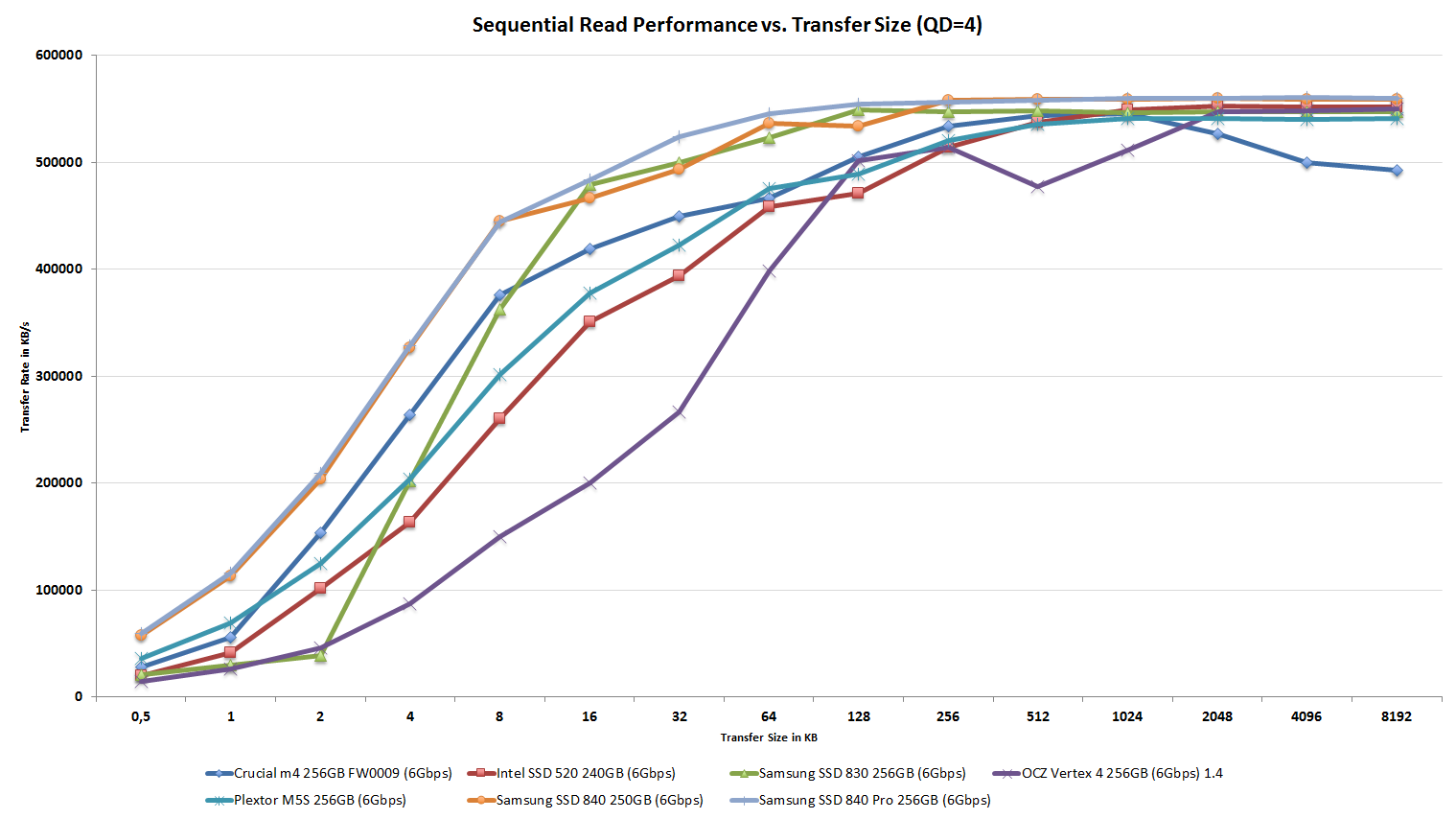
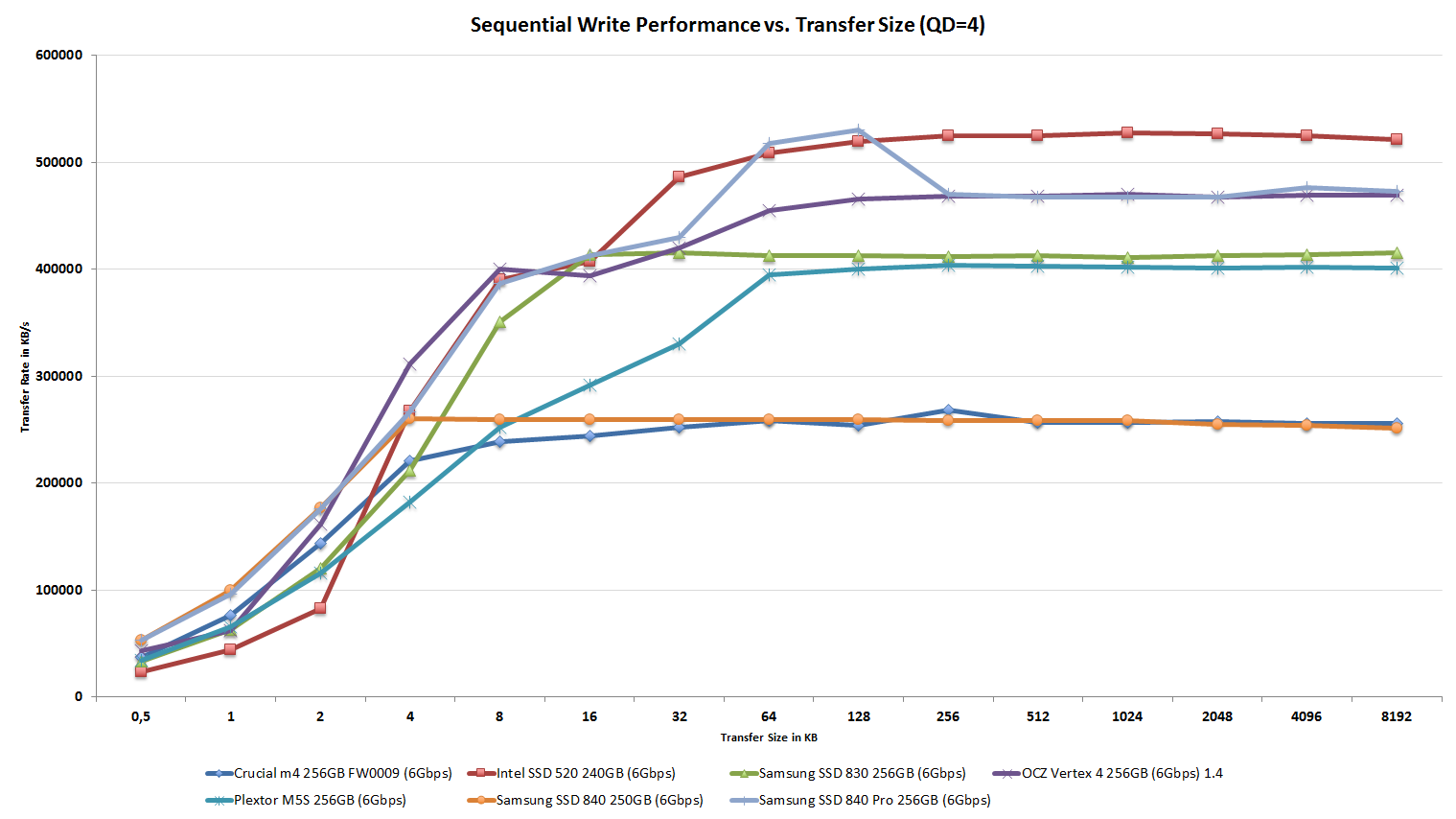
ATTO is a useful tool for quickly measuring the impact of transfer size on performance. Similarly to the 840 Pro, the 840 is a high performer at small transfer sizes, which is an area I think too many SSD vendors are ignoring. Not all IOs are huge in size and while the small IO read/write speeds aren't big enough to be used for marketing, they play a role in real world performance. In write speed the 840 tops out at 250MB/s, which is low compared to many other SSDs but otherwise the 840 performs very well.
Click for full size


 Facebook
 Twitter
 RSS
RSS


86 Comments
View All Comments
iwod - Tuesday, October 9, 2012 - link
I would be buying an Intel instead if it cost $109.99. While Sammy is possibly the closest to intel in terms of reliability. I wouldn't want a TLC SSD for the same price. And the difference would be marginal anyway. I could feel the difference between a decent 3Gbps SSD and 6Gbps SSD, i am not sure if there is anything to feel for two decent 6Gbps SSD.Now if the retail price is really in the range of $70 - 80 that would be a huge difference. Because you are essentially choosing the second best reliable SSD for decent performance and cheapest price.
Death666Angel - Tuesday, October 9, 2012 - link
The Samsung 830 is the 7th cheapest SSD (based on €/GB) I can find on my go-to price comparison website. 3 of the six before it are much slower Kingston/OCZ drives and the other 3 have SF controllers. Considering the kind of inconsistent performance that delivers and the track record, I would go with the Samsung all the time.Now, the 840 just launched and the pricing here is 25% above the 830. But it isn't even available for shipping anywhere. So I don't think that your comparison based on the Vertex4 ship has been shipping for months has any relevance. Also, aren't the Vertex4 numbers with their turbo-mode enabled which stops working after filling the drive to 50%? The Vertex4 256GB model costs 175€, the Samsung 830 256GB model costs 148€. Do you really think the 840 will be more expensive than the 830 in a couple of months? And even so, do you think the Vertex4 if that much better for consumers than the 830? I just don't see it.
Blazorthon - Monday, October 29, 2012 - link
Actually, the slowing down after 50% and such for Vertex 4 was fixed in firmware 1.5. The current numbers don't rely on Turbo, they're all the time.Also, to all of you, Vertex 4, unlike its predecessors, uses a Marvell-designed controller. Anyone who's used a Crucial or Plextor SSD probably knows that Marvell based SSDs are about as reliability as you can get, up there with Samsung and Intel. Vertex 4 is OCZ's most reliable SSD to date by huge margins, especially with current firmware where it rivals even Samsung and the others in reliability unlike the original firmware (which was specifically stated to be in beta, so anyone who bought Vertex 4 around launch time without doing their research and finding that out probably isn't someone who should be allowed to buy their own SSDs without expert help).
Also, IDK about UK prices, but in the USA, the Vertex 4, Samsung 830, Samsung 840, and occasionally also the Crucial M4 and Plextor M5S are all at about the same price points for 64GB, 128GB, and 256GB capacities right now. As someone who has experience with Vertex 4, I'd definitely recommend it over Samsung 830 and Samsung 840 so long as it's not more expensive.
Assimilator87 - Monday, October 8, 2012 - link
How come the OCZ 4 series just suddenly disappear when the review gets to the power consumption tests?JarredWalton - Monday, October 8, 2012 - link
Because Kristian imported the results from SSD Bench for the "1.4 Firmware" for the OCZ drives, and when those were retested Anand didn't add in power use figures. I've added them to the graphs using the original power figures at release. Thanks for the heads up!Coup27 - Monday, October 8, 2012 - link
Excellent article Kristian, enjoyed it.Some constructive criticism, although I appreciate that English is not your native language. Sentences aren't that clear when you use a double negative, such as "I wouldn't find it unlikely...". It would be much clearer if you had wrote "It would be likely..."
Kristian Vättö - Monday, October 8, 2012 - link
Point taken, thanks for the feedback :-)Some things sound logical in my ears but they may not make much sense for a native speaker. I guess this is partially because in English exams and stuff, using more difficult sentence structures (like double negative) will yield higher scores, even though they are not commonly used by natives. Will try to pay more attention to this in the future.
Sufo - Tuesday, October 9, 2012 - link
I don't know if I agree with this. While double negatives are certainly inappropriate in some situations, the example you give is nit picking. Add to that, there is a subtle (albeit not technical) difference between "I wouldn't find it unlikely" and "I would find it likely". I accept that had Kristian made a legitimate grammatical error, then correcting it (while a little pedantic) may have been justified, but simply editing for style seems unnecessary.I guess my point is Kristian was not objectively wrong, or even unclear (although admittedly, complexity for complexity's sake benefits no one) and so he shouldn't pay too much heed to comments like this simply because OP is an English speaking native and he is not. I am, however, confident that he's more than capable of coming to his own conclusions on the matter :P
smartthanyou - Monday, October 8, 2012 - link
I am probably in the minority on this, but as a matter of policy, I don't think you should call anything a review without pricing and a approximate release date.Particularly the price. If I don't see a price, I don't bother to read the article.
sean.crees - Monday, October 8, 2012 - link
Price is on the 5th page labeled "The Samsung SSD 840" about half way down.Although i noticed the price for the 840 250GB is the same as the 840 Pro's 256GB? Is this a typo? Why would anyone buy the non pro with 6 less GB and slower speeds for the same price?