



Introduction
Last week, we took a first look at the new PhysX add-in physics accelerator from AGEIA. After our article was published, AGEIA released an update to their driver that addresses some of the framerate issues in Ghost Recon Advanced Warfighter. While our main focus this time around will be on BFG's retail part, we will explore the effectiveness of this patch and go a little further in-depth with the details behind our performance analysis.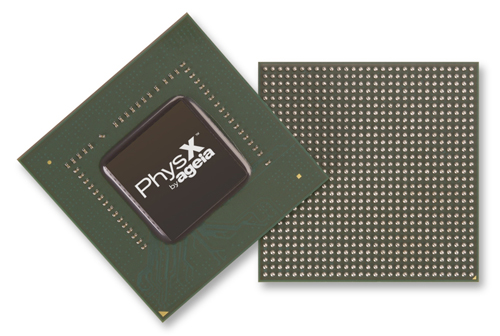
In addition to the BFG retail PhysX card and Ghost Recon update, we will take a look at a few demos that require the PhysX card to run. While there aren't any games scheduled to come out in the near future that will take this new technology to the extreme, it will be nice to get a glimpse into the vision AGEIA has for the future. Getting there will certainly be a hard road to travel. Until more games come out that support the hardware, we certainly can't recommend PhysX to anyone but the wealthy enthusiasts who enjoy the novelty of hardware for hardware's sake. Even if PhysX significantly enhances the experience of a few games right now, it will be a tough sell to most users until there is either much wider software support, good games which require the hardware, or a killer app with a PhysX hardware accelerated feature that everyone wants to have.
As for games which will include PhysX hardware support, the only three out as of this week are Tom Clancy's Ghost Recon Advanced Warfighter (GRAW), Rise of Nations: Rise of Legends (ROL) and City of Villains (COV). Rise of Legends came out last week, and we have been extensively testing it. Unfortunately, PhysX hardware support will only be added in an upcoming patch for which we have no real ETA.
We worked very hard to test City of Villains, and we finally succeeded in creating a repeatable benchmark. The specific content in City of Villains which supports the AGEIA PhysX PPU (physics processing unit) is a series of events called the Mayhem Missions. This is a very small subset of the game consisting of timed (15 minute) missions. Currently these missions are being added in Issue 7 which is still on the test server and is not ready for primetime. Full support for PhysX was included on the test server as of May 10th, so we have benchmarks and videos available.
Before we jump into the numbers, we are going to take a look at the BFG card itself. As this is a full retail part, we will give it a full retail workup: power, noise, drivers, and pricing will all be explored. Our investigations haven't turned up an on-chip or on-board thermistor, so we won't be reporting heat for this review. Our power draw numbers and the size of the heat sink lead us to believe that heat should not be a big issue for PhysX add-in boards.


 Facebook
 Twitter
 RSS
RSS


67 Comments
View All Comments
yanyorga - Monday, May 22, 2006 - link
Firstly, I think it's very likely that there is a slowdown due to the increased number of objects that need to be rendered, giving credence to the apples/oranges arguement.However, I think it is possible to test where there are bottlenecks. As someone already suggested, testing in SLI would show whether there is an increased GPU load (to some extent). Also, if you test using a board with a 2nd GPU slot which is only 8x and put only 1 GPU in that slot, you will be left with at least 8x left on the pci bus. You could also experiment with various overclocking options, focusing on the multipliers and bus.
Is there any info anywhere in how to use the PPU for physics or development software that makes use of it?
Chadder007 - Friday, May 26, 2006 - link
That makes wonder why City of Villans was tested with PPU at 1500 Debris objects comparing it to software at 422 Debris objects. Anandtech needs to go back and test WITH a PPU at 422 Debris objects to compare it to the software only mode to see if there is any difference.rADo2 - Saturday, May 20, 2006 - link
Well, people have now pretty hard time justifying spending $300 on a decelerator.I am afraid, however, that Ageia will be more than willing to "slow down a bit" their future software drivers, to show some real-world "benefits" of their decelerator. By adding more features to their SW (by CPU) emulation, they may very well slow it down, so that new reviews will finally bring their HW to the first place.
But these review will still mean nothing, as they compare Ageia SW drivers, made intentionally bad performing, with their HW.
Ageia PhysX is a totally wrong concept, Havok FX can do the same via SSE/SSE2/SSE3, and/or SM 3.0 shaders, it can also use dualcore CPUs. This is the future and the right approach, not additional slow card making big noise.
Ageia approach is just a piece of nonsense and stupid marketing..
Nighteye2 - Saturday, May 20, 2006 - link
Do not take your fears to be facts. I think Ageia's approach is the right one, but it'll need to mature - and to really get used. The concept is good, but execution so far is still a bit lacking.rADo2 - Sunday, May 21, 2006 - link
Well, I think Ageia approach is the worst possible one. If game developers are able to distribute threads between singlecore CPU and PhysX decelerator, they should be able to use dualcore CPUs for just the same, and/or SM3.0 shaders. This is the right approach. With quadcore CPUs, they will be able to use 4 core, within 5-6 yers about 8 cores, etc. PhysX decelerator is a wrong direction, it is useful only for very limited portfolio of calculations, while CPU can do them as well (probably even faster).I definitely do NOT want to see Ageix succeed..
Nighteye2 - Sunday, May 21, 2006 - link
That's wrong. I tested it myself running Cellfactor without PPU on my dual-core PC. Even without the liquid and cloth physics, large explosions with a lot of debree still caused large slowdowns, after which it stayed slow until most of the flying debree stopped moving.On videos I saw of people playing with a PPU, slowdowns also occurred but lasted only a fraction of a second.
Also, the CPU is also needed for AI, and does not have enough memory bandwidth to do proper physics. If you want to get it really detailed, hardware physics on a dedicated PPU is the best way to go.
DigitalFreak - Thursday, May 18, 2006 - link
Don't know how accurate this is, but it might give the AT guys some ideas...http://www.hardforum.com/showthread.php?t=1056037">HardForum
Nighteye2 - Saturday, May 20, 2006 - link
I tried it without the PPU - and there's very notable slowdowns when things explode and lots of crates are moving around. And that's from running 25 FPS without moving objects. I imagine performance hits at higher framerates will be even bigger. At least without PPU.Clauzii - Thursday, May 18, 2006 - link
The German site Hartware.de showed this in their test:Processor Type: AGEIA PhysX
Bus Techonology: 32-bit PCI 3.0 Interface
Memory Interface: 128-bit GDDR3 memory architecture
Memory Capacity: 128 MByte
Memory Bandwidth: 12 GBytes/sec.
Effective Memory Data Rate: 733 MHz
Peak Instruction Bandwidth: 20 Billion Instructions/sec
Sphere-Sphere collision/sec: 530 Million max
Convex-Convex(Complex) collisions/sec.: 533,000 max
If graphics are moved to the card, a 12GB/s memory will be limiting, I think :)
Would be nice to see the PhysiX RAM @ the specced 500MHz, just to see if it has anything to do with that issue..
Clauzii - Thursday, May 18, 2006 - link
Not test - preview, sorry.