



IDF Day 3: AMD and Intel's Dual Core Demonstrations; The Race to Dual Core
by Kristopher Kubicki on September 10, 2004 7:22 PM EST- Posted in
- Trade Shows
Dual Core Intel Solutions
Intel's dual core demonstrations came in two forms; the first being a demonstration of Itanium 2 during the Day 1 Keynote. Day 2's Keynote demonstrated a first look at a 65nm mobile processor, dubbed Yonah.
We got an extremely detailed analysis of the Montecito core from the introduction keynote. Below you can see the general layout of the core.
Things we do know about Montecito are listed below:
- Codename: Montecito
- Process: 90
- Operating Wattage: 100W
- Clock Speed: 1.7GHz
- Two cores, Four threads - First Itanium processor with HyperThreading
Although Montecito had quite a bit of promise around it, it only exists in A-0 (Alpha) silicon. Intel was extremely pleased to state that Montecito boasted 1.5 to 2 increases in performance on first silicon. Obviously, average performance improvement should increase even further as programs become more threaded and as more efficient arbiter algorithms are produced. It is important to remember that performance from a dual core processor can never exceed 2x (and even getting a specially optimized benchmark to see full 2x improvement is very impressive), so it looks like Intel is on a very solid track.
The Day 2 Keynote, which revealed the "Yonah", was Intel's introduction to "Personal Parrallel Computing" - a term introduced during the Day 1 Keynote. Applications like realtime facial recognition require on average 50 gigaflops with today's software. These enormous requirements are not out of reach of near-future processors, claims Intel. We were then introduced to Yonah, a 65nm dual core successor to Dothan.
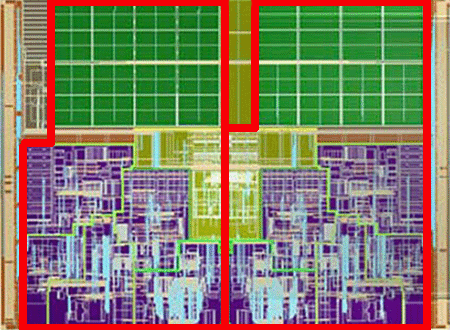
We outlined both cores in red, but many of the elements found on Montecito are clearly visible in Yonah as well. The topmost portion of the the image is the L2 cache and the arbiter unit is placed in the center. The Yonah cache (green) and Dothan cache (black) do not look proportionate. It may be the case that Yonah processor and the Dothan core utilize the same amount of cache.
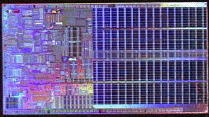
Although difficult to tell from the quality images we have of Dothan's core, Yonah and Dothan do not appear to share many qualities with each other. This may be due to the fact that Intel uses an automated layout process that is trained to minimize hotspots and efficiently route signals. This may have just been the result of their optimizations, but it may also reflect alterations or enhancements Intel has made to the Dothan core. Things we do know do know about Yonah are listed below:
- Codename: Yonah
- Process: 65nm
- Operating Wattage: 50W
- Clock Speed: Unknown
- Launch Q3'05
Don't forget, a few weeks ago we touched upon Smithfield; Intel's dual core desktop processor. As we mentioned in our Day 1 coverage, expect to see shipments of Smithfield, Yonah and other dual core processors pan out in this fashion:
Multi-Core Processor Shipping Expectations
|
2004 |
2006 |
Desktop |
55% HyperThreading |
40% Dual-Core |
Servers |
100% HyperThreading |
85% Dual/Multi-Core |
Mobile |
|
70% Dual Core |
And just how is Intel producing chips with higher clocks and lower wattages, and then sticking additional cores on them? Many of the answers lie in our earlier IDF 65nm coverage. For the most part, moving from the 130nm to 90nm process seems to result in the largest changes. Variants of Enhanced Speed Step are also showing up on all processors in the Intel arena as well.


 Facebook
 Twitter
 RSS
RSS


12 Comments
View All Comments
mikecel79 - Sunday, September 12, 2004 - link
#9 Actually Intel did demo a dual-core desktop CPU at the IDF.According to this article at ZDNet:
http://news.zdnet.com/2100-9584_22-5356703.html
Here's a quote from the article:
"Like the current Pentium 4, Intel's dual-core desktop chip is built on the NetBurst architecture and fits into motherboards using Intel's 915 Grantsdale chipset. But Siu declined to provide many details on the dual-core demonstration chip, which he described as an engineering prototype.
"It is real silicon running on a standard 915 platform," Siu said. He wouldn't comment on whether it has the 64-bit memory extension technology, called EM64T."
Burbot - Sunday, September 12, 2004 - link
#8: well, it does not happen often, but it is entirely possible. Here is a real life example: http://ixbt.com/cpu/intel-amd-cpu-roundup-3dsmax-3... . They've encountered more then 100% scaling in one scene with Xeon Prestonia, and the testers there are definitely far from your average GarbageMark hugging newbies. It happens IRL.PrinceGaz - Saturday, September 11, 2004 - link
There's no need for AMD to increase the speed with a die-shrink; moving from 130nm to 90nm allows them to fit twice as many transistors in the same size core -- meaning they will be able to manufacture dual-core processors at no extra cost to current single-core A64/Opteron's. Die-shrinks used to mean significantly higher clocks but that may now be a thing of the past, at least compared to the sort of increases we were used to. The future lies in multi threaded applications and die-shrinks will allow for more physical cores to be included on a processors.Anemone - Saturday, September 11, 2004 - link
To start off, the current desktop A64's are very much better than their P4 counterparts for the gaming arena.However, that said, AMD is apparently more ready to demonstrate 90nm tech on dual core than they seem ABLE to demonstrate the same technology on a faster running A64 single core.
Intel's issue is that they can't demonstrate either a faster running P4 OR a dual core desktop chip. So they have it far worse, especially that they are both claiming to be offering these items 9 months from now.
So, from appearances, AMD is failing to demonstrate their A64 can run past 3ghz with a die shrink, so it would appear they are also hitting a speed ceiling. And Intel can't demonstrate either dual core or faster than 4ghz P4's at their own dev conference.
*rolls dice* Well it seems AMD is farther ahead in the desktop performance game, but they may be hitting the end of the road. Intel is already there and has nothing to show you any different from the rumors. Buy AMD, imo, but next year isn't going to be as grand as either is making it out to be.
Locutus4657 - Saturday, September 11, 2004 - link
#6 while those types of exersises make for great text book reading material the fact is in the real world you're almost never going to be able to optimise your application to get exactly 2x preformance increase. Maybe close but it's hard!AtaStrumf - Saturday, September 11, 2004 - link
Blah, this is all crap! The best idea both AMD and Intel can come up with is sticking two cores on one die. Why dont't they take, say a prescott and a Hammer core and stick 'em together? That way we would have the best of both worlds :) Or maybe they could stick a Dothan and a Prescott core together?Of course I'm jokeing, but seriously, when I first heard of multy cores I thought they would be more like specialised sub cores better at certain tasks, stuck together for higher performance. The above given examples are a bit extreme, but wouldn't that be better, than simply everything times two?
Burbot - Saturday, September 11, 2004 - link
Quote: It is important to remember that performance from a dual core processor can never exceed 2xThis appears to be wrong. In fact, the "how can a 2-CPU system archieve more then double perfomance of an identic single CPU machine?" is a frequent textbook question. If the data set of an application does not fit entirely into cache of one CPU, but fits into two such caches, then two CPUs (assuming that cache coherency is implemented) can be more then twice faster.
icarus4586 - Friday, September 10, 2004 - link
ZobarStyl--"I really wanted to see a dual-core desktop Intel based on the Pentium M, but if seems they can't swallow their pride..."Kristopher Kubicki--"Intel’s strategy also includes server processors as the most prevalent CPU product SKU, but actually weights higher priority on mobility P6 (Pentium M) Yonah processors."
Ksherman: Dual core AMD64 chips have a bank of L2 cache per core, but share a memory controller. Dedicated cache, not RAM.
GhandilInstinct: Agreed. Dual core Netburst? I didn't think they'd even try.
GhandiInstinct - Friday, September 10, 2004 - link
150-200 watts, looks like BTX awaits!ZobarStyl - Friday, September 10, 2004 - link
As was mentioned on the last page, it seems like in their current form the dual-core AMD solutions have already won. Current Xeons are bandwidth starved as it is with their single memory controller and adding a second core isn't going to change anything for the better unless they adopt on-chip memory controllers. Top that off with the fact that the Opteron will work in current sockets and there's just no competition, barring if AMD were to release their duallies 6 months after Intel.I really wanted to see a dual-core desktop Intel based on the Pentium M, but if seems they can't swallow their pride and it's going to hurt them since they can't even get Prescott past 3.4 in appreciable quantities. Smithfield isn't even 65 nm either, it's just two Prescotts stuck together...water-cooling will no longer be an option for such setups (a la G5?).
Also, the HT/Dual Core Montecito would be nice if Itanic weren't already sinking, but they are blinded by their hubris and think that it's Itanium's speed that's holding back its success instead of its incredible price tag that stops programmers from writing for it.