



Intel 65nm and Beyond (or Below): IDF Day 2 Coverage
by Kristopher Kubicki on September 9, 2004 9:26 AM EST- Posted in
- Trade Shows
Intel 65nm and Beyond (or Below)
Earlier this year we saw our first glimpse at 90nm technology with the launch of Intel's Prescott Pentium 4. Even more recently we have seen 90nm processes show up on server and workstation CPUs, like Nocona. Yet while 90nm processes are just showing up on the market in full force, Intel already has massive plans for pushing technology even farther, with roadmaps ramping to the 32nm stage by 2009. The technologies and strategies to get them there are surprisingly well documented and explained.
The talk of Fall IDF 2004 Day 1 and Day 2 was that of Moore's law; the philosophy put forth that transistor count on a processor doubles every 18 to 24 months. Near the end of our Day 1 Keynote, we got our first look at Montecito, Intel's 90nm IA64 processor with an astounding 24MB of L3 cache. Understanding how Intel is capable of placing 1.72 billion transistors on single chip is certainly a not a simple task; but Intel was kind enough to provide us with a plethora of details on how we can cram billions of transistors on a chip, and how we will continue to uphold Moore's law in the future.
First, a quick look at how Intel has upheld Moore's law:
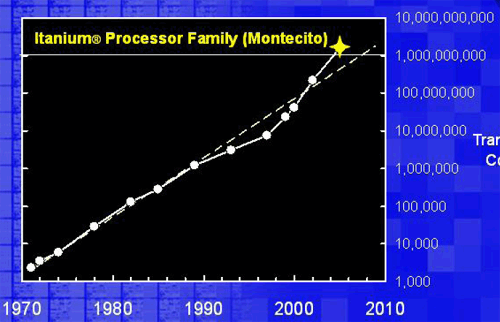
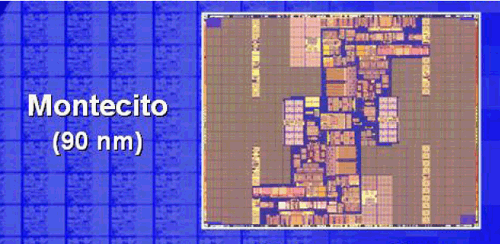
With the introduction of Montecito, Intel surpassed Moore's law very slightly with massive banks of cache. We will go into more detail about cache and SRAM in a little bit, but in the meantime we have an image of what the processor core actually looks like.


 Facebook
 Twitter
 RSS
RSS


21 Comments
View All Comments
drwho9437 - Friday, September 10, 2004 - link
Eskimo I was jus being sloppy in my language. As I progressed. Its good to know I'm not totally nuts. The resists will be a problem because of chain length. I mean for positive resists it seems ovious as it seems to be the ratio of the native to the broken resist chain length that would matter (there solublity). For a negative resist I guess you could somehow have some very simple and short chain somehow but I would think it would still need to be of the order of nm in length. I think it will be interesting if intel or someone else can reach high yeilds on structures of 5-10nm size. That would make SETs or other quantum devices useable in the millions.KristopherKubicki - Friday, September 10, 2004 - link
ceefka: Intel is actually moving in the other direction - particularly for server products. The Memory controller is in fact getting its own tunnel on chipsets like Twin Castle. I suspect this is being done so that they can incorporate multiple memory controllers on a single motherboard.Kristopher
ceefka - Friday, September 10, 2004 - link
Great article, Kristopher.7 + 17 Right on! Seems like all they're doing is shrinking, more cache and pumping the FSB.
Where is that on die memory controller?
It doesn't seem like much of an animal if you keep it in a cage. What they're doing at Intel is great in itself, but it needs something extra.
Eskimo - Thursday, September 9, 2004 - link
#13/#14, You are correct we are now entering the arena where the actual polymer chains which make up our resists are approaching some of the features that are being printed on the wafers. As for etching keep in mind that we don't actually etch the resist. Resist after exposure is developed away in an aqueous solution. The remaining resist serves as a mask for the underlying material either protecting from ion bombardment or etches. The standard etch for today's high aspect ratio features is Reactive Ion Etching (RIE). The 193nm resists in use in leading edge lithography do not have the same etch protection capabilities that were present in DUV(248nm) and i-line(365nm) resists. A new challenge for resists is posed by the upcoming widespread adoption (even Intel might come around) of immersion lithography where the resist will be directly exposed to water in the scanner.As for the article itself, it seems to suggest that Intel came up with the idea of phase shift masks. When in fact they were developed in the late 70's and first put into use in the early 90's by a variety of companies. The only real news on this front is that to reach 65nm on 193nm dry systems you will definately need alternating aperature phase shift masks like the diagram describes which are very costly.
As for the statement saying Intel did not specify what sort of oxide they are doping with carbon for their low-k dielectric it is Silicon Dioxide. Since SiO2 is so prevalent in silicon processing and so well understood we often just refer to it simply as oxide. If it was in fact another material oxidized that would've been specifed (e.g. Aluminum Oxide).
mkruer - Thursday, September 9, 2004 - link
#7 Read again what I wrote, I mentioned nothing abut the SPEED, working faster =! Speed in MHz which you are apparently inferring. I was simply stating that obvious that Intel solution for the majority of its problems is to simple through more cache at it.GodsMadClown - Thursday, September 9, 2004 - link
I remeber going to a talk on the Chandra X-Ray telescope and hearing about all the craziness with mirrors that they had to go through to get the optics to work. I guess that Intel could do the same thing, but It's just getting crazy. No real content, but to make everyone aware that when you deal with EUV radiation, optics get very complex.stephenbrooks - Thursday, September 9, 2004 - link
I'm pretty sure that on the last page it should be "line width" going to 0.7x every two years, not line LENGTH! Total line length on a chip should increase 1.4x every two years because they're packing it in smaller.drwho9437 - Thursday, September 9, 2004 - link
To clarify, I mean you have to etch the resist, dry or wet, you have to do it and that has some limit, but I don't know what it might be or even what kind of etching big fabs use.drwho9437 - Thursday, September 9, 2004 - link
Humm. Aren't we going to hit the limit of resists soon? I mean the resists I know about for ebeam lithography have resolution of something like 8nm. Intel is going to do 23 with photolithography, that's impressive, you can always go to x-rays if all it was was a matter of making the photon wavelength sorter but what about the chemistry? (I'm not a chemist, I'm a physicist/EE)ncage - Thursday, September 9, 2004 - link
I read the other post and thats what i used as my reference to spell it. Dumb idea i guess ;)