



4-Way Power Supply Shootout: Vantec, Enermax, ThermalTake, Antec
by Kristopher Kubicki on January 17, 2003 4:31 AM EST- Posted in
- Cases/Cooling/PSUs
Temperature, Ripple and Sound
We have a battery of tests lined up for these four power supplies, including thermal, sonic and electrical tests on the DC output of the power supply. Our test bed consists of:
|
Gigabyte GA-7VRX |
|
AMD Athlon XP 2100+ |
|
2x256 Kingston KV133 |
|
4x Maxtor 80GB 7200RPM |
All tests will be conducted over a full load: all 4 drives will be spinning during each of our tests in order to maximize the drainage on the +12.0V rail. Furthermore, our testbed will also be rendering a very large scene in 3D Studio Max 5 in order to stress the +3.3V and +5.0V rails.
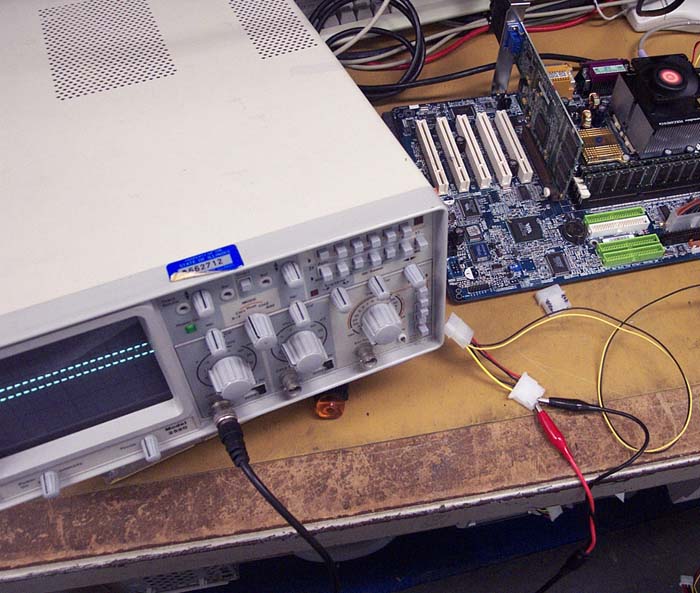
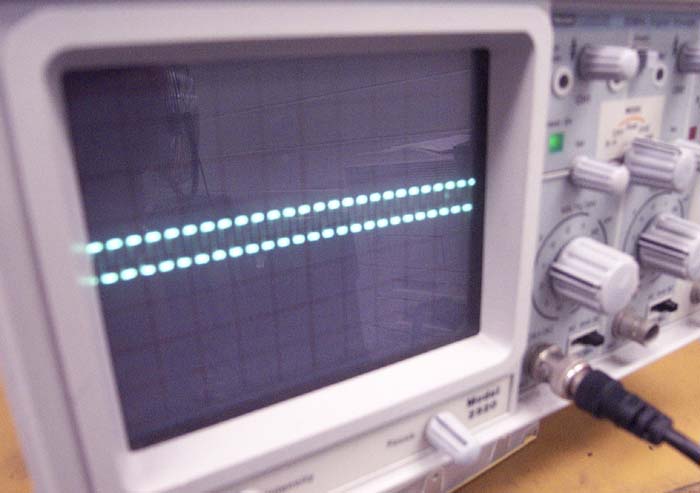
The ripple is the variation in voltage over a particular rail. Like we mentioned on the previous page, too much fluxuation in voltage can lead to damaged hardware. A surprising fact we dug up during this review was that the majority of damaged RAM returned to memory manufacturers is destoryed by fluctuations in the voltage. For our first benchmark, we used an oscilloscope and a multimeter to measure the voltage and ripple within 10millivolts. All three rails were tested directly on the motherboard to simulate real world results. Remember, less ripple is better. These are the real world results, as opposed to the results printed on the boxes. (Each unit we tested has a rating of +/-50mV, +/-50mV, and +/-120mV respectively.)
Vantec
|
Low |
High |
Actual Ripple |
Advertized Ripple |
|
|
+3.3V |
3.26V |
3.32V |
~50mV |
~50mV |
|
+5.0V |
4.93V |
5.04V |
~60mV |
~50mV |
|
+12V |
11.88V |
11.94V |
~120mV |
~120mV |
Antec
|
Low |
High |
Actual Ripple |
Advertized Ripple |
|
|
+3.3V |
3.28V |
3.31V |
~40mV |
~50mV |
|
+5.0V |
4.97V |
5.02V |
~40mV |
~50mV |
|
+12V |
11.92V |
11.99V |
~90mV |
~120mV |
ThermalTake
|
Low |
High |
Actual Ripple |
Advertized Ripple |
|
|
+3.3V |
3.27V |
3.33V |
~50mV |
~50mV |
|
+5.0V |
4.94V |
4.99V |
~50mV |
~50mV |
|
+12V |
11.87V |
11.97V |
~120mV |
~120mV |
Enermax
|
Low |
High |
Actual Ripple |
Advertized Ripple |
|
|
+3.3V |
3.29V |
3.33V |
~40mV |
~50mV |
|
+5.0V |
4.98V |
5.04V |
~50mV |
~50mV |
|
+12V |
11.95V |
12.02V |
~80mV |
~120mV |
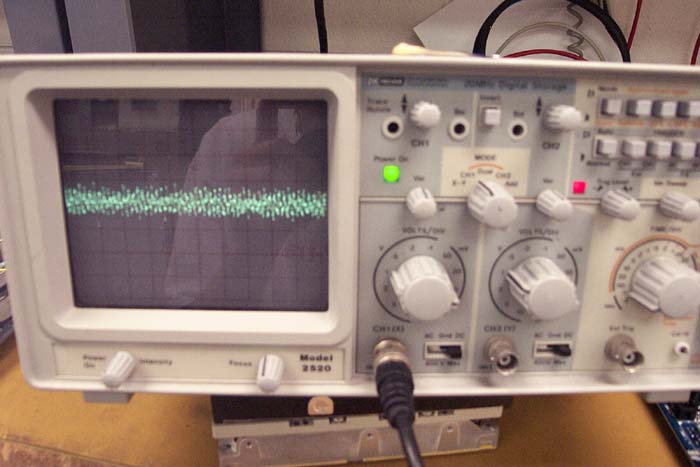
We see that Antec and Enermax provided the lowest amount of ripple, while keeping their average low and high voltages very tight. Remember, these tight patterns are a necessity in order to keep processors and the entire system, stable. Almost all of the power supplies had lower than advertised ripples with the exception of Vantec. Interesting to see was the Vantec unit actually tipped a little bit over the advertised rating of 50mV (+/-1.0%) on the +5.0V rail. We were slightly dissapointed to see this, especially considering the other units were for the most part under the advertised ripple rating. Most notable was the Enermax unit which was well under the +12V rail ripple advertisement.
Our thermal tests were conducted on a high load system inside a closed ThermalTake A6000B Xaser II Aluminum case. All temperature is in degrees Celsius. The temperature was taken from inside each of the units, just above the +3.3V transformer.
Vantec
|
Thermal Test |
Temperature |
|
10 Minutes |
31.7C |
|
30 Minutes |
32.8C |
Antec
|
Thermal Test |
Temperature |
|
10 Minutes |
32.5C |
|
30 Minutes |
33.7C |
ThermalTake
|
Thermal Test |
Temperature |
|
10 Minutes |
33.1C |
|
30 Minutes |
34.0C |
Enermax
|
Thermal Test |
Temperature |
|
10 Minutes |
32.1C |
|
30 Minutes |
32.4C |
Vantec stayed the coolest of the four, but remember this power supply has three fans. As we will see, the Vantec is able to stay a slight bit cooler, but unfortunately at a tradeoff with noise.. We previously pointed out that switching power supplies work inefficiently if they are not kept reasonable cool. Each of these units operates well under 35C, but to put that figure into perspective, most portions of the inside of the case actually operate at a higher temperature.
The description of a quiet fan has almost always been a sort of oxymoron. Of course, manufacturers like Vantec are already at a disadvantage with an additional fan. A human whisper is roughly 30dBA while a typical conversation is held around 60dBA. Keep in mind, the decibel scale is logarithmic. Therefore, a device that is 8dBA louder than another is approximately twice as loud. We performed our sound test outside of the case as to isolate the noise level of just the power supply. Each measurement was taken from 12” away with the power supply outside of the case.
Vantec
|
Sound Level |
Decibels |
|
High |
~54dBA |
|
Low |
~50dBA |
Antec
|
Sound Level |
Decibels |
|
Auto |
~31dBA |
ThermalTake
|
Sound Level |
Decibels |
|
Auto |
~40dBA |
Enermax
|
Sound Level |
Decibels |
|
High |
~36dBA |
|
Low |
~33dBA |
Vantec seemed to be the noisiest supply in our batch, and a sound level meter only confirmed that. Even though Vantec had a variable speed option in the rear, the fans are just too noisy. For the most part, we can attribute this to the additional fan. Since the Stealth Aluminum PSU has 2 80mm intakes and only 1 80mm exhaust, positive pressure exists inside the unit (assuming all 3 fans are running at the same rate). In real world situations, the additional fan really did not improve the cooling performance significantly; the enormous increase in noise is not necessary.
Antec’s Truepower was on the opposite end of the spectrum. At 31dBA, the unit is barely audible; certainly not able to be heard over typical case fans. When inside a case, the supply is further muffled so that it is almost silent. We also need to show respect to the Enermax unit which provides the Truepower with very solid competition in the noise category.


 Facebook
 Twitter
 RSS
RSS


6 Comments
View All Comments
Sir Fredrick - Tuesday, January 11, 2005 - link
I would have really liked to see them compare the current draw from the wall, to see how the PSUs compare in terms of energy efficiency.Anonymous User - Friday, August 22, 2003 - link
Switching power supply means the unit can be switched between American 60 Hz, 120 v, and European 50 Hz, 240 v input.Jeff7 - Monday, June 18, 2012 - link
"Switching power supply" refers to precisely what the article says. The "switch" refers to the manner in which the incoming power is handled, not to a physical component on the unit.Plenty of switching power supplies, also called SMPS (switch-mode power supplies), are available without any switches.
Beside me is a switcher supply that accepts 100-240VAC and puts out 12VDC. There are no switches on it.
Some of the circuitry I work with uses small switcher supplies, which take 12-36VDC and put out a solid 12VDC output.
I also work with boosters, which are a kind of switching power supply topology that's capable of putting out a higher voltage than what comes in. These particular ones can take 12VDC and put out about 17.5VDC.
And, I'm looking at a power supply for integration into a new product, and it can handle anything from 85-264VAC at 47-440Hz. Again, no switches on it.
Some of the older or cheaper switcher supplies *do* indeed have the selector switch on them to let them accommodate different voltages. But that's not what makes them "switching" power supplies. The name "switch" being the same is simply a coincidence.
Anonymous User - Friday, August 8, 2003 - link
:):):):):):):):)Anonymous User - Thursday, August 7, 2003 - link
Anonymous User - Thursday, August 7, 2003 - link
PFC, power factor correction, is not just about noise. The square wave shape of current draw of non PFC corrected supplies adds a significant 3rd order harmonics element to the line. This usally is gets diverted by the impedance of power company transformers to flowing in the Neutral line of the power system, which in the past carried almost no current. This nuetral line was installed at a SMALLER size than the mains. There have been buildings burned up in Europe, (which has an older infrastructure) because of this. Also, drawing higher peaks instead of sinusoidal current is less efficient and adds more loss the the wires and transformers, shortening their life and adding more pollution to the world, (ie. more power has to be generated to make up the loss, resulting in more smokestack emissions).