



Netgear NTV200 : Over-the-Top Streaming for Non-Networked TVs
by Ganesh T S on December 22, 2011 10:50 PM EST- Posted in
- Media Streamer
- Home Theater
- NetGear
The current flux in the television market is embodied by the emergence of two closely related categories, namely, the Smart TV and the connected TV. While the former category is being actively promoted by Google (and, till recently, Intel), the latter is in the hands of the usual TV manufacturers like Samsung, LG, Vizio etc. The popularity of OTT (over-the-top) premium content in the form of Netflix, Vudu, Hulu Plus etc. in the US has also aided in popularizing the concept of Smart / connected TVs. With the upgrade cycle for TVs being in the order of 5 - 10 years, there are a large number of consumers who have yet to jump onto either of these bandwagons. This has opened up the market for an intermediate device to bring connected features to their existing TV sets. It is precisely this market that has made devices like the Roku boxes and the Sony network media players successful. Last year, we looked at one of the Roku models that Netgear rebadged, and came away satisfied. This time around, Netgear has decided to come out with its own device for this purpose, namely, the NTV200.
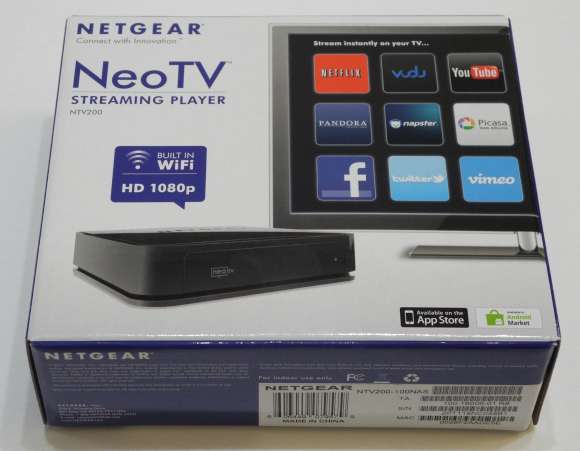
The NTV200 is a low power palm sized box slightly larger than Roku 2. Its intent is to serve up premium service apps like Netflix and Vudu and make your TV a connected one. The box includes both wired and wireless network support.


At the very outset, it must be made clear that the NTV200 has limited appeal if you already own a Smart TV or a connected TV. Without doubt, the Netflix app is meant to be the crowd puller. The Netflix app is the baseline for all connected TV boxes in the US market right now. To put one over the Roku boxes, Vudu streaming is also available. An official YouTube app rounds up the services provided by the NTV200 and not the Roku 2. Of course, Roku 2 has Amazon VoD and Hulu Plus which are not offered by the NTV200. While it is debatable as to whether Amazon VoD or Vudu is more popular, one can take the safe ground here by indicating that both the Roku 2 and the NTV200 are equally matched with respect to popular streaming services.
Support for various online services is only half the story. The user experience and general performance of the device are more important factors. Before looking at those aspects, we will take a look at the hardware and setup impressions.


 Facebook
 Twitter
 RSS
RSS


24 Comments
View All Comments
ender707 - Friday, December 23, 2011 - link
Every time I see one of these reviews for media player, I wonder how it compares to the Xbox and PS3 in terms of streaming video etc.Does any one have any input on how these stack up to the current consoles?
MGSsancho - Friday, December 23, 2011 - link
These devices exist because Sony and Microsoft refuse the listen to their customers and supports formats for media we have. Had Microsoft and Sony had more backbone then none of these other devices would really exist.Tetracycloide - Friday, December 23, 2011 - link
Even if the Xbox/PS3 were the best over-the-top boxes they could possibly be there would still be a market for competing devices that don't have the added cost of including expensive gaming hardware. The NTV200 is $70 on amazon right now for example.Matt355 - Friday, December 23, 2011 - link
Very true. I have a Xbox and a playstation and the Boxee Box is still my go to device. Because it plays everything. Since I purchased it about 2 months ago at Best Buy for $89 vs $300 Xbox and $500 Playstation. it has never failed to play anything and will stream video from my iPhone to the TV like an Apple TV. I get all types of News, Anime and even Adult channels free through streaming. With a dedicated Netflix button and all without ever using more then 15W.Matt355 - Friday, December 23, 2011 - link
The Xbox has very limited codec's and needs most video transcoded for streaming even ones it should play if they don't have 2 channel audio, No mp4 with dolby digital audio, It will not allow files over 4g to stream unless their wmv, has no web browser, No mkv, and is the only device that makes you pay extra for viewing Youtube, hulu and Netflix, $60 Xbox Gold account required.The Playstation is a lot better as a media hub. free streaming of Netflix, Hulu and Youtube. CEC so you can use your TV remote, and plays my Blu-Ray disc's But the browser is horrible, No mkv files and forget Blu-ray disc backups with Cinavia
The Boxee Box has become my go to device. It simply plays everything and mine has a dedicated Netflix button.
Death666Angel - Friday, December 23, 2011 - link
Considering that neither Xbox360 nor PS3 can play back the .mkv format and lack support for certain codecs, they are pretty limited in terms of usability. Unless one goes through the process of building their library based on these two devices, most people are better off with a dedicated media player or a small HTPC. :-)bknight555 - Thursday, February 9, 2012 - link
PS3 can play MKV if encoded with proper codec (PS3 has native support for H.264). There is a catch though, the file needs to be copied locally on the PS3 file system.Just last night I copied 30 gig of Cowboys & Alliens rip (transfer via Java PS3 server took about 4 hours). Once the file was copied successfully I was able playback with no issues.
Sivar - Friday, December 23, 2011 - link
3 letters:M K V
ender707 - Friday, December 23, 2011 - link
Thanks for the feedback everyone, I think I have a better understanding of the limitations of the consoles vs the media boxes now.I think that there are a probably a lot of people like me who already own an Xbox / PS3 who wonder if these devices could provide a benefit to them that the consoles can not provide.
It seems that there is, thanks again.
gudodayn - Friday, December 23, 2011 - link
Why are these Net-TV remote controls so basic .......I would like for once see one with a simple keypad!