



The AMD Llano Notebook Review: Competing in the Mobile Market
by Jarred Walton & Anand Lal Shimpi on June 14, 2011 12:01 AM ESTPower Gating
With 1.45 billion transistors on die, Llano relies on extensive power gating in order to keep things in order. The APU is split into two independent power islands: the CPU and the GPU. The memory controller and North Bridge both live on the GPU's power island. Each island has its own independent voltage source.
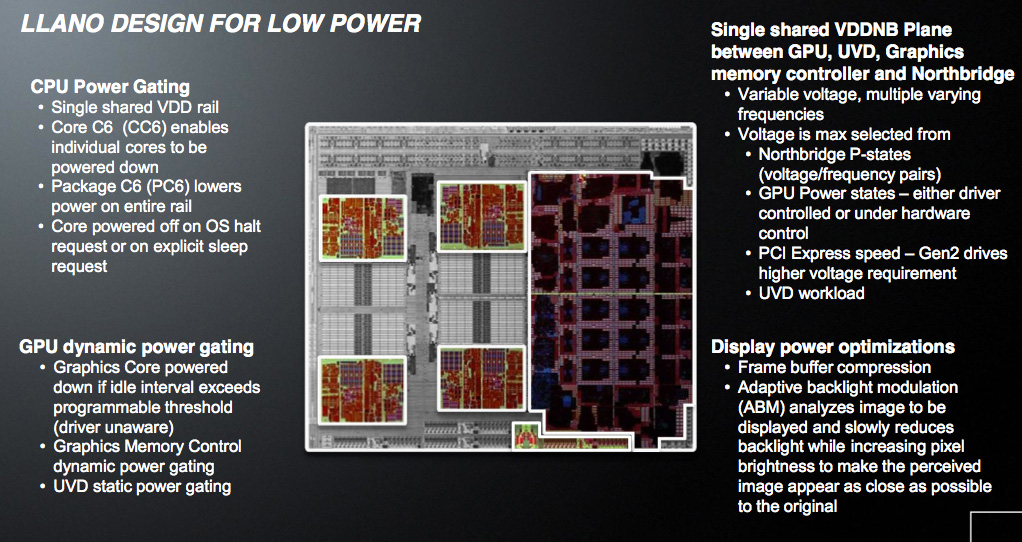
Everything from an individual CPU core to the entire GPU or virtually the entire APU package can be power gated. AMD provided photon recombination images to show the impact power gating the GPU can have on leakage current:
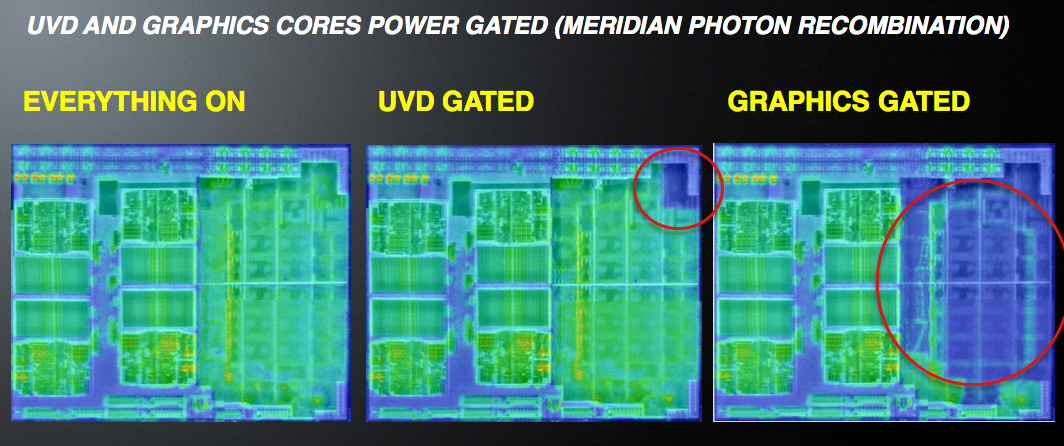
Although not depicted above, Llano can also fully power gate the x86 CPU cores or both the CPU and GPU if the entire APU is in a deep sleep state. Being able to completely power gate CPU cores or the GPU is an important part of enabling the next major feature of Llano: Turbo Core.
Turbo Core
All processors whether CPUs, GPUs or APUs have to be designed to strict thermal and power limits. OEMs need to know exactly what sort of chassis they'll be able to build around these chips and as a result the chip vendors provide guidance in the form of specifications, including the chip's thermal design point (TDP).
In the old days of microprocessors things were simple. You had a single core that ran all the time and it consumed all of the available thermal budget allocated for that core. AMD and Intel eventually enabled dynamic clock frequencies which let your single core underclock itself when it wasn't being used, which helped reduce power and extend battery life. Then came the multi-core era.

CPUs couldn't just start putting out twice as much heat now that they had two cores; instead, each core had to consume less power. The chip guys achieved this by running the cores at lower frequencies and voltages than they did in the single-core days. Two cores paved the way to four cores, which meant another reduction in clock speed per core. Sure we got much better multi-threaded performance, but for single-threaded applications performance wasn't as great as it could be. Users had to make a tradeoff: good multi-threaded performance or good single-threaded performance; you couldn't have both. Until power gating came along that is.
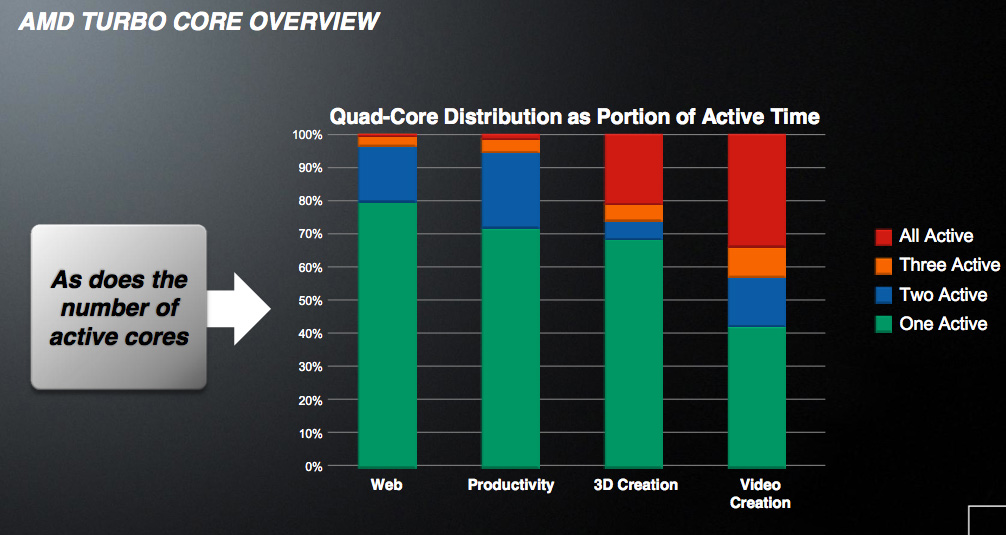
Without power gating you can never really shut off power to an idle core. The transistors aren't switching but power is still dissipated thanks to leakage current. Remember that transistors don't simply stop conducting electricity when they're off. The smaller they get, the more leaky our beloved transistors become. Power gating lets you physically block the flow of current to the transistors that are being gated, so when they're off, they're actually off. With an idle core shut off, now you have the extra TDP headroom to run any active cores at higher frequencies.
Intel does this with a technology it calls Turbo Boost. Intel looks at current draw and thermal sensors spread out all over the chip and determines when it has the available thermal headroom to turbo up any active cores. AMD implements a similar technology in Llano (and previously in their hex-core desktop parts) called Turbo Core.
I say similar but not identical because AMD's approach differs in a very important way. While Intel looks at current draw and temperature data, AMD looks at workload. Each activity within the Llano APU is assigned a certain power weight (e.g. an integer multiply is known to require a certain amount of power). Llano is aware of the operations it's currently working on and based on the weights associated with these operations it comes up with a general estimate of its power consumption on a per core basis. I mention this is an estimate because it correlates digital activity to power consumption; it doesn't actually measure power consumption.
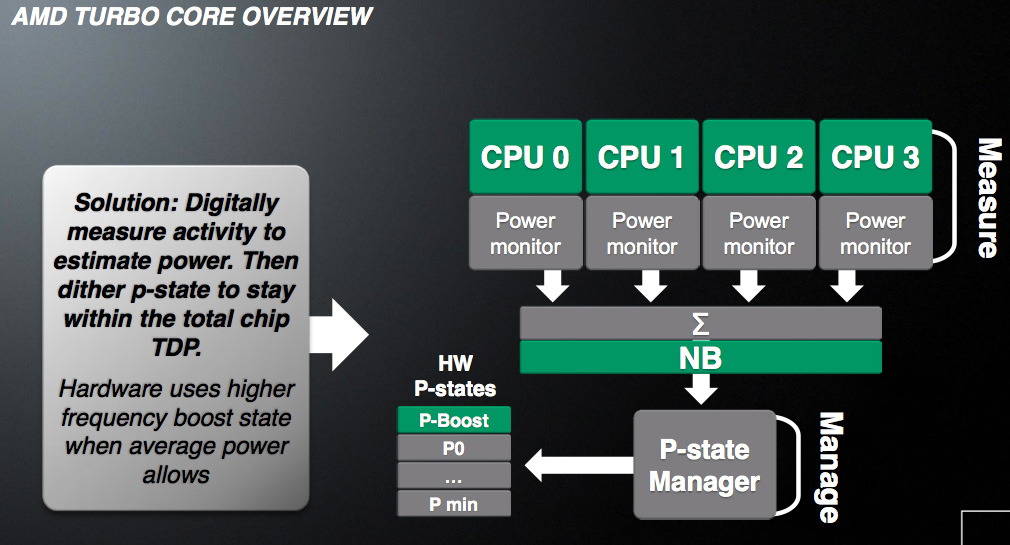
Based on the number of events and their individual weights, AMD estimates the power consumption of each core and determines how much TDP headroom exists in the system. If the OS is requesting the highest p-state from the CPU and there's available TDP headroom, Llano will turbo up any active cores up to a maximum frequency. Like Sandy Bridge, Llano is able to temporarily exceed the APU's maximum TDP if it determines that the recent history of power consumption has been low enough that it'll take a while for the APU to ramp up to any thermal limits.
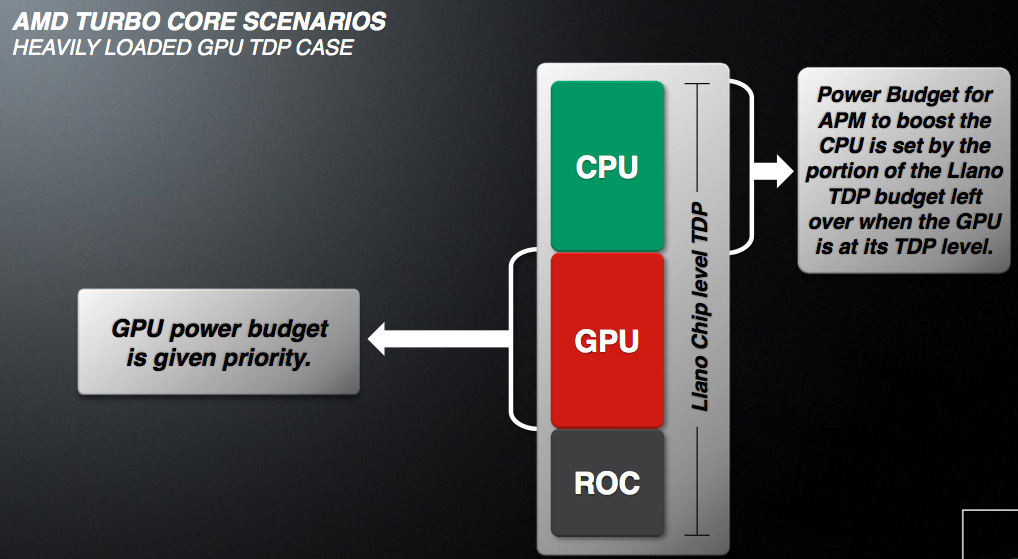
One major limit of Llano's Turbo Core is that the GPU can't turbo up in the event of the CPU cores being idle. Only the CPU cores can turbo up if they have available headroom. I suspect future versions of Llano will probably enable GPU Turbo Core as well:
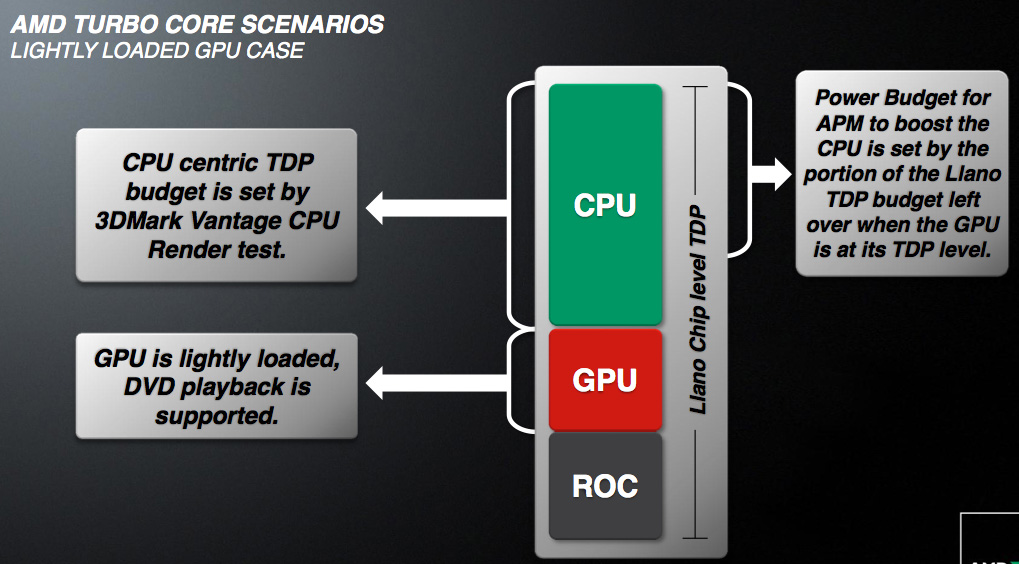
It's unclear to me at this point what shortcomings or advantages exist for AMD's Turbo Core method vs. Intel's Turbo Boost. At the bare minimum the two are finally comparable although they use different approaches to attain a similar end result. AMD doesn't yet have a method of actually displaying Turbo Core frequencies, unfortunately, so we're operating a bit blind at this point. Over time I hope to have a better idea of how AMD's solution stacks up.


 Facebook
 Twitter
 RSS
RSS


177 Comments
View All Comments
CyanLite - Tuesday, June 14, 2011 - link
Looks very interesting. Getting one ASAP. Looks like AMD is back.therealnickdanger - Tuesday, June 14, 2011 - link
Yeah, back behind Intel yet again. If the price is right (cheaper than Intel) and the form factor is right (super thin and light notebooks), then I would consider this over SNB. Right now you can get entry-level SNB with medium-quality discrete AMD or NVIDIA graphics for under $700 that will more than match this notebook on GPU performance, battery life, and then proceed to run circles around it in CPU performance. $650 isn't a very good starting point. I hope they work down into that $500-600 bracket soon.Shadowmaster625 - Tuesday, June 14, 2011 - link
I dont get all the talk of $600-$800. There is fundamentally no reason why we wont see these chips in $449 back to school specials, or black friday specials. It is only $50 more in parts vs what we're seeing on slickdeals for $400.For example, this is from today: Lenovo ThinkPad Edge E520 15.6" Notebook Laptop: Core i3-2310M (2.10GHz), 4GB DDR3, 320GB 7200RPM, DVD Super Multi, Intel HD Graphics, HDMI, Win 7 Pro $434 Shipped
That is a $200 ripoff chip from intel. In a $450 notebook deal.
mino - Tuesday, June 14, 2011 - link
Go troll somewhere else.Intel managed to book a bunch of Quad+Discrete while preventing any dual+HD chips in this review providing a fine level of reality distortion field.
But that field does not reality change. Period.
Samus - Wednesday, June 15, 2011 - link
Well considering it will be cheaper than Intel (significantly when considering the additional cost of a comparable $50+ graphics card) and it uses less power than just about any SNB configuration, I think you answered your own questions.8steve8 - Tuesday, June 14, 2011 - link
eh, while this offers modest improvements over sandy bridge in games, the general cpu performance is pretty poor. If gaming is that important to you, then you won't be happy with EITHER IGP, so you'll still be better off with sandy bridge (paired with another gpu).That said, if they were free, I'd buy one. So they could still be a winner in the market if the price is right.
ash9 - Tuesday, June 14, 2011 - link
operative word is mobile - Who number crunches on a laptop anyway?8steve8 - Tuesday, June 14, 2011 - link
well mobile computers are becoming primary machines for many people. It's not just about "crunching numbers" everything non-3d-gaming is limited by storage,cpu, or memory bandwidth. try using a netbook, they aren't a pain to use because of their graphics, storage or memory bandwidth, they suck cause of their cpu performance.duploxxx - Tuesday, June 14, 2011 - link
that is why you probably have an Atom :) perhaps try an E-350 and see how much usable it is in a daily task.Broheim - Tuesday, June 14, 2011 - link
E-350 isn't an improvement over Atom in the CPU department,.