



Apple iPad 2 Preview
by Anand Lal Shimpi, Brian Klug & Vivek Gowri on March 12, 2011 6:01 AM ESTThe GPU: PowerVR SGX 543MP2
There are no spoilers here but the PowerVR SGX 535 in the original A4 is out, replaced by the new PowerVR SGX 543MP2. The 543 as a building block has a bit over twice the peak floating point throughput of the SGX 535. The MP2 just means there are two of these 543s working in tandem. The result is what Apple uses as the basis for their "9x faster" GPU claims. In practice the improvement should be less than that, but it's still enormous.
We've got GPU performance data coming, but I thought I'd take a slightly different route and show what one developer is using the extra horsepower offered by the A5 for.
Epic Games is a familiar face around these parts. We've used games powered by their Unreal Engine in our reviews for years now. More recently Epic has made a splash in the iOS world with the release of its Citadel demo and eventually Infinity Blade.
In time for the launch Epic updated Infinity Blade to have some special enhancements for iPad 2 owners. Rather than simply deliver a higher framerate for iPad 2 users, Epic enabled higher resolution textures and anti-aliasing. The resulting boost in image quality is astounding, particularly on the iPad 2's 1024 x 768 screen:

Mouse over to see Infinity Blade on the iPad 2
There's far more detail in the character models as well as the environment. Lighting looks improved and the AA is definitely appreciated.

Mouse over to see Infinity Blade on the iPad 2
The gallery below has a bunch of side by side shots showing the improvements made to Infinity Blade for the iPad 2 vs. what you get when you run the game on a first generation iPad.


As we mentioned before, the A5 (and iPad 2) are about enabling developers. In a year's time the PowerVR SGX 543MP2 will be found in the majority of iOS tablets on the market - and games are just going to get prettier from there.
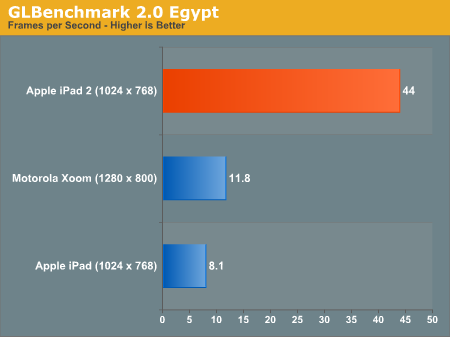
Update: We've published a look at the performance of the PowerVR SGX 543MP2 running GLBenchmark 2.0 here. If you want a teaser, it's good:


 Facebook
 Twitter
 RSS
RSS


82 Comments
View All Comments
Destiny - Saturday, March 12, 2011 - link
If Apple iPAD 2, NVIDIA's Tegra 2, TI's OMAP 4 and Samsung's Exynos all use the same Dual Core ARM Cortex A9... why are there performance differences shown in your testing and benchmarks of these products?StevoLincolnite - Saturday, March 12, 2011 - link
iPad uses iOS the others use variations of Android with who knows whats loaded in the background.But the simple reason is different OS's provide different performance characteristics as they handle processes and memory loads differently.
Destiny - Saturday, March 12, 2011 - link
Thank-you for the reply... now my knowledge and processor IQ just went up a notch... : )solgae1784 - Saturday, March 12, 2011 - link
Yep. All that hardware specs means nothing if your software can't utilize it. That much is clear even way back in the days.vol7ron - Saturday, March 12, 2011 - link
It's not just due to the OS, it is also due to the other hardware coupled with the A9. For instance, more RAM means application data can be loaded quicker, rather than from the HD. The GPU and screen size/resolution also effect benchmarks - the amount of effect depends on the type of test.Also the different hardware vendors may have modified some of the firmware instruction sets to make it more efficient.
But that's a big reason why these benchmarks are used, to have some sort of common ground that more accurately compares the different hardware/software combinations.
MonkeyPaw - Saturday, March 12, 2011 - link
We also don't know the clocks of the A5. Maybe it's not safe to assume it's running at 1.0ghz?Anand Lal Shimpi - Saturday, March 12, 2011 - link
Er you're very right about that. Geekbench reports 900MHz :)Take care,
Anand
tipoo - Saturday, March 12, 2011 - link
http://www.apple.com/ca/ipad/specs/Its 1GHz. Geekbench reports the instantaneous speed, so you'll hear different numbers from that depending on what it ramps its speed down to to save power.
dagamer34 - Saturday, March 12, 2011 - link
It's all about the OS at that point, just like how iOS 4.3 gives 2.5x increase in Javascript performance compared to iOS 4.0 even using the same original iPad.vol7ron - Saturday, March 12, 2011 - link
That isn't the OS, that's the JS engine. Both software, both different roles.