



Apple iPad 2 Preview
by Anand Lal Shimpi, Brian Klug & Vivek Gowri on March 12, 2011 6:01 AM ESTI remember the speculation that lead up to Apple's iPad launch. The list of things everyone expected the device to do was absurd, and the theories on the architecture behind Apple's first branded SoC was just as fantastic. The simplest answer is sometimes the right one and as Ars Technica's Jon Stokes pointed out, the A4 was nothing more than a hardened ARM Cortex A8 core running at 1GHz in the iPad (and 800MHz in the iPhone 4).
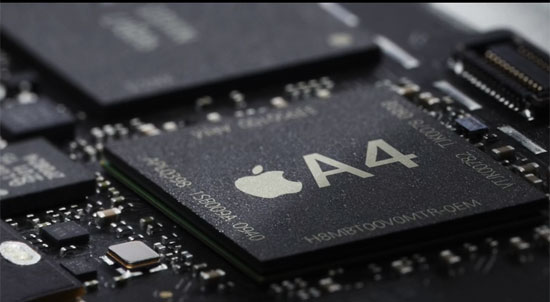
The Cortex A8 is something we've covered extensively here so I won't go into great detail right now. It's a dual-issue, in-order architecture with a 13 stage integer pipeline and a non-pipelined FPU.
When Apple announced the iPad 2, it also briefly announced the A5 SoC. The only detail given? The A5 is a dual-core processor with a GPU that's 9x faster than what's in the A4.
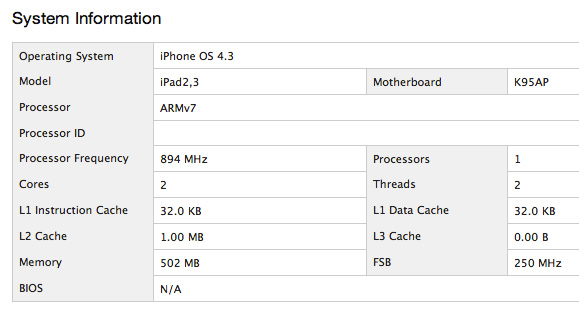
There are only two recent ARM architectures that have multicore support: the ARM11 and the ARM Cortex A9. The A8 doesn't come in a multicore variant. Given how many other SoC vendors are shipping dual-core Cortex A9 SoCs, the A5 was likely no different than NVIDIA's Tegra 2, TI's OMAP 4 or Samsung's Exynos in that regard: armed with a pair of Cortex A9s running at 1GHz. Update: Geekbench reports clock speed at 900MHz. Update 2: Apple confirms 1GHz clock speed on the iPad 2 specs page.
| Architecture Comparison | |||||||
| ARM11 | ARM Cortex A8 | ARM Cortex A9 | Qualcomm Scorpion | ||||
| Issue Width | single-issue | dual-issue | dual-issue | dual-issue | |||
| Pipeline Depth | 8 stages | 13 stages | 9 stages | 13 stages | |||
| Out of Order Execution | N | N | Y | Partial | |||
| FPU | Optional VFPv2 (not-pipelined) | VFPv3 (not-pipelined) | Optional VFPv3-D16 (pipelined) | VFPv3 (pipelined) | |||
| NEON | N/A | Y (64-bit wide) | Optional MPE (64-bit wide) | Y (128-bit wide) | |||
| Process Technology | 90nm | 65nm/45nm | 40nm | 40nm | |||
| Typical Clock Speeds | 412MHz | 600MHz/1GHz | 1GHz | 1GHz | |||
The Cortex A9 is similar to the A8 but with an out-of-order execution engine and a shallower pipeline (9 stages). The result is better-than-A8 performance at the same clock speed. The A9 also adds a fully pipelined FPU.
Now it's unclear what the rest of the A5 SoC looks like, but from the CPU standpoint I think it's safe to say that there are a pair of ARM Cortex A9s in there. We can look at the increase in Geekbench Floating Point scores for some proof:
| Geekbench 2 - Floating Point Performance | ||||
| Apple iPad | Apple iPad 2 | |||
| Overall FP Score | 456 | 915 | ||
| Mandlebrot (single-threaded) | 79.5 Mflops | 279.1 Mflops | ||
| Mandlebrot (multi-threaded) | 79.4 Mflops | 554.7 Mflops | ||
| Dot Product (single-threaded) | 245.7 Mflops | 221.7 Mflops | ||
| Dot Product (multi-threaded) | 247.2 Mflops | 436.8 Mflops | ||
| LU Decomposition (single-threaded) | 54.5 Mflops | 205.4 Mflops | ||
| LU Decomposition (multi-threaded) | 54.8 Mflops | 421.6 Mflops | ||
| Primality Test (single-threaded) | 71.2 Mflops | 177.8 Mflops | ||
| Primality Test (multi-threaded) | 69.3 Mflops | 318.1 Mflops | ||
| Sharpen Image (single-threaded) | 1.51 Mpixels/s | 1.68 Mpixels/s | ||
| Sharpen Image (multi-threaded) | 1.51 Mpixels/s | 3.34 Mpixels/s | ||
| Blur Image (single-threaded) | 760.2 Kpixels/s | 665.5 Kpixels/s | ||
| Blur Image (multi-threaded) | 753.2 Kpixels/s | 1.32 Mpixels/s | ||
Single threaded FPU performance is multiples of what we saw with the original iPad. This sort of an improvement in single-core performance is likely due to the pipelined Cortex A9 FPU. Looking at Linpack we see the same sort of huge improvement:
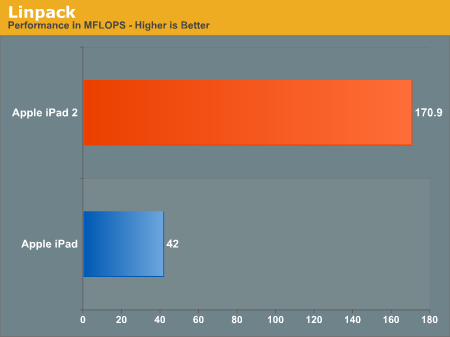
Whether this performance advantage matters is another matter entirely. Although there aren't many FP intensive iPad apps available today, moving to the A5 is all about enabling developers - not playing catch up to software.
Memory size, bandwidth and operating frequencies are all unknowns that I was hoping to find out more about once I put hands on the iPad 2. Geekbench reports the iPad 2 at 512MB of memory, double the original iPad's 256MB. Remember that Apple has to deal with lower profit margins than it'd like with the iPad, but it refuses to cut corners on screen quality so something else has to give.
L2 cache size has also apparently increased from 512KB to 1MB. The L2 cache is shared among both cores and 1MB seems to be the sweet spot this generation.
| Geekbench 2 - Memory Performance | ||||
| Apple iPad | Apple iPad 2 | |||
| Overall Memory Score | 644 | 787 | ||
| Read Sequential (single-threaded scalar) | 340.6 MB/s | 334.2 MB/s | ||
| Write Sequential (single-threaded scalar) | 842.4 MB/s | 1.07 GB/s | ||
| Stdlib Allocate (single-threaded scalar) | 1.74 Mallocs/s | 1.86 Mallocs/s | ||
| Stdlib Write (single-threaded scalar) | 1.20 GB/s | 2.30 GB/s | ||
| Stdlib Copy (single-threaded scalar) | 740.6 MB/s | 522.0 MB/s | ||
Geekbench's memory tests show an improvement in effective bandwidth as well. The biggest improvement is in the stdlib write test which shows a near doubling of bandwidth from 1.2GB/s to 2.3GB/s. Unfortunately this isn't enough data to draw conclusions about bus width or DRAM operating frequency. Given the increases in CPU and GPU performance, an increase in memory bandwidth to go along with the two isn't surprising.
Geekbench shows a healthy increase in integer performance, both in single and multithreaded scenarios. The multithreaded advantage makes sense (two are better than one), but the lead in single threaded tests shows the benefit the A9 can deliver thanks to its shorter pipeline and ability to reorder instructions around stalls.
| Geekbench 2 - Integer Performance | ||||
| Apple iPad | Apple iPad 2 | |||
| Overall FP Score | 365 | 688 | ||
| Blowfish (single-threaded) | 13.9 MB/s | 13.2 MB/s | ||
| Blowfish (multi-threaded) | 14.3 MB/s | 26.1 MB/s | ||
| Text Compression (single-threaded) | 1.23 MB/s | 1.50 MB/s | ||
| Text Compression (multi-threaded) | 1.20 MB/s | 2.82 MB/s | ||
| Text Decompression (single-threaded) | 1.11 MB/s | 2.09 MB/s | ||
| Text Decompression (multi-threaded) | 1.08 MB/s | 3.28 MB/s | ||
| Image Compress (single-threaded) | 3.36 Mpixels/s | 3.79 Mpixels/s | ||
| Image Compress (multi-threaded) | 3.41 Mpixels/s | 7.51 Mpixels/s | ||
| Image Decompress (single-threaded) | 6.02 Mpixels/s | 6.68 Mpixels/s | ||
| Image Decompress (multi-threaded) | 5.98 Mpixels/s | 13.1 Mpixels/s | ||
| Lua (single-threaded) | 172.1 Knodes/s | 273.4 Knodes/s | ||
| Lua (multi-threaded) | 171.9 Knodes/s | 542.9 Knodes/s | ||
On average Geekbench shows a 31% increase in single threaded integer performance over the A4 in the original iPad. NVIDIA told me they saw a 20% increase in instructions executed per clock for the A9 vs. A8 and if we remove the one outlier (text decompression) that's about what we see here as well.
| Geekbench 2 | |||||||
| Overall | Integer | FP | Memory | Stream | |||
| Apple iPad | 448 | 365 | 456 | 644 | 325 | ||
| Apple iPad 2 | 750 | 688 | 915 | 787 | 324 | ||
The increases in integer performance and memory bandwidth are likely what will have the largest impact on your experience. The fact that we're seeing big gains in single as well as multi-threaded workloads means the performance improvement should be universal across all CPU-bound apps.
What does all of this mean for performance in the real world? The iPad 2 is much faster than its predecessor. Let's start with our trusty javascript benchmarks: SunSpider and BrowserMark.
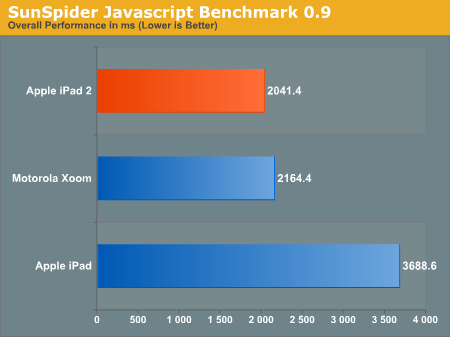
Apple improved the Safari JavaScript engine in iOS 4.3, which right off the bat helped the original iPad become more competitive in this test. Even with both pads running iOS 4.3, the iPad 2 is 80% faster than the original iPad here.
The Motorola Xoom we recently reviewed scored a few percent slower than the iPad 2 in SunSpider as well. Running different OSes and browsers, it's difficult to conclude much when comparing the A5 to Tegra 2.
A bug in BrowserMark kept us from running it for the Xoom review but it's since been fixed. Again we're looking at mostly JavaScript performance here. Rightware modeled its benchmark after the JavaScript frameworks and functions used by websites like Facebook, Amazon and Gmail among others. The results are simply one aspect of web browsing performance, but an important one:
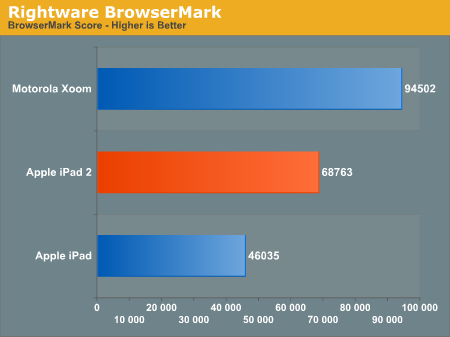
The move from the A4 in the iPad 1 to the A5 in the iPad 2 boosts scores by 47%. More impressive however is just how much faster the Xoom is here. I suspect this has more to do with Google's software optimizations in the Honeycomb browser than hardware, but let's see how these tablets fare in our web page loading tests.
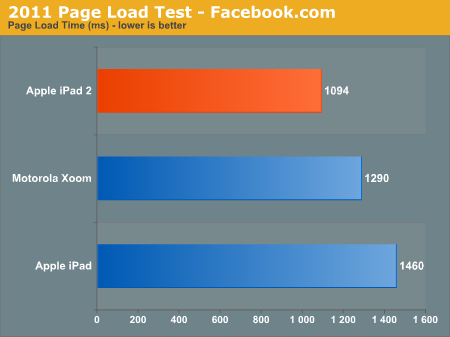
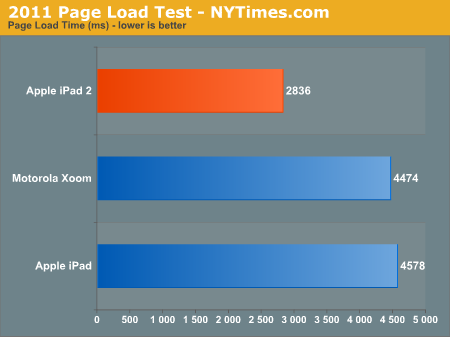
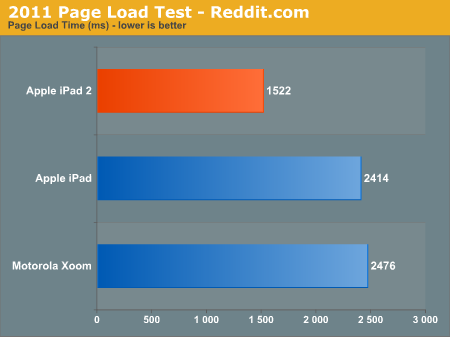
We debuted an early version of our 2011 web page loading tests in the Xoom review. Two things have changed since then: 1) iOS 4.3 came out, and 2) we changed our timing methods to produce more accurate results. It turns out that Honeycomb's browser was stopping our page load timer sooner than iOS', which resulted in some funny numbers when we got to the 4.3/Honeycomb comparison. To ensure accuracy we went back to timing by hand (each test was repeated at least 5 times and we present an average of the results). We also added two more pages to the test suite (Digg and Facebook).
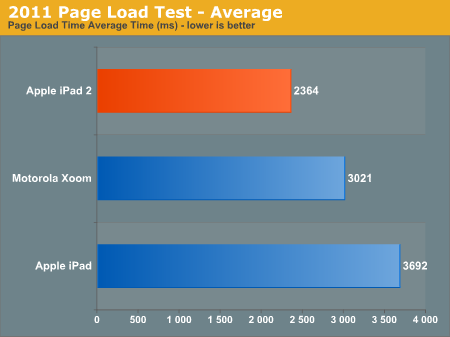
The iPad 2 generally loads web pages faster than the Xoom. On average it's a ~20% increase in performance. I wouldn't say that the improvement is necessarily noticeable when surfing most sites, but it's definitely measurable.
The move to iOS 4.3 really narrowed the gap between the original iPad and the Xoom. In some cases the two actually render pages in the same amount of time, however that's typically for lighter pages that are easy to render. Up the complexity and the Xoom easily distances itself from the original iPad.
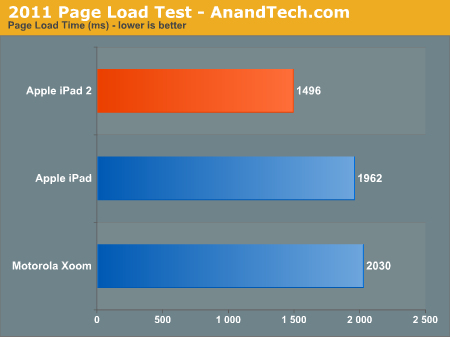
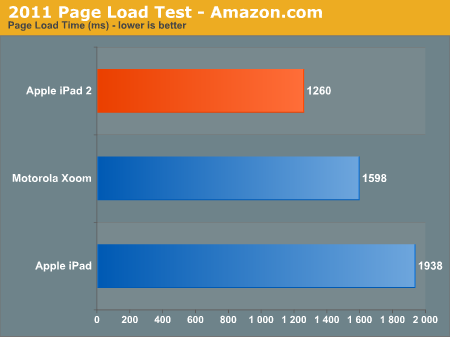
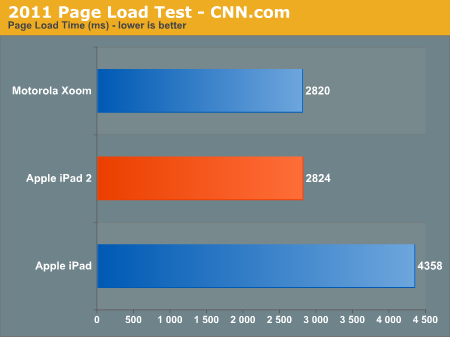
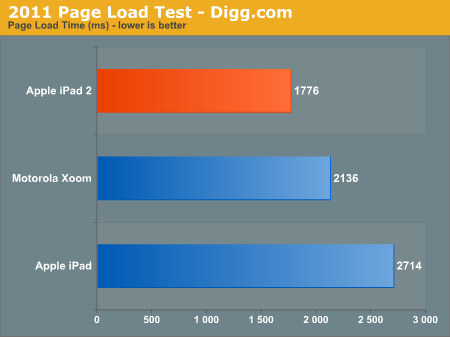
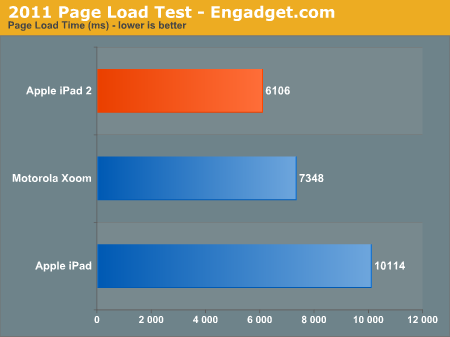
We'll touch on this more in the full review but it's not all about performance when talking about web browsing between the iPad 2 and the Xoom. Although the iPad 2 may have faster render times on average, the Xoom still supports tabbed browsing which definitely has its advantages.


 Facebook
 Twitter
 RSS
RSS


82 Comments
View All Comments
Destiny - Saturday, March 12, 2011 - link
If Apple iPAD 2, NVIDIA's Tegra 2, TI's OMAP 4 and Samsung's Exynos all use the same Dual Core ARM Cortex A9... why are there performance differences shown in your testing and benchmarks of these products?StevoLincolnite - Saturday, March 12, 2011 - link
iPad uses iOS the others use variations of Android with who knows whats loaded in the background.But the simple reason is different OS's provide different performance characteristics as they handle processes and memory loads differently.
Destiny - Saturday, March 12, 2011 - link
Thank-you for the reply... now my knowledge and processor IQ just went up a notch... : )solgae1784 - Saturday, March 12, 2011 - link
Yep. All that hardware specs means nothing if your software can't utilize it. That much is clear even way back in the days.vol7ron - Saturday, March 12, 2011 - link
It's not just due to the OS, it is also due to the other hardware coupled with the A9. For instance, more RAM means application data can be loaded quicker, rather than from the HD. The GPU and screen size/resolution also effect benchmarks - the amount of effect depends on the type of test.Also the different hardware vendors may have modified some of the firmware instruction sets to make it more efficient.
But that's a big reason why these benchmarks are used, to have some sort of common ground that more accurately compares the different hardware/software combinations.
MonkeyPaw - Saturday, March 12, 2011 - link
We also don't know the clocks of the A5. Maybe it's not safe to assume it's running at 1.0ghz?Anand Lal Shimpi - Saturday, March 12, 2011 - link
Er you're very right about that. Geekbench reports 900MHz :)Take care,
Anand
tipoo - Saturday, March 12, 2011 - link
http://www.apple.com/ca/ipad/specs/Its 1GHz. Geekbench reports the instantaneous speed, so you'll hear different numbers from that depending on what it ramps its speed down to to save power.
dagamer34 - Saturday, March 12, 2011 - link
It's all about the OS at that point, just like how iOS 4.3 gives 2.5x increase in Javascript performance compared to iOS 4.0 even using the same original iPad.vol7ron - Saturday, March 12, 2011 - link
That isn't the OS, that's the JS engine. Both software, both different roles.