



Sony EE34: Sony Makes Budget AMD Laptops?
by Dustin Sklavos on February 22, 2011 4:43 PM ESTIntroducing the Sony EE34
You can't buy it from Sony's website. If you blinked you might have missed the news popping up on a couple of different sites about its existence. If you were on the phone with me when I called Jarred about it, you might even have shared his reaction: "Sony makes a budget AMD laptop?" But sure enough they do, and we have a budget Sony EE34 notebook on hand that's liable to raise more than a few eyebrows. Around $600 for a Sony Vaio AMD-based notebook with a Blu-ray drive standard? They make those?
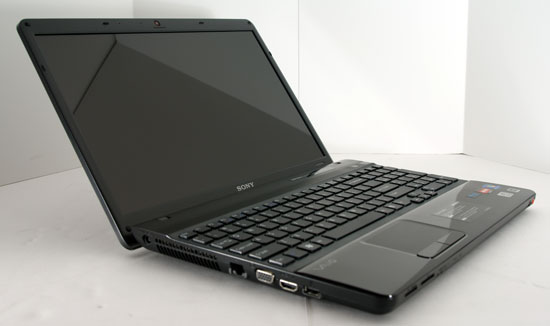
As a matter of fact, they do. With Intel's Sandy Bridge recall having largely enervated the retail market, we thought it would be a good opportunity to take another look at what AMD has on hand. When we saw the EE34 on the shelf, it wound up being such a curiosity that we knew we had to find out just what exactly a budget Sony Vaio AMD notebook means. This is also the first of hopefully many Sony notebooks we'll be taking a look at in the future and yes, we've heard your calls, we're trying to get a Z series on hand.
In the meantime, though, we're going to check out what happens when an AMD Athlon II mobile processor with a 25W TDP hangs out inside one of Sony's attractive Vaio notebooks.
| Sony EE34 Specifications | |
| Processor |
AMD Athlon II P340 (2x2.2GHz, 45nm, 1MB L2, 25W) |
| Chipset | AMD RS880M Northbridge + SB800 Southbridge |
| Memory | 2x2GB DDR3-1333 (Max 2x4GB) |
| Graphics |
AMD Mobility Radeon HD 4250 IGP (40 Stream Processors, 510MHz core clock) |
| Display |
15.6" LED Glossy 16:9 1366x768 (LG LGD02CA Panel) |
| Hard Drive(s) |
320GB 5400 RPM (Toshiba) |
| Optical Drive | BD-ROM/DVD+-RW Combo Drive |
| Networking |
Realtek PCIe Gigabit Ethernet Atheros AR9285 802.11b/g/n |
| Audio |
Realtek ALC269 HD Audio Stereo speakers Headphone and microphone jacks |
| Battery | 4-Cell, 11.1V, 39Wh battery |
| Front Side |
MS reader SD/MMC reader Wireless switch Indicator lights Headphone jack Microphone jack |
| Left Side |
AC adapter Exhaust vent Ethernet jack D-SUB HDMI USB 2.0 |
| Right Side |
3x USB 2.0 Optical drive Kensington lock |
| Back Side | - |
| Operating System | Windows 7 Home Premium 64-bit |
| Dimensions | 14.56" x 9.78" x 1.26"-1.47" (WxDxH) |
| Weight | 5.90 lbs |
| Extras |
Webcam Flash reader (MMC, SD/Mini SD, MS/Duo/Pro/Pro Duo) Blu-ray drive 103 key keyboard with 10-key |
| Warranty | 1-year limited warranty |
| Pricing | Available online for $630 |
It's no big secret that Intel's "Core 2010" series of mobile processors are faster than AMD's current lineup, and that the Sandy Bridge-based "Core 2011" series will be faster still. The problem is that the former are drying up in retail (no doubt due to trying to shift inventory to make room for the Sandy Bridge refreshes) while the latter are still about a month away due to the recall. That leaves us with a healthy amount of AMD-based notebooks on the market, and as we'll see that's not such a bad thing.
The Athlon II P340 (so nice of AMD to finally do away with any sense of logic in their chip naming just like Intel did) is basically the same as the dual-core desktop Athlon II, with no L3 cache but 512KB of L2 cache per core. It runs at an unexciting 2.2GHz, but should still provide enough processing power to handle most tasks. The best part, of course, is that this chip also features a 25W TDP that you'll see Sony actually manages to get some mileage out of.
Well, that's not the only best part. The other part is that while AMD's 40-shader integrated graphics haven't exactly aged gracefully, they're still better than any other IGP currently widely available on the market (NVIDIA's GeForce 320M is only available in MacBooks, and the 9400M is basically gone now) barring the Radeon HD 6310 in AMD's E-350, which brings with it the baggage of a much slower processor. As a result the Mobility Radeon HD 4250 may not be much but it can at least get the job done for the lightest of gaming, though most users will be disappointed to see it doesn't share the 700MHz core clock of the desktop IGP.
The other big selling point of the Sony EE34 is the Blu-ray drive, making it a very affordable way to get a decent computer and a Blu-ray player in one shot. The middling 720p screen may not help you get the most out of your movie watching experience, but it's a start, and there's always the HDMI port for external displays.
As for the rest of the EE34, connectivity is generally good and the 4GB of DDR3 is ample, but the system is bogged down by a lowest-common-denominator 5400RPM Toshiba hard drive with a paltry 8MB of cache. Every time I have to use a Toshiba or Fujitsu hard drive I feel like I'm being punished for something, and it's a disappointment to see them when most vendors have switched to using Seagate or Western Digital drives (though Samsung and Hitachi are also fine candidates.)


 Facebook
 Twitter
 RSS
RSS


52 Comments
View All Comments
silverblue - Tuesday, February 22, 2011 - link
I really doubt that AMD will release a faster IGP than the 4250 on this type of platform, or even one with more shaders, simply because it detracts from the Fusion initiative. Had they not gone the Fusion route, we probably would be seeing IGPs on the same level as, say, the 3850, by now (one can hope, though Llano should easily meet that).At the very least, it'd have been nice to see a 40nm version of the 4250 and not the 55nm versions we've been seeing for a couple of years, especially since Intel is producing their HD Graphics on a lower node.
nitrousoxide - Tuesday, February 22, 2011 - link
Llano IGP has 320 shaders, and should run at really high frequency. So it's reasonable to expect Mobility 5650 (or GT425M) level performance.mino - Tuesday, February 22, 2011 - link
320 ? Umm. More like 400(+) ...duploxxx - Wednesday, February 23, 2011 - link
ain't that funny arguing about shader count while you actually don't know for sure??? :)Liano will have 160-240-320-400 shaders in notebook depending on model, now you know.
And now it doesn't run really high frequency but indeed the highend will be around Mob 5650 perf and will run circles around anything integrated Intel can offer.
StevoLincolnite - Tuesday, February 22, 2011 - link
That might be true for lower resolutions... Just remember it still has to use system memory which is slower and of higher latency when compared to a discreet cards own memory subsystem (Plus system RAM's bandwidth is shared between all components.)Only so large and complex you can make an IGP before it is essentially pointless, on the bright side compute tasks should be decent.
silverblue - Wednesday, February 23, 2011 - link
It'll handle higher loads than Brazos, though Brazos wasn't really positioned as a gaming option.A triple channel memory interface would be immensely helpful but unfortunately incredibly unlikely to happen. The real value of Llano should be proven by throwing faster RAM at it; those RAM tests which yielded very little improvement should no longer apply.
I can't see Llano achieving 5650 performance in bandwidth-limited situations, however one might argue that anti-aliasing and anisotropic filtering aren't options suited to such platforms so if you leave those out, it should perform quite well.
nitrousoxide - Wednesday, February 23, 2011 - link
1366x768 gaming isn't that bandwidth limited. My laptop runs at 1600x900 with 128bit D3 running at 800MHz. So that's only 25.6GB/s available bandwidth but still managed to run Black Ops/Need for Speed Shift at highest settings and rarely dropped below 30fps. While Llano won't be that fast to handle HD gaming, at 1366x768 (which is the standard resolution for most 14 inch laptops) it should really provide decent gaming experience.drew_afx - Tuesday, February 22, 2011 - link
Thanks for the thorough reviews on this siteit's really informative and accurate
but since a lot of people like myself visit here to
decide on which tech product to choose from,
is it possible to include a comparison chart of carrying weight?
I can see the specs on the first page, but
those i5's and i7 laptops w/ more than double the
charge capacity of sony's battery should be packing at least
a solid pound more. Efficiency wise, it would be better to compare
laptops by weight too, since power vs weight is always good comparison
in cars(efficiency of engine). As the review noted, this range of laptops is
suitable for college students who need multitasking, but don't need
gaming or video encoding power w/ more weight.
Another good measure of laptop comparison can be the
practical part of design. Does the vents on the bottom get blocked
when put on lap?(the pictures w/temps were very helpful) Is it single or dual heatsink/fan?
Is it easy to disassemble and clean vents later? Can it be
held with one hand comfortably, both when opened and closed without flexing?
any sign of lcd distortion when pressed on the back cover? hinge quality?
keyboard & mouse clicking noise level? I think one of the reasons for
apple's success in educational notebooks is due to meeting these practical design
criteria.
Malih - Wednesday, February 23, 2011 - link
interesting, it's good to include these kindof daily usage annoyances test, cause that's what we're facing everyday, it will complete the review as buyer's guideScreammit - Wednesday, February 23, 2011 - link
Positioning of the vents is one of the first things I look at when I make a laptop purchase. I greatly prefer that the main intake or outtake is not on the bottom.