



AMD Discloses Bobcat & Bulldozer Architectures at Hot Chips 2010
by Anand Lal Shimpi on August 24, 2010 1:33 AM ESTIt’s an Out of Order Atom
Ever since the Pentium Pro (P6), we have been blessed with out of order microprocessor architectures - these being designs that can execute instructions out of program order to improve performance. Out of order architectures let you schedule independent instructions ahead of others that are either waiting for data from main memory or waiting for specific execution resources to free up. The resulting performance boost comes at the expense of power and die size. All of the tracking logic to make sure that instructions executed out of order still retire in order eats up die area as well as more power.
When Intel designed the Atom processor it went back to an in-order design as a way of reducing power. Intel has committed to using in-order architectures in Atom for 4 - 5 years post introduction (that would end sometime in the 2012 - 2013 time frame).
For smartphones, Intel’s commitment to in-order makes sense. Average power consumption under load needs to remain at less than 1W and you simply can’t hit that with an out-of-order Atom at 45nm.
For netbooks and notebooks however, the tradeoff makes less sense. Jarred has often argued that a CULV notebook is a far better performer than a netbook at very similar price/battery life metrics. No one is pleased with Atom’s performance in a netbook, but there’s clearly demand for the form factor and price point. Where there’s an architectural opportunity like this, AMD is usually there to act.
Over the past decade AMD has refrained from copying an Intel design, instead AMD usually looks to leapfrog Intel by implementing forward looking technologies earlier than its competitor. We saw this with the 64-bit K8 and the cache hierarchy of the original Phenom and Phenom II processors. Both featured design decisions that Intel would later adopt, they were simply ahead of their time.
With Atom stuck in an in-order world for the near future, AMD’s opportunity to innovate is clear.
The Architecture
Admittedly I was caught off guard by Bobcat’s architecture: it’s a dual-issue design, the first AMD has introduced since the K6 and also the same issue width Intel chose for Atom. Where AMD and Intel diverge however is in the execution side: Bobcat is a fully out of order architecture.
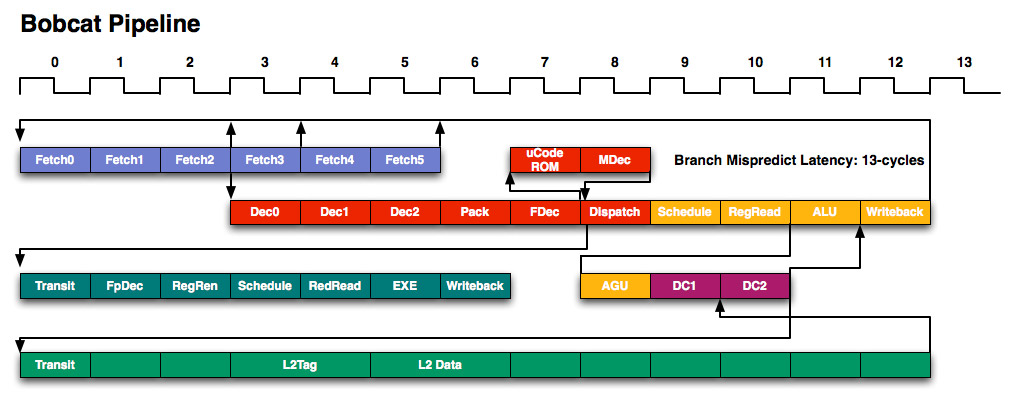
The move to out of order should provide a healthy single threaded performance boost over Atom, assuming AMD can ramp clocks up. Bobcat has a 15 stage integer pipeline, very close to Atom's 16 stage pipe. The two pipeline diagrams are below:
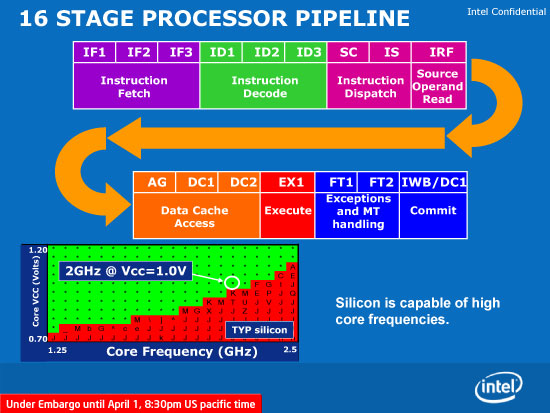
Intel's Atom pipeline
You’ll note that there are technically six fetch stages, although only the first three are included in the 15 stage number I mentioned above. AMD mentioned that the remaining three stages are used for branch prediction, but in a manner it is unwilling to disclose at this time due to competitive concerns.
Bobcat has two independent, dual ported integer scheduler. One feeds two ALUs (one of which can perform integer multiplies) while the other feeds two AGUs (one for loads and one for stores).
The FPU has a single dual ported scheduler that feeds two independent FPUs. Similar to the Atom processor, only one of the ports can handle floating point multiplies. The FP mul and add units can perform two single precision (32-bit) multiplies/adds per cycle. Like the integer side, the FPU uses a physical register file to reduce power.
Bobcat supports SSE1-3, with future versions adding more instructions as necessary.
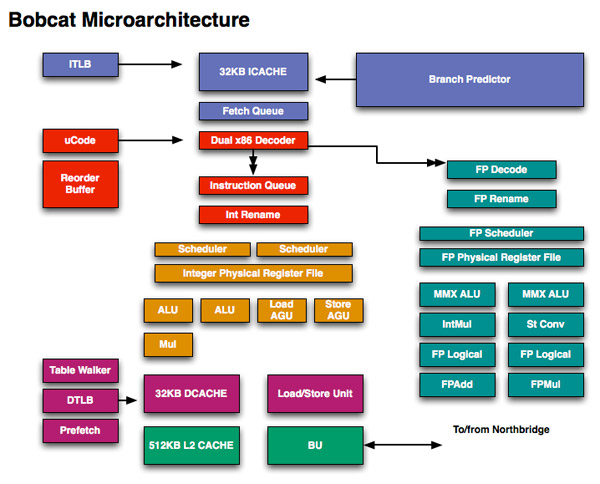
Bobcat supports out of order loads and stores similar to Intel’s Core architecture as well.
The Bobcat core has a 3-cycle 64KB L1 (32KB instruction + 32KB data cache) that’s 8-way set associative. The L2 cache is a 17-cycle, 512KB 16-way set associative cache. I originally measured Atom’s L1 and L2 at 3 and 18 cycles respectively (I’ve heard numbers as low as 15 for Atom’s L2) so AMD is definitely in the right ballpark here.
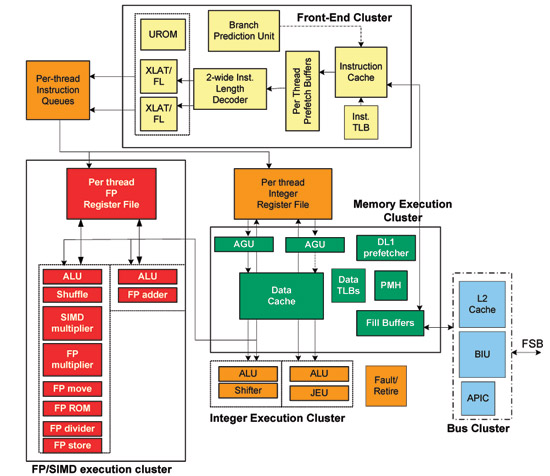
Intel's Atom Microarchitecture
Unlike the original Atom, Bobcat will never ship as a standalone microprocessor. Instead it will be integrated with other cores and a GPU and sold as a single SoC. The first incarnation of Bobcat will be a processor due out in early 2011 for netbooks and thin and light notebooks called Ontario. Ontario will integrate two Bobcat cores with an AMD GPU manufactured on TSMC’s 40nm process (Bobcat will be the first x86 core made at TSMC). This will be the first Fusion product to hit the market.
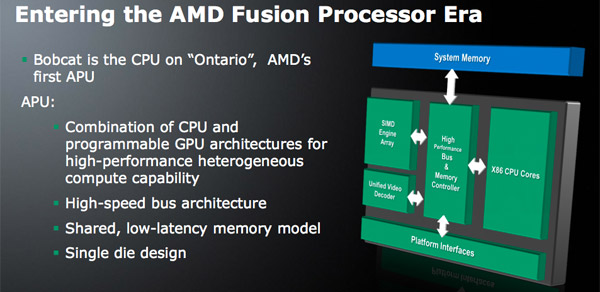
Note that there's an on-die memory controller but it's actually housed in between the CPU and GPU in order to equally serve both masters.


 Facebook
 Twitter
 RSS
RSS


76 Comments
View All Comments
SuperiorSpecimen - Tuesday, August 24, 2010 - link
Let's see some competition outside of the price game!mrmojo1 - Tuesday, August 24, 2010 - link
Awesome article, can't wait to see their release :) Should be very interesting!crawmm - Tuesday, August 24, 2010 - link
I drooled on my laptop reading this. Thank you, Anand. Good overview. And fun reading after a day of tedious (and mindless) work.lothar98 - Tuesday, August 24, 2010 - link
"In many ways the architecture looks to be on-par with what Intel has done with Nehalem/Westmere."I truly hope that this does not end up to be how things roll out. It has been far too long since we have seen good competition throughout the range of consumer CPU lineup. Currently we have options and competition in the mid-low end giving us exceptional bang for our buck. While one would never say you can get the best bang for your buck in the mid or high end everyone can still appreciate having options as well as getting value.
Freddo - Tuesday, August 24, 2010 - link
Bobcat seems very interesting to me, I hope it won't take long until we see a good netbook with it, with good build quality (metal, no plastic toy), a HDMI port and 2GB RAM.Mike1111 - Tuesday, August 24, 2010 - link
I'm wondering: what about AMD powered notebooks? And I don't mean netbooks or CULV notebooks. Looks like bulldozer won't come to notebooks until 2012, which would mean that AMD would most likely have to compete with Intel's 22nm Sandy Bridge successor, Ivy Bridge.Penti - Tuesday, August 24, 2010 - link
Llano APU, it's briefly mentioned. It's where we're at. Basically K10-based 4-core with integrated DX11 GPU. Better then today but not much of a competition.mino - Tuesday, August 24, 2010 - link
The GPU in the is supposed to be at least 5x the speed of current IGP performance.Basically you get a "discrete" GPU for a price of IGP ...
MonkeyPaw - Tuesday, August 24, 2010 - link
I can see Bobcat scaling upward in notebooks. It's multi-core capable, and is a fully-functional CPU. A quad core Bobcat with better-than-Intel graphics should be a very fulfilling product for notebooks in the mid-range, while providing good battery life (thank you, power gating). Anything above that could be handled by low-voltage Bulldozers as a premium offering. To me, that seems like a better solution than Intel's, where the Atom to Core increase is so severe.Kiijibari - Tuesday, August 24, 2010 - link
Ehh guys ...MMX is depracated in 64bit mode together with x87 and 3Dnow!:
--------
The x87, MMX, and 3DNow! instruction sets are deprecated in 64-bit modes. The instructions sets are still present for backward compatibility for 32-bit mode; however, to avoid compatibility issues in the future, their use in current and future projects is discouraged.
--------
http://msdn.microsoft.com/en-us/library/ee418798%2...
Why on Earth should AMD build in 2 special MMX pipes in a brand new µarchitecture ?
AMD just announced that they got rid of 3Dnow!, MMX pipes make no sense at all.
You probably mean XOP, dont you ?