



Two OMAP 3430 Phones: Nokia N900 and Motorola Droid
by Brian Klug on June 10, 2010 9:29 PM EST- Posted in
- Smartphones
- N900
- Maemo
- Motorola Droid
- Droid
- MeeGo
- Android
- Mobile
The SoC - OMAP3 3430
Before we dive into the phones, let's take a look at the SoC at the core of both. We talked about the OMAP 3430 back in 2009 (well maybe not way back, but it sure feels like it) in the context of the Palm Pre, which uses the OMAP 3430. It turns out that Texas Instruments' OMAP 3430 SoC is quite popular if not a microcosm of the generation of smartphones we're talking about; it's common to the N900, Motorola Droid, and Palm Pre.
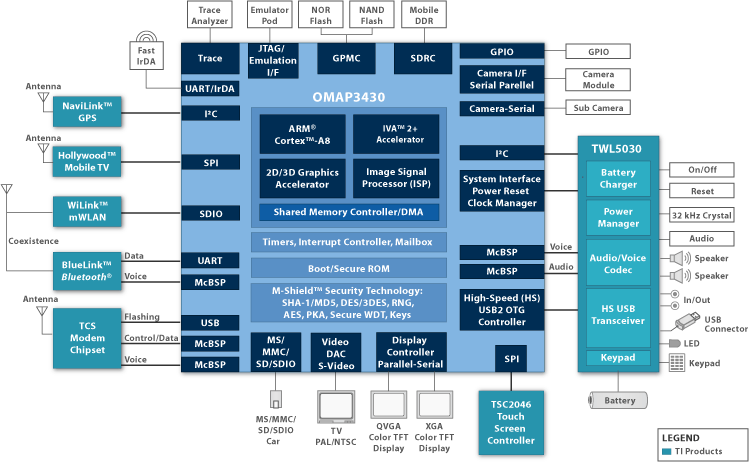
The Texas Instruments OMAP 3430 is designed for a 65nm manufacturing process, in fact, all of the OMAP34x series are designed for 65-nm process, whereas OMAP36 is intended for 45-nm processes. OMAP 3430 supports up to 12 megapixel cameras on its onboard image-signal processor, and packs an onboard IVA 2+ image, video and audio DSP accelerator clocked at 430 MHz, and a PowerVR SGX 530 GPU. Those clocks are recommended by TI, but in practice handset OEMs set them through a dialog with carriers to meet appropriate performance and battery life targets. OMAP3430's IVA 2+ supports MPEG-4 and H.264 encode/decode of 30 fps video at 720x480, and WMV9 decode at the same resolution and framerate. OMAP3430 can drive displays up to WXGA (1280x800) resolution at 24-bits. Note that the OMAP3 series SoCs don't pack internal cellular modems, meaning OEMs shop around for their own and connect over internal USB or multi channel buffered serial (McBSP).
At the heart of the OMAP 3430 SoC is the 600 MHz ARM Cortex A8 CPU. Remember that Cortex-A8 is an ARMv7 design with a 13 stage pipeline, compared to the 8 stage ARM11 (ARMv6) design common to OMAP2 and the CPU in the iPhone 3G. In practice, the performance delta between ARMv6 (ARM11) and ARMv7 (Cortex-A8) is between 2x and 3x.


 Facebook
 Twitter
 RSS
RSS


68 Comments
View All Comments
tarunactivity - Thursday, June 10, 2010 - link
a notable omission:The FM receiver on the N900 requires Bluetooth to be switched on. So if you want FM, you need to plugin your earphones + enable bluetooth.
Kind of counter productive , if you ask me,and surely a waste of power.
Brian Klug - Friday, June 11, 2010 - link
Ahh, you're totally right. I think I glossed over that because I already had Bluetooth on, but it makes sense now since the FM radio is on that same piece of silicon.I wonder how much of a difference it makes on battery - had it disabled for those other tests of course.
-Brian Klug
asdasd246246 - Thursday, June 10, 2010 - link
I'm sure the Nokia has sweet hardware, but it's still all plastic..Plastic screen that will scratch the first 10 minutes you own it, and a friend has a similar model without a keyboard, and the plasticness is so horrible I shudder.. -_-
legoman666 - Thursday, June 10, 2010 - link
I've had the N900 since last November. No screen protector, no case. Not 1 scratch. So speak for yourself, maybe you ought to put your phone in a separate pocket as your keys.legoman666 - Thursday, June 10, 2010 - link
back: http://imgur.com/tf6RE.jpgfront: http://imgur.com/XDsyI.jpg
akse - Friday, June 11, 2010 - link
The case is somewhat plastic yeah.. but it hasn't really bothered me so much. I have only a few tiny tiny scratches on the screen, you can only spot them by mirroring a clean screen against bright light.At the back I have a few bigger scratches because the phone fell on concrete..
Calin - Friday, June 11, 2010 - link
I have a 1200-series Nokia phone, which I keep in the same pocket as the keys, and the display is in a serviceable condition after more than two years of abusearnavvdesai - Thursday, June 10, 2010 - link
Actually, the Symbian OS- Nokia's No.1 Smartphone OS is more open with entire OS(including the core APIs) being Open Source. Symbian is more open than Android.Talcite - Friday, June 11, 2010 - link
That's only true for symbian^3 and newer OSes. Only the Nokia N8 is currently shipping S^3 I believe.You should also mention that the Maemo 5 OS has many binary packages to get all the cellular hardware and PowerVR GPU working.
Anyways, it definitely has more support for the FOSS community than android though as far as I know. You're free to flash your own ROMs without needing to root it and you don't need to do weird stuff with java VMs. Just a simple recompile for ARM and support for Qt I think.
teohhanhui - Friday, June 11, 2010 - link
Nokia N8 is still far from "currently shipping"...