



Sources close to Seagate roadmaps have leaked the potential of a 3TB SAS drive being released this year.
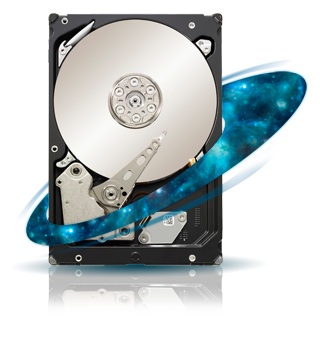
The quest for storage is almost a never ending saga. Dubbed the Constellation-ES, the replacement for the Seagate Barracuda-ES, the drive is expected to arrive later this year with a 7200 RPM rotation speed, and a 6Gbit/s SAS interface. A 1TB version of the 2.5" Barracuda-ES is also expected to arrive around the mid year point.
A 3TB drive would suggest an increase in maximum platter size, from the current 500GB limit. If you remember back that far, the increase in density was due to a change in bit alignment, from horizontal to vertical, to counter the superparamagnetic effect. Hitachi made an excellent and funny flash animation to describe the technology. The feeling is that the increase in platter size is an extension of that technology, rather than a new physical property being exploited.
Depending on how quickly these new hard drives hit the enterprise sector, we could see consumer 3TB hard drives by the end of the year as a positive estimate. However, 17GB/$ ($175 a unit) or a price comparable to current 2TB hard drives would be required for consumer market acceptance. Whether people require 3TB is another matter - video editors, professional photographers, or just for storing your movie and blu-ray collection are possibilities.


 Facebook
 Twitter
 RSS
RSS


23 Comments
View All Comments
pesos - Monday, May 10, 2010 - link
...instead of sas? as far as I know sas drives are maxing out around 600 GB these days, not 2 TB... or is this saying that we will go from 600 GB all the way to 3 TB in 2010?somedude1234 - Monday, May 10, 2010 - link
Disk vendors have been offering 7200 RPM enterprise SAS disks for a while now. Seagate offered the Barracuda ES.2 and now the Constellation ES in both SAS and SATA variants. As you can imagine, there is a slight price premium associated with the SAS versions over their SATA counterparts.The disk assembly is very much the same, you get the benefits of a dual-ported SAS interface (which helps in enterprise disk arrays).
eddyg17 - Monday, May 10, 2010 - link
The video animation is awesome.I cant wait for these new drivers to hit the market.. and drop the prices on current drivers,lol. 3TB is too much, I cant even fill up my 250GB drive.
MonkeyPaw - Monday, May 10, 2010 - link
Is it just me, or does anyone else get nervous about having up to 3tb of data on one big drive? Seems like a disaster in the waiting.jimhsu - Monday, May 10, 2010 - link
Now you see, I don't understand that line of thinking. Suppose you have two choices:1. Store 2 TB of data across 2 x 1 TB drives.
2. Store 2 TB of data on a 2 TB drive.
Assume that the per-device failure rates are the same (now I don't know how good of an approximation this is, but it's probably true for incremental series drives from the same manufacturer) Which is the safer option? I can't see any reason why you'd pick 1.
Navitron - Monday, May 10, 2010 - link
If everyone thought that way we would all be storing things on hundreds of 10GB hard drives. If all drives have the same chance to fail why split to 2 drives why not 5,10 or 200, then if one fails its not that big a deal :DTechnology needs to move forward. Bring on the 3TB drives.
jimhsu - Monday, May 10, 2010 - link
Yes, that was my point. Storing things on a single drive is less risky than storing it on any number of (un RAIDed) drives greater than 1, assuming that you treat any data loss as undesirable. And besides the point, you are making a backup (... right?) so your concern is not whether you get the data back, but how quickly you can get up and running again. A large drive simplifies this considerably.My advice totally changes if you are looking at performance though. Lots of small hard drives are GOOD for increasing IOPS.
zdzichu - Tuesday, May 11, 2010 - link
Both choices are flawed. Proper way is to store 2TB of data on 2x2TB drives.The0ne - Tuesday, May 11, 2010 - link
I believe the original post refers to the "risk" of losing so much data. The solution is NOT a bigger drive or MORE drives. the solution is BACKUP.SunSamurai - Saturday, May 15, 2010 - link
Huh? The solution is BACKUP on ONE BIG DRIVE, broseph. Thus what the other guy said; RAID1.