



ASUS G73Jh: Today's Top Gaming Laptop
by Jarred Walton on April 17, 2010 2:25 AM ESTG73Jh: Good Laptop LCDs Exist
Thankfully, the ASUS G73Jh doesn't succumb to the old flaw of stuffing a poor quality LCD into an otherwise great notebook. The 1080p panel in the G73Jh looks awesome, and the objective testing confirms our impression. It's not the brightest LCD we've ever used, and color gamut is only above average, but it's one of the highest contrast LCDs we've seen in a laptop.
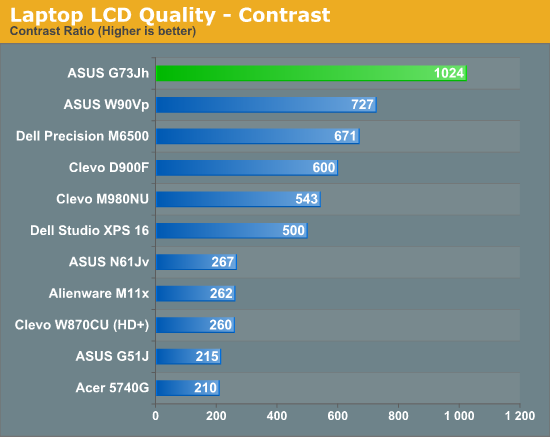
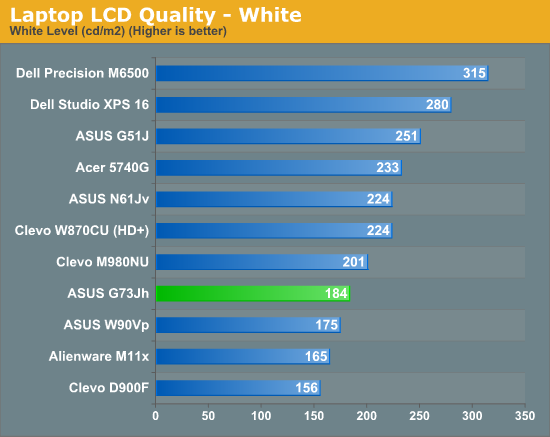
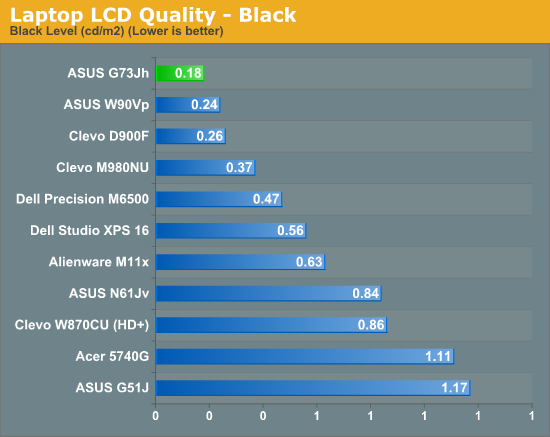
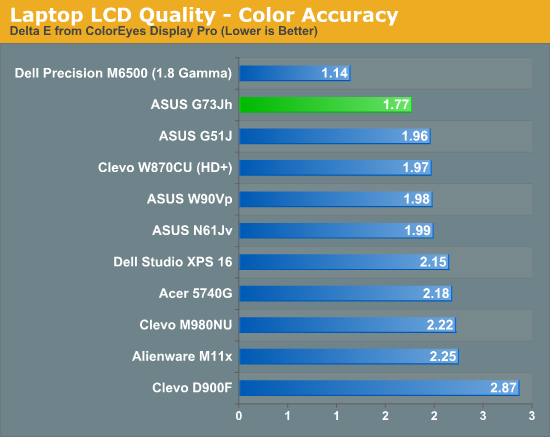
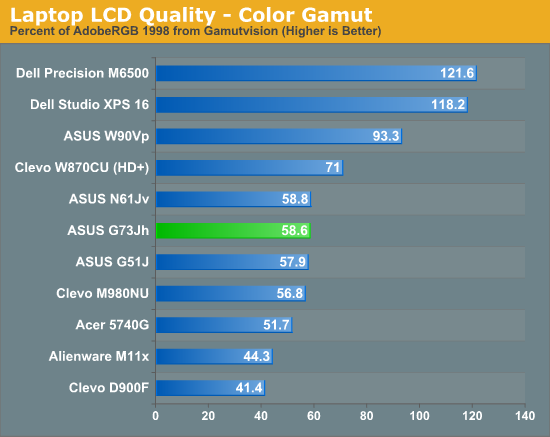
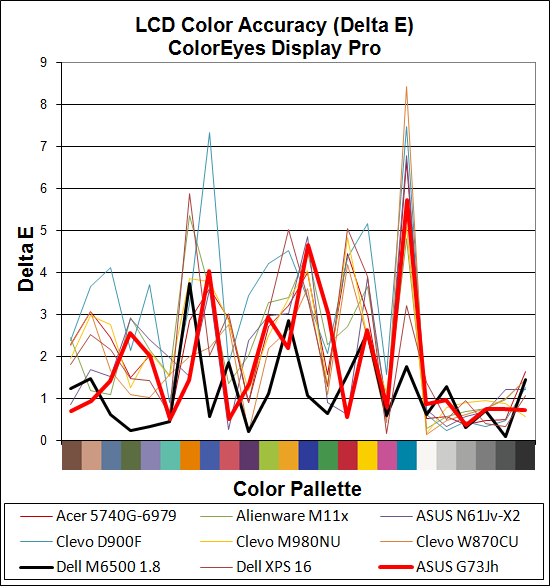
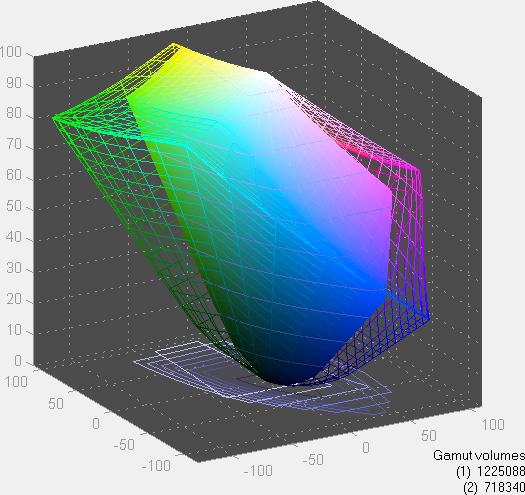
Some of you are going to wonder why the W870CU does so poorly, and it's simply a result of our test unit using an inferior HD+ (1600x900) LCD panel. Our understanding is that most (all?) of the W870CU 1080p panels are the exact same HannStar HSD173PUW1 that's in the G73Jh. That doesn't change the fact that the 17.3" panel looks great and performs better than most other laptop panels. The high water mark is still the RGB LED panel in the Dell M6500 (with a matte coating to sweeten the deal!), but RGB LED backlighting currently costs far more than WLEDs so you won't find that WUXGA panel in notebooks costing under $2000. The M6500 needed a target setting of 1.8 gamma before we could unlock its potential for color accuracy; we've tried a variety of settings on the other laptops and the best result on the G73Jh is still the default settings in ColorEyes Display Pro.


The viewing angles are still about the same as most other TN panels. From the side the display is easily viewable, but there's a narrow vertical range before you get severe color shifting. We'd love to see a 1080p equivalent of the IPS panel used in the iPad, but barring that we'll take a good high contrast TN panel over the junk shipping in most midrange laptops.


 Facebook
 Twitter
 RSS
RSS


72 Comments
View All Comments
ATC9001 - Saturday, April 17, 2010 - link
One thing I'd like to point out Jarred is that you didn't mention the G73's lack of hardware RAID support. This was actually the deal breaker for me. If a laptop is going to offer dual HDD's and is 17", it really needs to offer RAID. I was about to go with the W870CU, when I figured I could get a more portable (use on the couch) W860CU with nearly the same specs and price. Overall though it's a great laptop, but I think it needs to be dinged and noted that theres no RAID.I ended up building my own Clevo based W860CU...with the differences being 15.4", 4GB RAM, 128GB SSD, and i7 620m for the same price the reviewed model....now granted I do have to put it together, and if a reseller were to build it they'd charge ~1700-1800 or so.
coolsam2 - Saturday, April 17, 2010 - link
I would agree with you - but then I believe a better setup is SSD + Spindle HD.. You will beat the performance of the SSD, but won't need to worry about the data loss as in the case of RAID0.. The 750 2.5" HD is already out, right?coolsam2 - Saturday, April 17, 2010 - link
*I mean the SSD would beat the performance of the RAID.. I need to sleep!therealnickdanger - Sunday, April 18, 2010 - link
... Unless you RAID two SSDs... :)dvsman - Monday, April 19, 2010 - link
I had my 2 Samsung 256gb SSDs in RAID 0 in my Gateway FX P6831 and it was definitely fast BUT the problem I've come to discover is that RAID setups do not support TRIM / Garbage Collection whereas Win 7 will support these functions individually right out of the box. If you know anything about SSDs then you know TRIM / GC is essential.I've since split the pair to a SSD boot + conventional HD storage setup in my 2 laptops that support 2 drives (the gateway above and my newish Asus G51J). Plus it makes cloning (for restore or backup) alot easier. Try cloning a raid setup off of a laptop, its a A>B>C then C>A kinda thing that wastes your whole day!
chrnochime - Saturday, April 17, 2010 - link
I would think there's a fairly low number of people who would be using this laptop as gaming PC replacement AND do work on it at the same time(I doubt the games need RAID do they?). Those really dedicated to having their work safe with RAID would get a separate PC to deal with that just solely for work (if they don't have one put aside already), so you're probably amongst the very small minority who are bemoaning the lack of RAID here.Jeff7181 - Monday, April 19, 2010 - link
RAID will not make your work safe. If you're worried about your work being safe you should be doing regular backups, not relying on RAID 1 as data is written in real time to both drives. RAID 1 only helps protect against data loss due to hardware failure. As I said, if you're that concerned about the integrity if your data, you better have a backup and then you may as well just put the drives in RAID 0 and get the performance increase.arkcom - Saturday, April 17, 2010 - link
Raid was the deal breaker, yet you didn't even use it in your build?coolsam2 - Saturday, April 17, 2010 - link
Just sold my Asus G51vx-a1 and might jump into this.. I hated the 'hotness' of the G51 with all the undervolting etc. etc. it was still very hot.. i'm pleased to read this runs a lot cooler (could have used some direct numbers or charts though).. might just get rid of my desktop with a 4870x2.Anyways I do have one recommendation and a very fair one - Can we get comparisons @ 1920*1200? Many of us are going to replace our desktops with this which doesn't necessarily mean replace the nice LCDs we all have. I would have this laptop (if I owned one) hooked up to the 24" LCD and run games at 1920*1200. It's sad that they won't do 1200p on laptops and 1080p is becoming more of the standard. I've a Dell Studio 1537 with a 1920*1200 CCFL and still I decided to get rid of the G51 and keep my Dell - for some people screen estate is just that important..
except for the missing data on temps (or did I miss it) excellent article.
ATC9001 - Saturday, April 17, 2010 - link
It's hard to do a fair comparison since mobile CPU's often difficult or the reviews are done with CPU's faster than the mobile counterpart (which is to be expected). But here's a review comparing the desktop 5770 (basically 5870m) and your desktop 4870X2...your X2 is obviously faster...http://www.anandtech.com/show/2856
Putting an SSD is smart I agree, but for me as a gamer, I want RAID'd SSD's! I can Tony Trim the drives when I want as well, and I think very soon if not already Intel may have a solution for TRIM'd arrays.
This is still a great laptop, but that I'm a RAID junky.