



Internet Explorer 9 Platform Preview: Investigated
by Brian Klug on March 17, 2010 11:44 AM EST- Posted in
- Trade Shows
Yesterday, Microsoft launched the Internet Explorer 9 Platform Preview at MIX10. Though the current release of the platform preview is very rough around the edges, it promises to bring Internet Explorer into full web standards compliance, partially erasing the web-standard scourge that IE 6 still scandalizes on the internet. Some of the biggest applause-drawing moments happened when IE team members themselves mentioned how important rapid migration away from IE 6 is. What that means is W3C compliance is a very real and important goal, including complete support for HTML5, CSS3, SVG, XHTML, and H.264/MPEG4 HTML5 <video> playback. At the same time, Microsoft hopes to gain valuable insight from web developers about what direction the IE team should take.
JavaScript Performance
But some of the strongest focus of the IE9 platform preview is targeted towards raising the so-called "glass ceiling" on web browsing performance. Microsoft hopes to drive that performance cap higher half through GPU-acceleration for rendering 2D, 3D, and HTML <video> content, and the other half through an entirely new multithreaded JavaScript engine codenamed "Chakra."
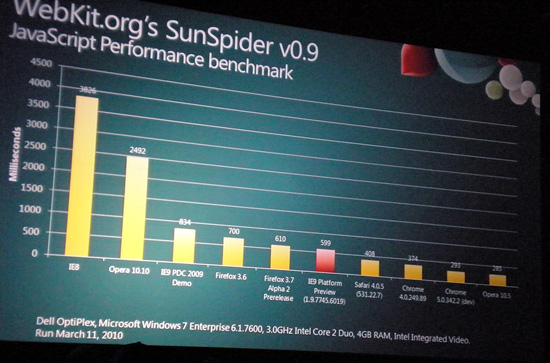
Microsoft provided a number of slides comparing JavaScript performance of IE 9 in its current preview, and claims it's at party with Firefox 3.6 and nearly as good as Chrome 4.0.249.89 (stable) tested with SunSpider 0.9:
I initially attempted to validate and reproduce these results on my Latitude XT, and saw something very strange:
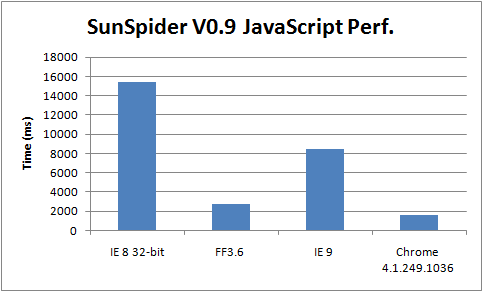
I ran and re-ran the test several times; for whatever reason, IE 9 Platform Preview doesn't like my Latitude XT running Windows 7 with a Core 2 Duo U7600 with 3 GB of RAM. Puzzled by the discrepancy, I ran the same tests on another computer running Windows Server 2008 R2 with a Celeron E3400 2.6 GHz with 4 GB of RAM. This CPU is essentially a Core 2 Duo with just 1 MB of L2 cache.
The results were much better:
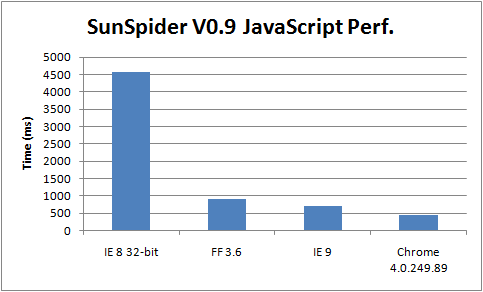
I realize there's a slight discrepancy between the builds of Chrome on each test bed, however the JavaScript engine itself remains relatively unchanged; performance is on a nearly identical level. Obviously, something on the notebook hinders IE 9's performance dramatically.
Another interesting benchmark we considered was how well IE 9's codename "Chakra" JavaScript engine scales per thread. I was in the process of firing up IE 9 platform preview again to evaluate SunSpider results with different processor affinities toggled, when I was greeted with this:
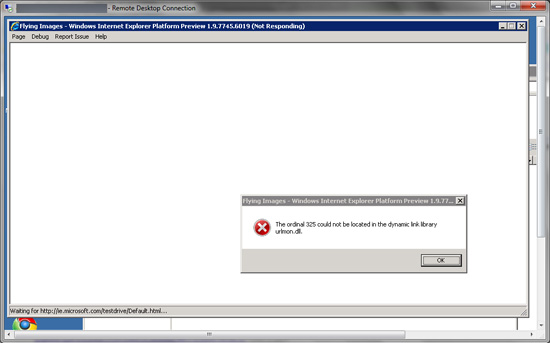
Uh oh
Considering how early of a preview this is, it's completely understandable that not everything is working properly across every system configuration. I've submitted feedback and a bug report, and plan on continuing to investigate the discrepancy.
It's important to note that IE9 in its current form isn't really a beta, it's somewhere between an alpha and a beta. Microsoft describes this release as "just enough of a slice of the browser" to both let web developers and designers try the new rendering engine, flesh out what HTML5 markup is most favored, and start to get feedback flowing. There's nothing in the way of a back button, tabs, address bar, or favorites. It's just a barebones Trident-wrapper that gives a relatively complete perspective on the direction Microsoft hopes to take IE. They promise to adhere to a strict eight-week schedule for updating the platform with improvements, addressing issues at each step, and increasing their Acid3 score every step of the way. More on that later.
Initial Perspective
But enough with that, let's take a look at it by loading anandtech.com:
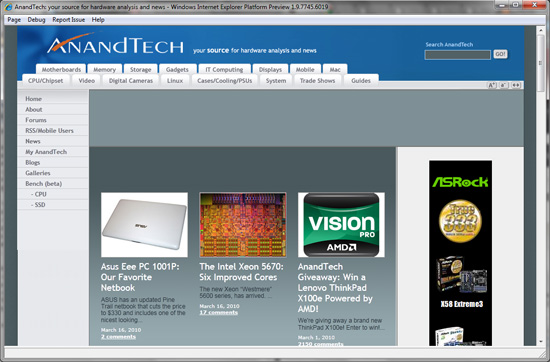
It throws an error about scripts; again, there are bound to be problems given the massive rewrite of the JavaScript engine, but otherwise it seems to run. Other than that, yeah, the UI exactly what you see: totally bare-bones. Control-O for opening an address, and F10 for home will get a lot of use if you decide to try this preview out. As mentioned earlier, there's no back button or keyboard shortcut for it at all.


 Facebook
 Twitter
 RSS
RSS


60 Comments
View All Comments
opalfroot - Monday, March 22, 2010 - link
I find it hard to get excited about something like this - I mean since ie6 MS has been the cause of most web developer's headaches. I mean this should have been ie7 - now we all have to wait for ie6, 7 and 8 to die before we can utilise these 'new' capabilities on a global scale.Its no wonder people lose faith in companies like MS - for years they have failed to deliver anything close to a good browser and now all of a sudden they expect us to whoop over what the open source community gave is 5+ years ago .
Performance might be something but so too is backwards compatability - everything upto windows 7 (default browser) will not be able to take advantage of the new capabilities and as MS knows the majority of people dont go looking for an alternative .
Being sinical - this is nothing short of a PR stunt to in the wake of being forced to openly advertise alternatives.
opalfroot - Monday, March 22, 2010 - link
Great all the features developers wanted ...5 years ago.If we want to take advantage of these already supported features in FF, Chrome, Opera etc we have to wait for ie7 and 8 to die ...great
bobbozzo - Friday, March 19, 2010 - link
If MS were actually serious about migrating everyone off of IE6, they'd release a new IE for Windows 2000.piasabird - Friday, March 19, 2010 - link
Every time Microsoft releases a browser more programs fail to work. They just dont get it. People want stability and backwards compatability. We dont need a new browser every 5 minutes that doesnt work with standard code.I wait with baited breath.
AssBall - Saturday, March 20, 2010 - link
Do you use worms or lures?*Bated
minime - Thursday, March 18, 2010 - link
It's that simple. Doesn't matter how fast IE9 is going to be.ashtonmartin - Thursday, March 18, 2010 - link
The Acid test is stupid and I wonder why review sites even bother with it. Just because you get a higher score on the test doesn't mean you can render webpages better. IE which scores lowest on the test will render more pages correctly than either firefox or chrome, especially pages that use aspx.Stas - Thursday, March 18, 2010 - link
I've been using Opera for the past 4 years, and always felt like it was a superior browser (smaller, faster, more options, tweaks, settings, features out of the box). Good to see how my assumptions are backed by the test results :)P.S. At work I use FF with about 7 extensions because of my coworker that refuses to use anything else. It's always up-to-date and tweaked. My home backup browser is Chrome - very fast (on par with Opera 10.5), but lucks in interface and functionality for me personally (plus it seems to have MORE issues with displaying websites correctly than other browsers). And I always user IE 7/8 on clients' machines. So I'm not prejudice, and I know and actively use other browsers. The only one I stay away from is Safari. It's huge, it's slow, it breaks pages all the time. Apple is Apple, and I know better than to use their products :)
Thanks for the article!
vailr - Thursday, March 18, 2010 - link
Wonder if Microsoft might also consider making an IE9 version for OSX 10.6, as well as for Windows 7 & Vista?Maybe even get over their longtime disagreement with Sun (now owned by Oracle) and include the latest Java version within Windows 7?
Xenoterranos - Thursday, March 18, 2010 - link
That bare bones shot looks exactly like my stripped down version of FF at work :)