



ASUS M4A89GTD Pro - A Core Unlocking 890GX for $140
by Rajinder Gill on March 10, 2010 12:00 AM EST- Posted in
- Motherboards
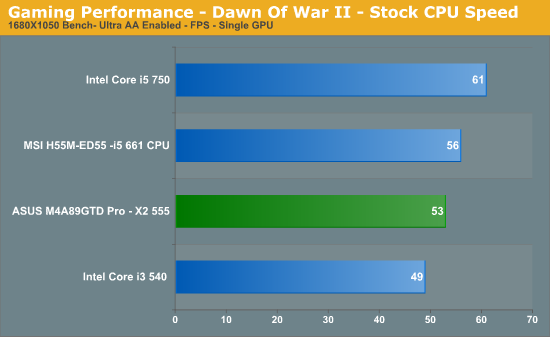
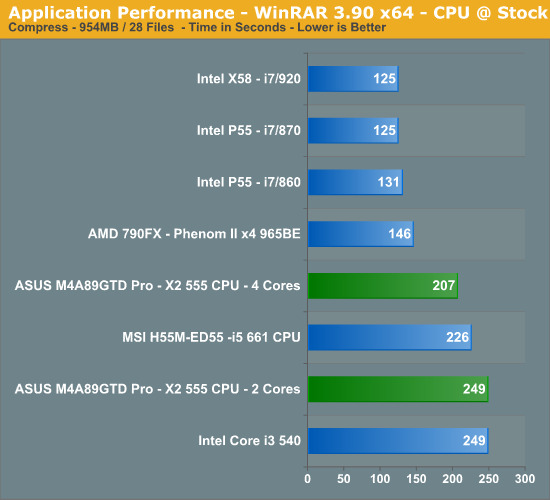
The gaming/performance figures tell a familiar story:
Power Consumption
Our power consumption testing utilizes the same batch of components under similar circumstances in a bid to monitor variances between idle and CPU load conditions. We install the vendor supplied power saving utilities on each board and enable power saving modes that don't involve any kind of underclocking or CPU core frequency modulation in order to run an apples to apples comparison.
ATX PSU switching losses are absent from our figures because we monitor power consumption directly at the DC rails of the PSU. Total system power consumption will vary depending upon the efficiency of your PSU.
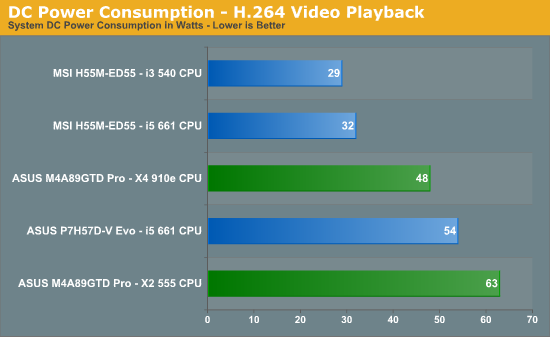
While AMD processors can’t keep up with Intel’s for power consumption, the M4A89GTD Pro turns in a respectable performance against ASUS’s ATX sized Intel equivalent P7H57D-V Evo. The X2 555 falters slightly in these tests due to a high stock VID of 1.35V. The soon to be released X4 910e operates at 2.6GHz with 4 cores with a 65w TDP hence the lower consumption numbers.
You can under-volt the X2 555 somewhat to reduce its power draw, although we found our sample was not capable of running at 3.2GHz at a VID lower than 1.25V. As a quick experiment, we overclocked the 910e to 3.2GHz whilst maintaining a 1.15V VID and it came through our benchmark suite without a problem - whilst pulling only a few extra watts of power. The X4 910e is definitely a superlative bin.
DPC Audio Latency
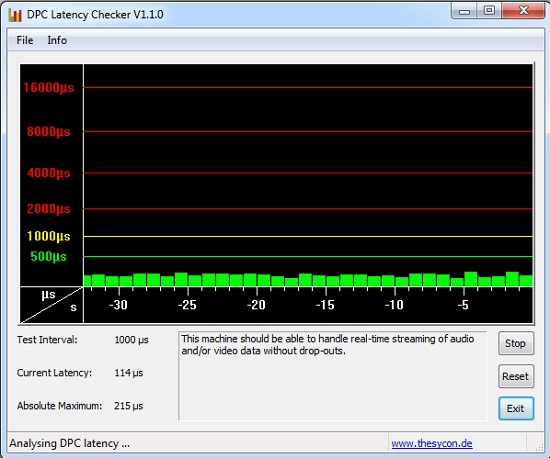
We’re often asked to include a DPC latency screenshot by audio enthusiasts, here’s what the M4A89GTD Pro manages:
Overclocking
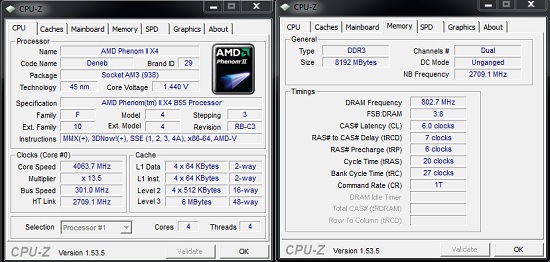
Although we managed to hit target frequencies with all of our processors, the most exciting processor to overclock out of the bunch was the X2 555. Unlocked to 4 cores, we ended up with a stable 301 base clock; a shade over the 4GHz mark running 8GB of our Corsair Dominator GT’s @ CAS 6-7-6-20 1T DDR3-1604MHz:
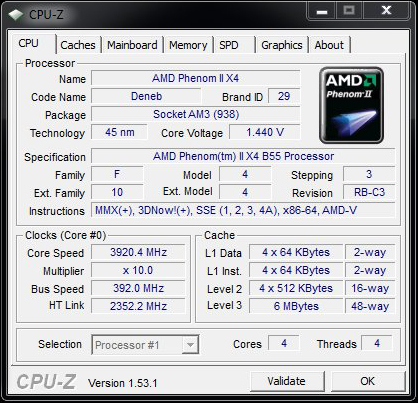
For those that like to benchmark and chase numbers for fun, base clocks up to 390MHz are possible if you use Turbo-V to increase bus speed within Windows (POST maximum up appears to be limited around 370 MHz).
It’s a pretty good show from ASUS considering the Hyper modules are rather picky about operating parameters on this motherboard. Using more ‘realistic’ modules, expect to see 4GB maximums fall in the region of DDR3-1800~1900 MHz at CAS 8, while good 8GB kits should hit the DDR3-1800MHz mark on the 0402 BIOS.


 Facebook
 Twitter
 RSS
RSS


46 Comments
View All Comments
ReaM - Friday, March 26, 2010 - link
I don't know why you people say "I don't like AMD"Now tell me, have you ever been satisfied with intel's performance? I have never been. Since my 1400 thunderbird :P I am with AMD. Unlike the p4 3000 Northwood, it did not have fps drops in counter strike. I had to overclock the northwood to 3.4 to play it decently.
Then I had a Venice 3000+ that would run at 2.8ghz from 1.8 base. I still have it.
And still today, in games AMD beats the more expensive i5 750. How many of the market will use i5 750's benefits? Almost noone! People really need to look and see that the best bang for buck is AMD. Cheap Boards, Cheap CPUs, and in summer RAM prices are expected to drop. It will be a 200 dolla upgrade to a quadcore if you have PSU and a case already.
I have just bought i7 860 yesterday (i got it real cheap, I wanted the 920) with p55m ud2 Gigabyte and gskill 4gb 1600 cl7 ONLY because I need the render faster in Maya. I just have no choice here, because AMD does not seem to be the renderer's choice.
It is bad to have no choice, because there is not direct competition between the two, but often I do not understand why many mainstream people get i7 920 for gaming. Because they don't care how much they spend?
I am also forced to choose Quadro over FireGL, but that's another story. Radeon since 4xxx series is SICK!!! I love ATI and AMD.
You should not hate AMD, cmon
But for mainstream user, why i5? Way too expensive
butdoesitwork - Thursday, March 11, 2010 - link
Forget speed. Is it safe to be an early adopter?1. Does the Linux kernel support this chipset at all yet? Does it need any special boot parameters to work at all? e.g. Do I need to forcibly disable MSI again?
2. How _well_ does it work? If you copy files over these new-fangled SB850 SATA ports, does it get there correctly? e.g. can you do a linux "diff" to prove that it isn't broken? Are there any strange messages in /var/log/messages?
Been bitten by this too often in the past. Most recently the cheap JMicron SATA-to-USB bridges found in most external enclosures often caused bus resets and data corruption. May have just hit a similar problem with my board's JMicron eSATA port.
Taft12 - Thursday, March 11, 2010 - link
As a Linux user you should be well aware by now that it's never safe to be an early adopter.Check the changelogs of the newest kernels.
Rajinder Gill - Thursday, March 11, 2010 - link
I have not tested Linux on this platform yet - I find things need a while to settle before everything works properly (that goes for all operating systems). I might give things a whirl on our next review depending upon time constraints. For this article we tested platform compatibility with Windows 7 and found the big problem was with the Sharkoon QuickPort (LucidPort perhaps, although its still up in the air).Regards
Raja
AceKing - Wednesday, November 10, 2010 - link
So has anyone tested this with Linux yet? I'm curious to know if there has been any problems. I see the last post on this was in March, which was 7 months ago.bji - Friday, November 19, 2010 - link
I own one, and it works perfectly in Linux. Onboard video and audio are flawless and well supported in Xorg (no xorg.conf even needed) and ALSA (easy alsaconf setup). I use a Phenom II 1075T and man does it fly. I primarily do software development and 6 thread compiles are just so fast. Even faster than the much more expensive 4 core hyperthreaded Xeon that I have at work.The board does do this weird thing where if you power it off before the OS has shut it down completely, when you power it back on it thinks that you have an overclocking problem (probably detects an incomplete shutdown and assumes bad overclocking) and requires going into the BIOS and back out to continue the boot. And I don't have any overclocking enabled at all, I just manually set the timings for my memory because the defaults were not right.
I disable the JMicron SATA RAID and IDE controller though as I don't need them and I never trust anything that JMicron makes. Nor should you.
caraway - Tuesday, November 30, 2010 - link
Which kernel and distribution are you using?GeorgeH - Wednesday, March 10, 2010 - link
Measuring DC power consumption as opposed to AC is a very welcome improvement - hopefully this is Anandtech's new SOP for all reviews.The only question I think you should make clear (or clearer, with apologies if I missed it) is if you're measuring and summing the DC power across all of the rails or just on a select few; i.e. are you including HDD, ODD, GPU PCIE, and fan connections in the power consumption figures?
Rajinder Gill - Wednesday, March 10, 2010 - link
Hi,I'm not adding HDD's/DVD peripherals into the figures. The power figures shown are from all 4 rails - EPS 12V, ATX 12V, 5v and 3.3v. The CPU fan consumption is about 2w and left in. I can make things lot more granular than I have here - but I figure what we're providing at present is enough for reviews like this, unless concentrating on specific areas of consumption (which may be called for at some point).
regards
Raja
GeorgeH - Thursday, March 11, 2010 - link
I saw that in the 980X article - tell Anand you need a raise.