



AMD’s Radeon HD 5450: The Next Step In HTPC Video Cards
by Ryan Smith on February 4, 2010 12:00 AM EST- Posted in
- GPUs
Meet the Sapphire 5450
Along with our reference card from AMD, Sapphire also sent in their near-reference 5450. As it was clocked correctly at 650MHz/800MHz, we were able to use this card to benchmark the 5450 at its proper clocks, so we’d like to thank Sapphire for sending this in.
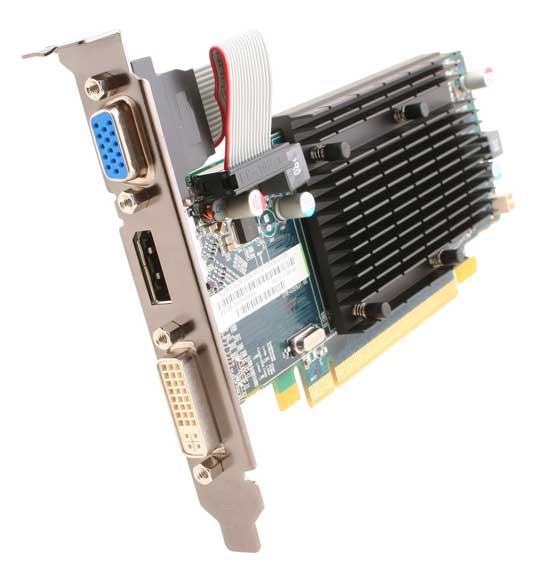
The Sapphire 5450 is nearly identical to AMD’s reference card. It uses the same PCB and the same port configuration, and the RAM chips are the appropriate 800MHz Samsung DDR3 chips. The key difference between the two cards is that while AMD is using a double-wide heatsink, the Sapphire 5450 is using a smaller single-wide heatsink. This means that the Sapphire 5450 will fit in to cases where only a single slot’s worth of space is available below the card.
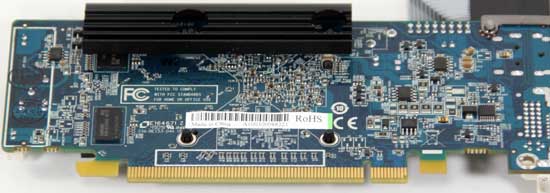
However on the flip side (in all senses of the word) Sapphire’s heatsink wraps around the card slightly, which results in it sticking up from the back side of the card. Technically speaking the heatsink is encroaching on the space that belongs to the card above it, so the Sapphire card won’t fit if there’s a card more than 2 inches long in the slot above it, or if there are tall motherboard components there. In our case it encroached on the audio riser card for our Rampage II Extreme Motherboard. This shouldn’t be a problem for the vast majority of users and is more compatible than a card with a double-wide heatsink, but nevertheless check your case to make sure there’s room for the heatsink on the back side of the card.
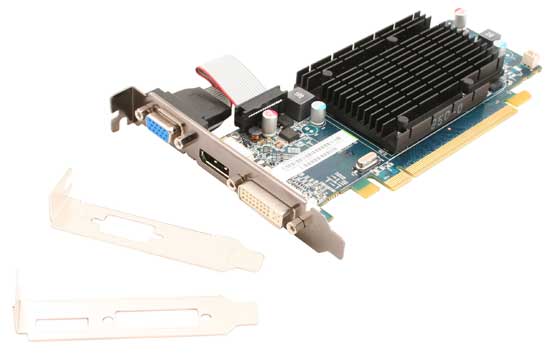
As is usually the case with bottom-tier cards, Sapphire packs the 5450 with very little. It comes with a driver CD, the low-profile brackets for the card (it ships with the full-profile bracket installed), an instruction manual, and ArcSoft’s SimHD plugin for upconverting video conferencing feeds. Surprisingly, all of this comes in a full-sized box – this is the first sub-$100 card we’ve seen in some time to not come in a mini-box.
Sapphire also sent along their entire 5450 product chart. Of note, they will be releasing DDR2 and DDR3 cards with HDMI ports that are otherwise identical to today's DisplayPort card, so HTPC users will not be left out in the cold.


 Facebook
 Twitter
 RSS
RSS


77 Comments
View All Comments
Purri - Monday, March 8, 2010 - link
Ok, so i read a lot of comments that the cheap passive DP-Adapters wont work for a EyeFinity 3 Monitor setup.But, can i use this card for a 3 monitor windows-desktop setup without eyefinity - or do i need an expensive adapter for this too?
I'm looking for a cheapish, passivly(silent) cooled card that supports 3 monitors for windows applications, that has enough performance to play a few old games now and then (like quake3) on 1 monitor.
Will this card work?
waqarshigri - Wednesday, December 4, 2013 - link
yes of course it has amd eyefinity technology .... i played new games on it like nfs run,call of duty MW3, battlefield 3,plopke - Friday, February 5, 2010 - link
:o what about the 5830 , wasn't it delayed until the 5th. It is suddenly very quiet about it on all techsite. And not launched today.yyrkoon - Thursday, February 4, 2010 - link
Your charts are all buggered up. Just looking over the charts, in Crysis: Warhead, you test the nvidia 9600GT for performance. Ok fine. Then we move a long to the Power consumption charts, and you omit the 9600GT for the 9500GT ? Better still, we move to both heat tests, and both of these card are omitted.WTH ?! Come on guys, is there something wrong with a bit of consistency ?
Ryan Smith - Friday, February 5, 2010 - link
Some of those cards are out of Anand's personal collection, and I don't have a matching card. We have near-identical hardware that produces the same performance numbers; however we can't replicate the power/noise/temperature data due to differences in cases and environment.So I can put his cards in our performance tests, but I can't use his cards for power/temp/noise testing. It's not perfect, but it allows us to bring you the most data we can.
yyrkoon - Friday, February 5, 2010 - link
Well, the only real gripe that I have here is that I actually own a 9600GT. Since we moved last year, and are completely off grid ( solar / wind ), I would have liked to compare power consumption between the two. Without having to actually buy something to find out.Oh well, nothing can be done about it now I suppose.
I can say however that a 9600GT in a P35 system with a Core 2 E6550, 4GB of ram, and 4 Seagate barracudas uses ~167-168W idle. While gaming, the most CPU/GPU intensive games for me were world in conflict, and Hellgate: London. The two games "sucked down" 220-227W at the wall. This system was also moderately over clocked to get the memory and "FSB" at 1:1. Also these numbers are pretty close, but not super accurate, But as close as I can come eyeballing a kill-a-watt while trying to create a few numbers. The power supply was an 80Plus 500W variant. Manufactured by Seasonic if anyone must know( Antec EarthWATTS 500 ).
yyrkoon - Friday, February 5, 2010 - link
Ah I forgot. The numbers I gave for the "complete" system at the wall included powering a 19" WS LCD that consistently uses 23W.dagamer34 - Thursday, February 4, 2010 - link
Where's the low-profile 5650?? I don't want to downgrade my 4650 to a 5450 just for HD bitstreaming. =/Roy2001 - Thursday, February 4, 2010 - link
Video game is on XBOX360 and Wii, so i3-530 for $117 is a better solution for me. It supports bitstream through HDMI too. My 2 cents.Taft12 - Thursday, February 4, 2010 - link
I apologize if this has been confirmed already, but does this mean we won't see a chip from ATI that falls between 5450 and 5670?There were four GPUs in this range last gen (4350, 4550, 4650, 4670)