



Last year Lucidlogix came to us with a rather amazing claim: we can do multi-GPU better than the guys who make the video cards in the first place. Through their Hydra technology, Lucid could intercept OpenGL and DirectX API calls, redistribute objects to multiple video cards, and then combine the results into a single video frame. This could be done with dissimilar cards from the same company, even different companies altogether. It would be multi-GPU rendering, but not as you currently know it.
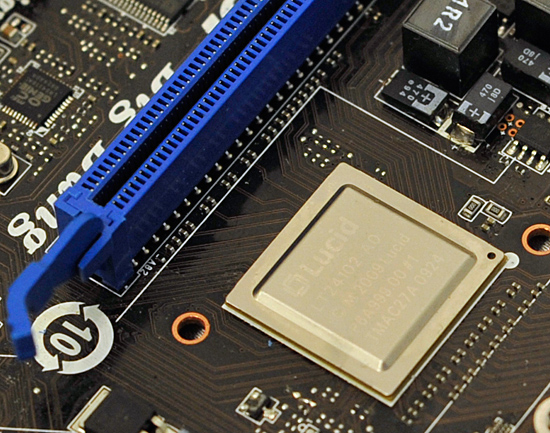
That was in August of 2008, when the company was first showcasing its technologies in hopes of finding a suitor. In 2009 they found that suitor in MSI, who are anchoring their new high-end Big Bang line of motherboards with the Hydra. After some bumps along the way, Lucid and MSI are finally ready to launch the first Hydra-equipped board: The Big Bang Fuzion.
We’ve had the Fuzion in our hands for over a month now, as the hardware has been ready well ahead of the software. Lucid has been continuing to develop the software side, and the two parties are finally ready to sign off on the finished product, although Hydra is still very much a work in progress.
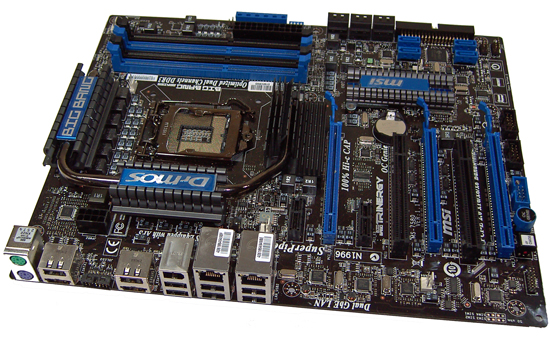
The Big Bang Trinergy, the Fuzion's identical twin
As we’re currently in Las Vegas for CES (where MSI is launching the Fuzion), today we’ll be taking a quick look at the performance and compatibility of the Hydra, to answer the most burning of questions about the technology. Once we’re back from CES, we will be following that up with an in-depth look at image quality, edge cases, and other deeper issues. We’ve only had the newest drivers for a few days now, so we haven’t had a chance to give it a complete workover.
Finally, this is just a look at the Hydra technology itself. We’ll have a separate review of the Fuzion board as a motherboard at a later time. However it’s virtually identical to MSI’s other Big Bang board, the NVIDIA NF200-equipped Trinergy. The only significant difference between the boards is that the Fuzion has the Hydra chip, while the Trinergy has the NF200.
With that out of the way, let’s get started.


 Facebook
 Twitter
 RSS
RSS


47 Comments
View All Comments
liveonc - Tuesday, March 23, 2010 - link
Hydra is still pretty raw, but can it be the One Chip to rule them all, One Chip to find them, One Chip to bring them all and in the darkness bind them In the Land of Mordor where the Shadows lie? CPU, GPU, GPGPU wars comming to a standstill, where it doesn't matter if you use an Intel, AMD, Nvidia or Ati.Focher - Wednesday, January 13, 2010 - link
I think people should really give Lucid their due in regards to proving the underlying concept - that it is feasible to deliver mixed frame rendering in real time. Granted, the technology still seems immature but one has to remember that AMD and NVIDIA have both rejected the approach at this point.I'm still prepared to wait and see how the technology - and not just the current approach from Lucid - evolves. For example, perhaps AMD and NVIDIA will put some RnD efforts into multi-GPU cards that are better equipped at mixed frame rendering. Having it all on the same board could alleviate some of the bottlenecks.
Baron Fel - Sunday, January 10, 2010 - link
Crysis has a 91 at Metacritic and sold millions.Just wanted to point that out.
x86 64 - Saturday, January 9, 2010 - link
I thought the Hydra didn't do SLI\CF through software? I thought that was one of the main benefits of Hydra, no software profiles were needed. The preliminary results you guys posted are less than impressive. Not to sound like a pessimist but I figured it was too good to be true.Focher - Wednesday, January 13, 2010 - link
I think the term "profiles" isn't appropriate, as the review suggests it's more of a whitelist than any type of profile with customized settings for the specific game.prophet001 - Friday, January 8, 2010 - link
The implications of this technology are tremendous. I'm rather surprised at people brushing it off. It is fledgling and will obviously need some work but they will be able to do some really neat things once this matures. I'm thinking GPU farm via external PCI-E.hyvonen - Friday, January 8, 2010 - link
"We’ll start with Call of Juarez, which is one of the Hydra’s better titles. With our 5850s in Crossfire, we get 94fps, which is just less than double the performance of a single 5850 (49.5)."Don't mean "... we get 94fps, which is more than double the performance of a single 5850 (49.5)."
Or, on other words, WFT happened - how do you get more than double the performance with CF?!?!? Something got messed up in your test here, bro.
Veerappan - Friday, January 8, 2010 - link
Read it again... He's saying that the 94fps that they got is just slightly LESS THAN double 49.5 fps. So if a single 5850 gets 49.5 fps, double that is 99 fps.They got 94 fps, which is just a little bit less than 99.
jmurbank - Friday, January 8, 2010 - link
To me Lucid got something going but they should have done it differently. If they created the Hydra chip to be an on-board graphics chip and dispatcher, things will be different. Right now all they have is a dispatcher chip that uses a discrete graphics card to output video which makes it have multiple bottlenecks. It will be better if the Hydra output the graphics on on its own through its own display port while all the processing is done by the discrete graphics cards using stream processing technology like CAL (ATI) and CUDA (nVidia).Of course bad drivers screws up everything. Have look at ATI's history. ATI still makes poor software, but people do not mind. It seems people care more about performance than reliable and stable drivers. I care more about reliable and stable drivers, so it screws up my day if my computer crashes because of a driver.
beginner99 - Friday, January 8, 2010 - link
The worst thing you can do is promise stuff you can't deliver. it's sad. After these first benchmark, the tech will just have a bad reputation even if it will get better over time. Intel way would have been better. Just don't release it at all if it's an underperformer.I do see that it must we extremly complex to get this running at all. So it's actually quite an achievment but it's similar to cars. Combustion engines have been optimized during the last 100 years. No wonder no new technology can compete.
Maybe in 1-2 years this will be usable. If lucid is still alive then...Don't believe many will buy this board.
I also was rather suprised about CF. Used to be quite bad too as I remember? Probably due to a driver update? And how nows what nvidia or ATI is doing in there drivers. I assume they could put in stuff to cripple hydra on purpose.