



Intel X25-M SSD: Intel Delivers One of the World's Fastest Drives
by Anand Lal Shimpi on September 8, 2008 4:00 PM EST- Posted in
- Storage
Real World Performance with PCMark Vantage
Next up is PCMark Vantage, another system-wide performance suite. I chose to run the whole suite rather than just the HDD test to hopefully better characterize real world performance of these drives.
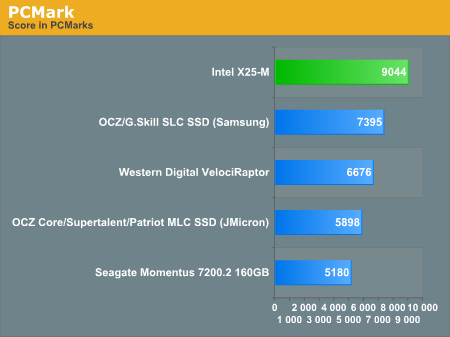
If we look at the individual test subsets of PCMark Vantage we can see the drive's strengths at work.
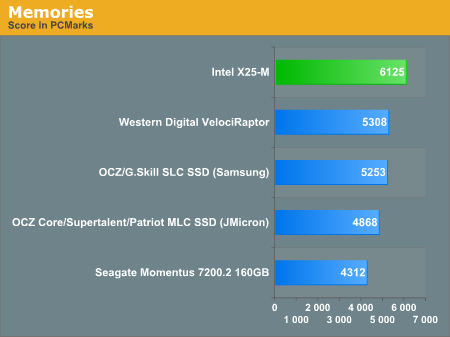
The memories suite for example includes a test involving importing pictures into Windows Photo Gallery and editing them, a fairly benign task that easily falls into the category of being very influenced by disk performance. The end result is a 15% performance advantage over the VelociRaptor, a 16.6% advantage over the Samsung SLC based SSDs and a 42% advantage over the 2.5" Seagate Momentus 7200.2 HDD - the X25-M is great for a desktop, but a miracle for a notebook.
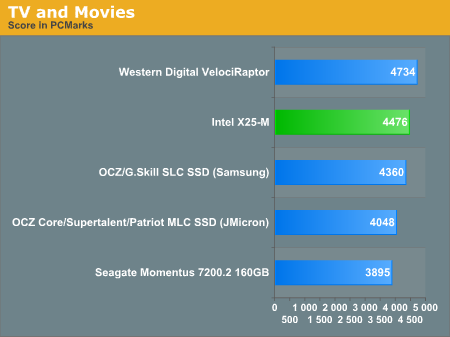
The TV and Movies suite shows that the X25-M won't always dominate. Here the tests are focused on video transcoding which is mostly CPU bound, but one of the tests involves Windows Media Center which tends to be disk bound. Despite the nature of the test, the X25-M competes at the top of the chart but is bested by the VelociRaptor. It's performance isn't bad, but not earth shattering. Again, compared to other notebook drives it is a dream come true.
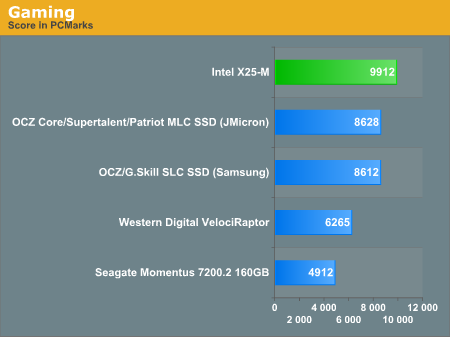
The gaming tests are very well suited to SSDs since they spend a good portion of their time focusing on reading textures and loading level data. All of the SSDs dominate here, but as you'll see later on in my gaming tests the benefits of an SSD really vary depend on the game. Take these results as a best case scenario of what can happen, not the norm. You can also see how tempting it is to opt for one of those JMicron based MLC SSDs, they perform quite well here - the test simply doesn't show the ugly side of living with them.
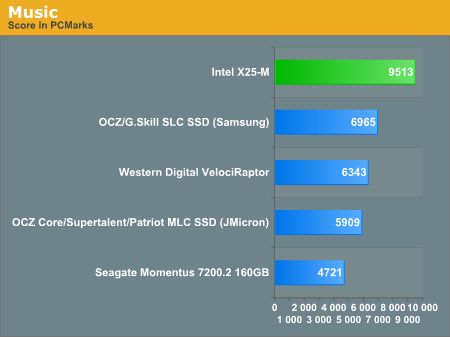
We're back to utter domination in the Vantage Music test. Here the main test is a multitasking scenario, which SSDs do quite well in: the test simulates surfing the web in IE7, transcoding an audio file and adding music to Windows Media Player (the most disk intensive portion of the test). The X25-M is nearly 60% faster than the VelociRaptor, around twice the speed of the Seagate Momentus 7200.2 and over 37% faster than the Samsung SLC based SSDs. When the X25-M is fast, it's very fast.
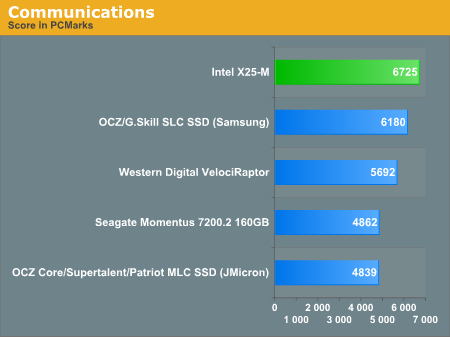
The Communications suite is made up of two tests, both involving light multitasking. The first test simulates data encryption/decryption while running message rules in Windows Mail. The second test simulates web surfing (including opening/closing tabs) in IE7, data decryption and running Windows Defender.
Despite the inclusion of Windows Defender, the X25-M's advantage over the VelociRaptor is only 18%. I would honestly expect more based on some of my other system scanning tests, but I believe the reason we're seeing general domination and not utter destruction is that the tasks being run alongside Windows Defender are quite light on the disk. Yes, I am nitpicking an 18% victory - this drive is that good. The SLC drives do well here but are no match for the X25-M. It's in tests like this that the X25-M really earns its keep, it delivers SLC performance at a much lower cost.
The Productivity test is awesome, let me explain:
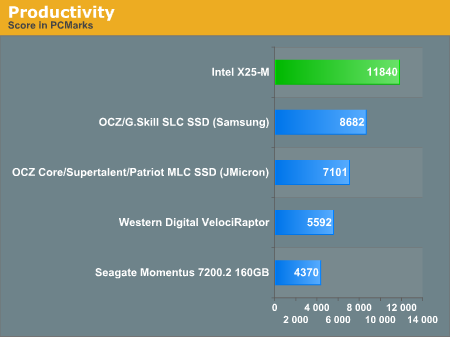
In this test there are four tasks going on at once, searching through Windows contacts, searching through Windows Mail, browsing multiple webpages in IE7 and loading applications. This is as real world of a scenario as you get and it happens to be representative of one of the most frustrating HDD usage models - trying to do multiple things at once. There's nothing more annoying than trying to launch a simple application while you're doing other things in the background and have the load take seemingly forever.
Note that the test itself isn't very write intensive, so even the JMF602 based MLC drives do well here. I can attest to this as one of the things that drove me to put a SSD in my desktop was that I wanted my applications to pop up instantaneously, regardless of what I was doing. The pausing doesn't get a chance to rear its head, so all of the SSDs rule the playing field here. The X25-M delivers 2x the performance of the VelociRaptor here and is faster than every other drive. Enough said.


 Facebook
 Twitter
 RSS
RSS


96 Comments
View All Comments
Alleniv - Wednesday, August 19, 2009 - link
Hi all,I report this new review about X25-M, that takes in consideration a comparative with other SSDs and also with HDDs, with several benchmarks ? http://www.informaticaeasy.net/le-mi...m-da-80gb.h...">http://www.informaticaeasy.net/le-mi...m-da-80gb.h...
Bytales - Saturday, January 3, 2009 - link
You said this: For example, let's say you download a 2MB file to your band new, never been used SSD, which gets saved to blocks 10, 11, 12 and 13. You realize you downloaded the wrong file and delete it, then go off to download the right file. Rather than write the new file to blocks 10, 11, 12 and 13, the flash controller will write to blocks 14, 15, 16 and 17. In fact, those four blocks won't get used again until every other block on the drive has been written to onceBy this i understand that a bigger capacity SSD, for instance 320 vs 160 will have more blocks and hence you will need more writes to deplete the number a write cycles the SSD was designed for. So for SSD bigger means even longer lasting. IS this TRUE ?
lpaster - Wednesday, November 26, 2008 - link
Can you overclock this SSD?Sendou - Wednesday, February 9, 2011 - link
There are optimization methods available for SSD's which can mitigate performance loss through genuine usage over time.One such is Diskeeper's HyperFast Technology.
There is a white paper regarding HyperFast available at:
http://downloads.diskeeper.com/pdf/Optimizing-Soli...
BludBaut - Thursday, March 31, 2011 - link
I read the pdf article you linked from Diskeeper.Based on the information Anand has given in his articles about Intel's technology, Diskeeper's "whitepaper" sounds like crap advertising by a company who's afraid their technology might be considered not only useless but detrimental to use with SSDs. I'm inclined to agree since Diskeeper's own results show a 4x write loss by just *one* "optimization" while Anand's article clearly suggests that the proper design (which he says Intel has accomplished) eliminates the need for Diskeeper's service.
Until I find more thorough examination of the facts, Diskeeper's remarks make me distrust them.
On the other hand, Anand's article definitely sounds not just like a puff piece for Intel, but qualifies in my mind as advertising. Wonder how much money Intel has spent on Anandtech? That's not to suggest that anything is misrepresentative (well, it wasn't meant to sound that way, but keep reading and you'll find the one-sided praise will later be partially retracted and I don't know the end of the story yet), but we all know that advertising always leaves out the negatives.
(Reviews shouldn't sound like advertisements but anyone who's been reading magazine reviews for 30 years knows that's frequently the case. The reviewer's bills get paid by the manufacturers' of the products he's reviewing. But, the reviewer is objective of course. It's a matter of journalistic integrity. Yeah, I believe that. Don't you?)
One such negative was the promotion of the life of the drive. "20GB a day for five years"? Anand praises Intel for multiplying that by five to "100GB a day for five years" but then tells us that they'll only guarantee the drive for three years and has the audacity to suggest we'll likely have a recourse "if we can prove" ... -- how is anyone going to prove how many GBs a day they put on their computer? The annoyance of trying to keep track is not something 99% of people would do.
Did you do the math to see how long it takes to write 100GB to a drive with a write speed of 200MB/s? Eight minutes and twenty seconds is all it takes.
Well, that's great if all you use your computer for is reading articles, checking the news and sales prices and sending email. The drive should last as long as your computer. But if you love video (who loves video???), it's a different story entirely.
There's another negative that, though first denied, eventually was acknowledged. More than six months later, Anand reports back and says essentially, 'Intel is still the best but the performance does degrade with time and I don't know why.' If he's explained it since then, I've yet to read it.
So, for those just reading the article, don't get so encouraged that you start drooling. The article has a tendency to make one think, "What am I waiting for? I want one of these puppies!" Unfortunately, Intel's technology isn't as rosy and bulletproof and Anand made it sound.
kevonly - Friday, November 21, 2008 - link
I hope you do some benchmark on Samsung's new 256GB SSD. Hopefully it's as good as Intel's.kevonly - Friday, November 21, 2008 - link
its read/write speed is 200/160 mb/s. Will it sustain that speed in a multi applications running environment??kevonly - Friday, November 21, 2008 - link
sorryread/write speed is 220/200 mb/s.
scotopicvision - Monday, November 10, 2008 - link
The article was an amazing read, fantastic, and well done thank you.D111 - Saturday, October 25, 2008 - link
Legacy OS like Windows Vista, XP, and Applications like Microsoft Office 2003, 2007, etc. have built in, inherent flaws with regard to SSDs.
Specifically, optimizations of these OS for mechanical hard drives like superfetch, prefetch, etc. tend to slow down, rather than help performance and is unnecessary to speed up reads in an SSD, but slow it down with unnecessary writes of small files, which SSDs are slower than a regular hard drive.
Things like automatic drive defragmentation with Vista does nothing for SSDs except to slow them down.
Properly optimized, even low cost 2007 generation SSDs test out as equivalent to a 7200 rpm consumer grade drive, and typical SSDs made in 2008 or later tend to outperform mechanical hard drives.
The tests done here have done nothing to "tweak" the OS to remove design hindrances to SSD performance, and thus, have no validity or technical merit.
The test, as presented, would be similar to installing a 19th century steam engine on a sailing ship, and observing that it is rather slow ---- without mentioning the drag and performance hits caused by the unused sail rigging, masts, etc.
See the discussion here for a detailed discussion of SSD performance tweaks and what it takes to make them perform well with legacy OS and Applications.
http://www.ocztechnologyforum.com/forum/forumdispl...">http://www.ocztechnologyforum.com/forum...display....