



The Gigabyte GA-X48T-DQ6 - Redefining the High End?
by Rajinder Gill on January 2, 2008 3:15 AM EST- Posted in
- Motherboards
BIOS Guide and Information
We have picked out a few of the more important BIOS functions for a breakdown of their use. Our testing is all based upon the F3C and F3D BIOS releases, so the ability to use some of these settings may change with future releases.
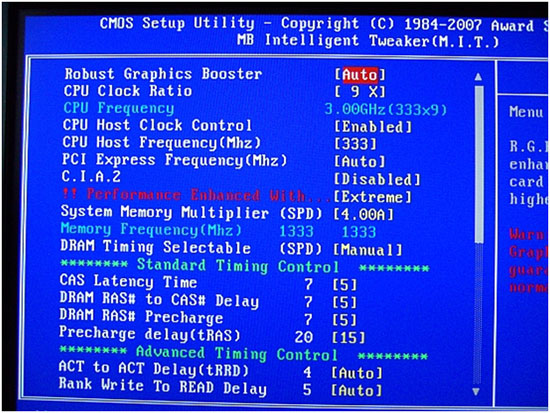
Robust Graphics Booster
Available functions are Auto, Fast and Turbo. We could find no good reason to use anything other than Auto or Turbo mode. Auto seems to default to Turbo mode anyway. In the interest of performance, we did attempt to use the Fast setting, which actually prevented driver initialization during the Windows boot sequence. Sticking on Auto or Turbo is best.
CPU Clock Ratio
This function sets the CPU multiplier; please note the F3D BIOS adds half multiplier support for the QX9650.
CPU Host Clock Control
Options are Enabled and Disabled. Select Enabled to change the FSB and overclock your processor. In the event of a failed overclock this function will return to Disabled.
PCI Express Frequency
Default is Auto. We have found overclocking the PCI-E bus up to 115MHz is possible, although we could not substantiate any real performance advantages in doing so. Speeds over 115MHz are liable to cause non-recognition of SATA drives. Using an IDE drive is recommended if you wish to run over 115MHz.
C.I.A. 2
Gigabyte's automatic overclocking function senses system load and overclocks the processor automatically. There are six available options: Disabled, Cruise, Sports, Racing, Turbo, and Full Thrust. The most aggressive setting is Full Thrust, providing a small percentage CPU/memory overclock under load. Select Disabled for manual overclocking.
Performance Enhanced With
There are three functions available in this setting: Standard, Turbo, and Extreme. Changing this setting does nothing more than manipulate Performance Level (tRD). The Extreme setting selects the default tRD, while Standard and Turbo will relax tRD by 1-2 levels.
System Memory Multiplier (SPD)
Memory divider ratios can be configured by this function. The available memory dividers per Northbridge strap are shown in the table below.
| Gigabyte GA-X48T-DQ6 Available Memory Dividers | |
| Northbridge Strap | Available Memory Dividers |
| 200 MHz | 5:3, 2:1 |
| 266 MHz | 5:4, 3:2, 2:1 |
| 333 MHz | 1:1, 6:5, 8:5, 2:1 |
| 400 MHz | 1:1, 4:3, 5:3, 2:1 |
| . | |
Leaving this function on Auto, results in the 2:1 divider being picked for overclocking by default. For manual use, we found the 333 strap 2:1 divider to be the most stable combination to use for quad-core processors. For dual-core processors, the 266 strap and 3:2 divider worked best for us.
DRAM Timing Selectable (SPD)
If left on Auto the BIOS will attempt to sense and adjust memory timings automatically depending on the level of FSB overclock applied. Set this to manual to obtain control of several key memory/chipset timing parameters below.
CAS
latency Time
DRAM RAS# to CAS# Delay
DRAM RAS# Precharge
Precharge Delay (tRAS)
These are the four primary memory options. If performance is desired, users with 1800MHz DDR3 can aim for 6-6-6-18 1N timings at DDR3-1600 (400FSB 2:1 divider). If low voltages are preferred then either CAS 7-7-6-20 at DDR3-1700 or CAS 8-8-7-21 may be used if you can find enough FSB stability with your processor.
ACT to ACT Delay (tRRD)
Auto will default mainly to a setting of 4 under 500 FSB, which is fine for stability and performance in most cases. Users may wish to experiment with tRRD under 4 via Memset in XP for benchmarking. For high FSB overclocking a setting of 5 may help with stability.
Rank Write to Read Delay
If using manual timings, remember that this setting is offset by -10. Setting 5 manually will give a real setting of 15. The range of interest for overclocking is between 5 and 9 in BIOS (15 to 19 actual), for Micron based modules. Memory speeds over DDR3-1800 require setting of ~9 for stability. For benchmarking, use Memset within Windows for manual tuning.


 Facebook
 Twitter
 RSS
RSS


37 Comments
View All Comments
Ozlaw - Monday, June 23, 2008 - link
I recently switched the inner workings of my computer from a Sriker Extreme, X8000 CPU and an 8800 GTX, to the Gigabyte GA-EX38T-DQ6, with an Asus HD 3870 X2 1gb (and I was about to add another in crossfireX, until I found out AMD was rolling out the 4000's series X2 early, actually possibly in Q3 of this year). If I had known, which is the story of my life and computers, that a newer chipset was coming out so soon, I would have waited for the 48T. The funny thing is that ever since I studied coomputer progaramming in college in the 70's, and began building my own computers when costs became parctical to do so, I suscribe to all the industry news but always miss something big.Oh well I can say that the 38T, since it was designed aroung quad core, including the extremes, instead of relying on BIOS updates to recoginize and work with critical hardware, such as the 680i in my old Striker Extreme was doing (I had the QX6850 in int for a time)in and of itself made an ennourmous difference in my computer's speed and functionality.
THanks for a good article and now I am going to have to decide whether to buy a new motherboard when I buy the new graphics cards as I admit to being on of those weak early consumers of tech products, althhough I am getting better when it comes to Intel's cpu's now that they have become a CPU of the month club.
papatsonis - Wednesday, April 16, 2008 - link
"(G)MCH Overvoltage ControlDefault voltage is 1.45V, and the available voltage scale provides an overvoltage of 0.025-0.775V. There an actual undervoltage of 0.2V from the BIOS set overvoltage. For example, as the stock voltage is set to 1.45V a BIOS setting of +0.50V would imply a voltage of 1.95V. However setting +0.50V gives an actual voltage of 1.75V, suggesting an undervoltage of 0.2V. "
The default voltage of X38/X48 is 1.25v (and in the article explaining tRD values , states that also) , the gigabyte in fact OVERvoltages MCH , when set to normal , to 1.45volt , but when adjusting values, it sets correct values (multimetered) e.g. +0.125 ->~ 1.38v
Galvin - Monday, April 28, 2008 - link
I dont have a volt meter. But I did verify thats what happening.I have the x48 ddr2 version. Normally the NB heatsink is too hot to keep my fingers on it. So if you run less voltage the heatsink should be cooler to the touch. Which is what happened. I set the overvolt for the MCH to 0.025 then rebooted. Waited a few min and I was able to hold my fingers to the heatsink without burning. I did this 2 more times to be sure.
Surprised no one has found this before. That explains why the NB heatsink was crazy hot.
Thanks
neat1 - Sunday, January 6, 2008 - link
http://www.firingsquad.com/hardware/intel_skulltra...">http://www.firingsquad.com/hardware/intel_skulltra...neat1 - Sunday, January 6, 2008 - link
Does this board supp sli or is there still only crossfire support on the x48 chipset? (which would be kind of odd)Looking fwd 2 see the ASUS X48 tested
Regard/neat1
Rajinder Gill - Sunday, January 6, 2008 - link
Hi,Right now Nvidia has no plans whatsoever to allow SLI on the desktop Intel chipssets. Skulltrail may be the only exception to this. Of course, that's assuming Skulltrail ever gets released.
regards
Raja
Rob94hawk - Sunday, January 6, 2008 - link
Benchmarks with skulltrail or just hype?Rajinder Gill - Sunday, January 6, 2008 - link
Hi Rob,Personally I have not seen anything of Skulltrail myself, Intel are notably tight-lipped about publishing anything. Of course we'd all love to have a play...lol
regards
Raja
kilkennycat - Friday, January 4, 2008 - link
Is Gigabyte paying Anandtech for front-cover "pseudo-advertising"? I though Anandtech exclusively reviewed quality products. Seems as if the pre-fitering within Anandtech of products for review needs to be strengthened.This review is so full of wishful thinking about future BIOS updates (whhich may never materialize) that I want to scream. Surely there are computer-related products in a far more mature state begging for serious technical reviews?
Rajinder Gill - Friday, January 4, 2008 - link
At least the preview/review let's people know what to expect at present. I guess I am wishful, because I hate to see good products go to waste via an inadequate BIOS. Immediate maturity with top-end performance boards (the reviews I concentrate on) is hard to find, almost impossible in fact. Occasionally we find a gem, when we do, we write about it. Not every board that comes down the channel is going to make the masses happy, especially in this segment. It's one of the toughest segments of all, the budget minded will never be happy with it. But then these products are not aimed at the budget segment at all. In the PC world there's no such thing as linear performance scaling per dollar. This board needed a 2 stage review, because fo the length of time the cascade cooled results can take. Where this may not be the typical approach, the performance boards are used by a percentage of this crowd. The rest is the more stable down to earth stuff which we endeavour to cover with the BIOS guides. It just so happens this all fell in with the Christmas season, when most companies go into shutdown.We review these boards in a way that the people who have the dollar or inclination to spend this kind of money will use them, no more, no less.
regards
Raja