



Apple's Mac mini - Tempting PC Users Everywhere
by Anand Lal Shimpi on January 25, 2005 7:39 AM EST- Posted in
- Mac
First Encounter with the mini
I'll get to the actual computer itself shortly, but there's one more little gem in the box that is absolutely worth mentioning. The Mac mini comes with a single video output, a DVI output. But, if you're familiar with the DVI spec, you'll know that the DVI connector can carry both digital and analog signals. So, with a very cheap adapter, you can get an analog VGA connector from a DVI port. Apple obviously supplies the aforementioned connector with the Mac mini, which does the same thing that any DVI-to-VGA adapter does.
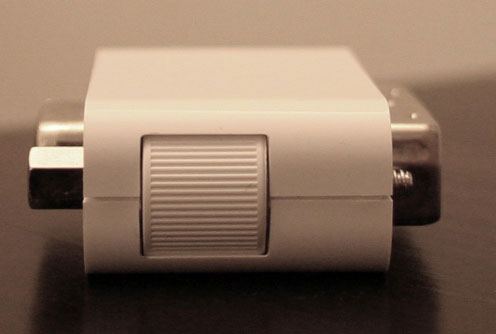
The difference here is that Apple actually managed to package the first well-made DVI-to-VGA adapter; well made in the sense that it has two half-exposed thumb-wheels integrated into the casing of the adapter - making it easy to actually screw the adapter into place, something that isn't always true about most conventional DVI-to-VGA adapters. It's nothing huge, but a nice little addition.
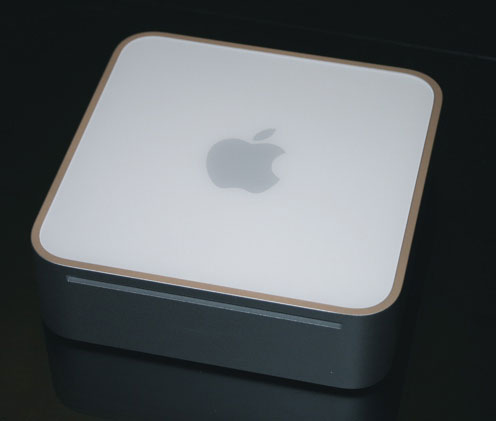
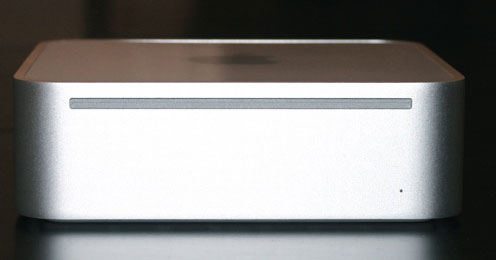
Then there's the mini itself, extremely small and extremely simple. All that's on the front of the machine is a very small power LED and a slot-loading CD-RW or optional DVD-R drive.
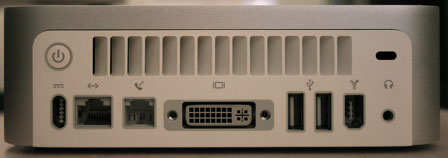
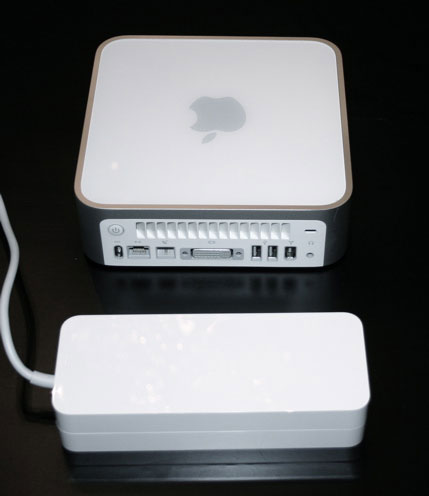
The back of the mini sports a tiny power button and vents, as well as the following I/O connectors, in order from left to right: power, 10/100 Ethernet, modem jack, DVI, two USB 2.0 ports, FireWire 400 port and 1/8" headphone/line out.
The slight separation between the aluminum casing and the plastic portion of the Mac mini isn't normally there. The machine pictured here was only partially assembled after our dissection process detailed later.
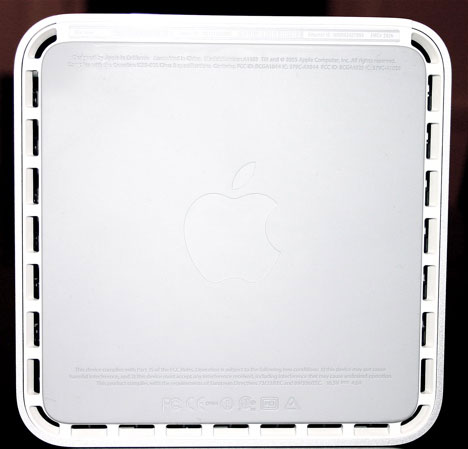
The base of the mini is rubber, making sure that it doesn't scratch or slide on any surface on which it happens to be placed. Also around the base of the system are vents used for cooling. The entire system only uses a single fan, so Apple had to maximize airflow by keeping air flowing through the vents.
One way that Apple was able to decrease the size of the mini was by using an external power supply, an 85W one to be more specific. The power supply features no fan and is about as wide as the mini itself, but not nearly as tall. The fact that the entire mini runs off of a single 85W power supply is impressive. Remember, that's less power consumption than most high end Intel and AMD processors alone.


 Facebook
 Twitter
 RSS
RSS


198 Comments
View All Comments
wildgift - Monday, September 19, 2005 - link
I bought one, and it's nice. It's very quiet (meaning it doesn't add to the noise in the office), reasonably quick, and very easy on the eyes. It is a decent development machine, at least for smaller database driven websites, and is portable enough to tote to the office. There's definitely something to be said for carrying your entire development environment around, but without spending all the $$ for a laptop. The price/performance ratios suck, but the overall fit and finish, and very nice software, more than compensate for the approximaely $150 premium you pay for going with a Mac. A SFF PC / OS combo to match the Mini simply cannot be purchased. A fairly comparable SFF PC (like the AOpen that's quiet) with the same RAM and larger hard drive, and slightly faster CPU, costs almost the same, and lacks the software. (Yes, I'm getting one of those too.)Also, going with any Mac at all gets you the better aesthetics that Windows lacks, and Linux totally lacks. You get better typefaces. You get better color calibration. Printing is smoother (and the addition of gimp-print is a big plus). You can type in any language you know. Even the screensaver photos are nicer. With iWork, you get nicer templates. Even the old AppleWorks clip art is pretty good (not really good, but, ok for "free" clipart). These things matter a lot if you work with documents.
If you're in the Unix niche, a Mac is nice because it has Unix under the hood. It's not quite the standard Solaris, BSD, or Linux environment, but it's close enough for most things.
The Mini is a pretty good computer, and a very good *product*. It's not the monster of spec benchmarks, but, most people, including technical people who you might think would care, simply don't care about those numbers.
steveo561 - Friday, April 1, 2005 - link
Interested in a FREE MAC MINI???I just got mine FOR FREE...EVEN SHIPPING...NO JOKE
Just copy and paste the link EXACTLY as you see it below:
www.FreeMiniMacs.com/?r=16680884
All you have to do is go to the link, sign up for one FREE offer, and have some of your friends do the same and it's all yours for FREE.
www.FreeMiniMacs.com/?r=16680884
steveo561 - Monday, March 28, 2005 - link
Interested in a FREE MAC MINI???I just got mine FOR FREE...EVEN SHIPPING...NO JOKE
Just copy and paste the link EXACTLY as you see it below:
www.FreeMiniMacs.com/?r=16680884
All you have to do is go to the link, sign up for one FREE offer, and have some of your friends do the same and it's all yours for FREE.
www.FreeMiniMacs.com/?r=16680884
MarshallG - Monday, February 28, 2005 - link
I love Anand's Mac articles. It's great to see an obviously pro-Windows guy like Anand look at the platform with such an open mind.Our home PC just died and this looks like a great replacement. I like the fact that I won't worry about viruses or spyware. I might get my 70 year-old mother one for the same reason.
But I'm surprised that Anand makes little if any mention of the Unix core of these machines. This is Linux for people who don't want to deal with driver problems. You can open a shell window, and run Perl or a zilllion other UNIX languages and apps. I'm really impressed by that! Now I can *really* teach my children how to use computers.
WorkingHardMan - Friday, February 11, 2005 - link
The way Tiger has been described by Apple is that Tiger will still handle the pixles if the GPU can not. Having said all that, the mini isn't really being marketed to the kind of people who want or need high quality 20" and 23" displays. One of the Apple desktop computers would make more sense for that crowd.Xmate - Thursday, February 10, 2005 - link
I'm sorry if this issue has already been addressed, I'd apreciate if you could restate the solution if it has been:OS X Tiger is supposed to use to GPU instead of the CPU to render all the pixels on the display correct? Well, while the Mac mini seems to be a very good solution for a PC user wanting to try out OS X, but from what I can see, the mini simply doesn't have nearly enough power in the GPU to power any of Apple's Cinema Displays. I have currently heard that most people are happy with the mini 20" CD combination, and I might (not certain) have heard people being happy with it even with the 23". With Tiger this is almost definetly not going to be the case.
I was wondering if anyone has any input on that, and if they know of some possible solution that could be implemented to solve the problem.
Thank you for your help,
Stefan
Wightout - Tuesday, February 8, 2005 - link
http://www.pbs.org/cringely/pulpit/pulpit20050120....PhoenixPyre - Sunday, February 6, 2005 - link
Yeah, that Dell configuration isn't normal. To get those specs normally, you would have to pay well over $499. Not to mention it would be under the Small Business section of Dell.com and you would probably have to pay a good amount for shipping (as noted in #189).jaxcs2002 - Thursday, February 3, 2005 - link
Hey good aricle but you tried to discuss too many things with this article. Two notes:1)The comparison Dell and the mini is fair but Dell doesn't sell any standard configuration computers. Every week (really, not kidding here), they run some kind of a promotion. You were able to snag a free LCD when you browsed the Dell page that day, but did you get free shipping? I guarantee the next week, you won't be able to get an LCD but maybe extra memory and a larger hard disk. They do this obviously to make each week a sale and to induce you to buy immediately.
2) You make note that the comp is not for Apple power users and then promptly seem to forget that fact. What user would buy a mini mac and hook it to a 23" Cinema Display? It is interesting to note that it would not do well, but the Dell standard vidcard (integrated probably) wouldn't either. Judgeing from your article, it would probably be fine on a 15 or 17 inch screen.
I think it would have been helpful, especially since you hint at it anyway to talk about its utility in performing more "average joe" type taks such as usng it in conjunction with the apple air port as a music file server or as video server. You know, those tasks that a buyer of an ipod might do with a mac mini. In every way, you seem to perfer its bigger cousins but this a mini, what tasks does the mini do well?
pitdog - Wednesday, February 2, 2005 - link
sorry for the double post....new to the forums