



ASUS W90Vp: ATI Mobility Radeon HD 4870... with CrossFire
by Jarred Walton on May 29, 2009 5:00 AM EST- Posted in
- Laptops
For better or for worse, most of the notebook manufacturers seem to be most interested in sending us their top-end gaming laptops for review. We hope to have a roundup of several "normal" laptops in the near future -- you know, laptops that weigh less than five pounds and hopefully get over three hours of battery life. In the meantime, we do have several monster notebooks to review, starting with the ASUS W90Vp-A1.
ASUS has a couple variants of the W90Vp; the A1 version we're looking at today is essentially identical to the X2 version, except for the fact that it has dual 320GB hard drives. Considering the difference in price, you might want to pick up the X2 if you can find it and add a second hard drive yourself. As for the rest of the components, this is one behemoth of a "laptop".
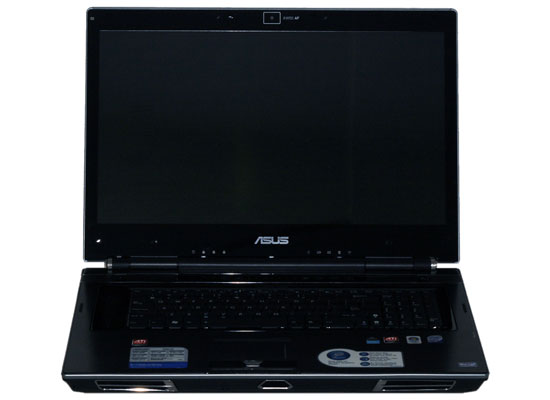
Several companies are now shipping 18.4" notebook chassis, generally loaded with high-end components. In the case of the W90Vp, you get a quad-core Q9000 processor, dual 320GB 7200 RPM hard drives, and 6GB (3x2GB) of DDR2-800 memory running at DDR2-667. The LCD is a high quality 1080p display, and although it uses standard CCFL backlighting it looks better than the vast majority of laptop displays we've used.
Obviously, the stars of the show are the dual ATI Mobility Radeon HD 4870 graphics cards in CrossFire. (Note that there are two GPUs on separate PCBs; this is not a mobile variant of the 4870X2.) This is the first high-end gaming laptop we've reviewed in a very long time that utilizes an ATI graphics solution, and as such we are very interested to see how it performs. On the desktop, NVIDIA still holds the crown for the fastest GPUs, but ATI is managing to compete very well in terms of overall price and performance. One of the main ideas in ATI's current GPU lineup is the use of multiple reasonably sized GPUs instead of a single monolithic GPU core.
What's interesting is that NVIDIA is sort of following that same approach for notebooks; the current top-end GTX 200M NVIDIA solutions do not stem from the desktop GT 200 series but instead build upon an enhanced G92M core. The new core is a 55nm part instead of 65nm, with up to 128 SPs. That should give it a similar die size relative to ATI's Mobility HD 4870 -- perhaps even slightly smaller. The desktop 9800M GTX+ has 754 million transistors, which should be relatively close to the GTX 280M. Needless to say, that's a far cry from the 1.4 billion transistors utilized in the desktop GTX 280! How will the GTX 280M compared to the Mobility HD 4870? Unfortunately, we can't conclusively answer that question yet, but we should have NVIDIA's competing solution in-house for testing soon. In the meantime, we do have an (aging) 8800M GTX SLI solution, with updated drivers. That brings us to the next topic.


 Facebook
 Twitter
 RSS
RSS


25 Comments
View All Comments
buzznut - Saturday, May 30, 2009 - link
Looky there, I went and missed "bash AMD day"Damn, they're prolly still reeling.
Johnmcl7 - Friday, May 29, 2009 - link
In the specs for this machine it lists an 8x DVDR drive initially, then refers to it as a blu-ray drive just further down - I assume the first entry should read bd-rom/dvd-r combo.I have to say the pictures are extremely disappointing as the main shots of the laptop are badly underexposed concealing most of the details. I do realise these machines are not easy to get a picture of but normally the pictures in reviews are pretty decent. It would be good to see some pictures with some standard items (DVD cases or something) when the laptop is open to get a better idea of the scale, I think the sleek look makes it look smaller than it is especially given it makes the D901C look small which I didn't think possible.
As for the laptop itself I did consider one of these mainly because the price was good but decided against it due to the size/weight. I had a Dell XPS 2 then M1710 and I think that's really the upper limit to carry around with me. I have an XPS M1730 at the moment and it never leaves the house as combined with its huge powerpack makes it quite a bit bigger and heavier than the M1710, there's no way I would go bigger again.
It's a shame to see the driver situation is so poor when the performance is clearly there, it's not very encouraging for other companies to pick up mobile ATI parts either.
mrbios - Friday, May 29, 2009 - link
Jarred (or anyone who may purchase this notebook), I have a different Asus laptop that has the same multimedia touchpad, and I did find a way to disable it. Go into the Mouse control panel, go to Device Settings, expand tapping, click on tap zones, and uncheck "enable tap zones".garydale - Friday, May 29, 2009 - link
Why is it so difficult to get good display drivers for games? The OpenGL interface is well defined so what's the problem with writing a driver for it that game developers can have confidence it will work according to spec.?Is this a case of the hardware manufacturers screwing up with the driver or the game developers trying to get around the API to work directly with the hardware or a bit of both? Frankly, I don't care. If I want to play a game on a computer, it should install and work just like any other piece of software or hardware.
Hopefully AMD/ATI's release of details of their API will help bring stability and performance, at least for Linux games. Now will NVidia follow suit and allow the open source community to build their own drivers to end this proprietary "buggy driver" lunacy?
JarredWalton - Friday, May 29, 2009 - link
I believe most of the driver updates are to optimize the way the GPU executes certain code. In theory, the drivers should run all code properly but not optimally. The reality, sadly, is that the "properly" part is only correct about 80% of the time with new titles. Add CrossFire into the mix and that seems to drop down to 50%. If you have a regular dual card CrossFire setup, disabling CrossFire in the CCC often solves compatibility issues, but that's not an option on the drivers I've received for the W90Vp.In the case of Empire: Total War it looked like the drivers were rendering properly on one card but not on the other. If I grabbed a screenshot via the PrintScreen button, everything looked correct, but looking at the screen only the landscaping and sky were always visible and correct. The units, trees, buildings, etc. were only visible about 10% of the frames, which pretty much means you can't play the game.
mbaroud - Friday, May 29, 2009 - link
I own one the W90VP-A1.I have been dyingto update the drivers, it sucks running on OUTDATED drivers :(
nubie - Friday, May 29, 2009 - link
If these are simply mobile desktop replacements why doesn't somebody get on making a desktop built into the screen already?And I don't mean the hideous monstrosity that is the Dell XP1.
I am all for laptops, but this form factor is silly above 15.4" in my opinion.
(that said, I love the tech, it is very cool.)
Jackattak - Friday, May 29, 2009 - link
Dunno if you've been asleep for the past two years but just about every major PC manufacturer offers a desktop built-in to the screen nowadays, none of which are "hideous" (strictly my opinion, but I find it hard to find a screen "hideous", and that's essentially all these offerings are is a screen).garydale - Friday, May 29, 2009 - link
It's generally cheaper and faster to run multiple desktops in the locations you need than to lug a "desktop replacement" around. Just keep your documents (and other settings) on a USB key or implement an Internet synchronization scheme.The simple fact is that you cannot get anything that can be reasonably called a laptop to match the performance of a desktop. Laptops don't have the space for multiple drives, they can't dissipate heat as well, and they certainly can't accommodate expansion.
To get the same performance of a desktop in a mobile platform, you have to wait for the technology to become available then pay a premium for the privilege. People have been saying laptops are getting near desktop performance for decades. What is actually happening however is the price of admission for an application platform has been decreasing.
You can get a resonable desktop today for what a hard drive would have cost you twenty years ago. However, if you want cutting edge power, you need a desktop or larger.
frozentundra123456 - Friday, May 29, 2009 - link
The charts are technically labelled incorrectly. I believe for instance the first chart, black bar, means the ratio of nVidia performance to ATI, not percent improvement as it is labelled. Saying "102 percent improvement" actually means that the nVidia solution is twice as fast as the ATI, which from reading the rest of the article appears not to be what the author meant. The rest of the charts are labelled in this way also.