



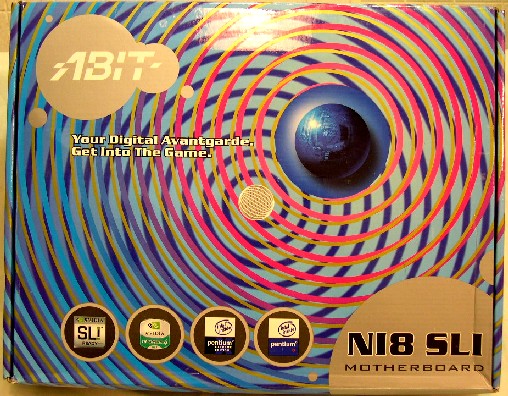
Abit NI8 SLI: nVidia SLI for the Intel Gamer
by Randi Sica & Wesley Fink on October 7, 2005 12:05 AM EST- Posted in
- Motherboards
AMD has recently dominated the gaming segment, thanks to NVIDIA, their nForce4 SLI chipset, and the power of the A64 FX processor. During that time, the Intel camp has had little to cheer about, with Intel gamers forced to rely solely on single graphics card solutions. They could only watch as AMD users walked on by in fps performance. NVIDIA recently shook up that status quo by introducing NVIDIA SLI to the Intel market.
Abit fans expect that if anyone can make a worthy Intel gaming board, it will be Abit. Their BIOS' have been tuned, in particular, towards gaming performance. Their current Fatality line of boards is a testament towards that gaming market, which has always held high regard for the Abit brand.
In the last year, much has been written of Abit's financial woes and re-organization, but despite the new challenges, they continue to engineer and introduce new products as the technology evolves. Let's see if the NI8 can help Abit to recapture some of their past glory.
Abit fans expect that if anyone can make a worthy Intel gaming board, it will be Abit. Their BIOS' have been tuned, in particular, towards gaming performance. Their current Fatality line of boards is a testament towards that gaming market, which has always held high regard for the Abit brand.
In the last year, much has been written of Abit's financial woes and re-organization, but despite the new challenges, they continue to engineer and introduce new products as the technology evolves. Let's see if the NI8 can help Abit to recapture some of their past glory.


 Facebook
 Twitter
 RSS
RSS


19 Comments
View All Comments
jojo4u - Friday, October 7, 2005 - link
The graphs give a nice overview, good work.Please consider to include the information what AF level was used into the graphs. This is something all recent reviews here have have been lacking.
About the image quality: The shimmering was greatly reduced with the fixed driver (78.03). So it's down to NV40 level now. But 3dCenter.de[1] and Computerbase.de conclude that only enabling "high quality" in the Forceware brings comparable image quality to "A.I. low". Perhaps you find the time to explore this issue in the image quality tests.
[1] http://www.3dcenter.de/artikel/g70_flimmern/index_...">http://www.3dcenter.de/artikel/g70_flimmern/index_...
This article is about the unfixed quality. But to judge the G70 today, have a look at the 6800U videos.
http://www.hexus.net/content/item.php?item=1549&am...">http://www.hexus.net/content/item.php?item=1549&am...
This article shows the performance hit of enabling "high quality"
jojo4u - Friday, October 7, 2005 - link
oops wrong forumAvalon - Friday, October 7, 2005 - link
Thanks for the clarification Wesley, and welcome aboard Randi!Wesley Fink - Friday, October 7, 2005 - link
Please welcome Randi Sica as our newest reviewer at AnandTech. Randi is a friend who is well known in the Extreme Overclocking community as Mr. Icee. That gives Randi a keen eye when looking at what's right and wrong with a motherboard from an Extreme Overclocker's perspective.We think you will also find Randi's review perspective and approach a little different. Those who have been screaming for overclocked benchmarks in board reviews will find them in Randi's reviews.
This is Randi's first review at AnandTech, so please make him feel welcomed.
yacoub - Friday, October 7, 2005 - link
PASSIVELY COOLED! That's soooo appealing. I wish board makers could get the northbridges cool enough on the AMD chipset to make more passively cooled boards. I hate having another fan in the case, especially a tiny one running at high revs making a racket. It's bad enough most GPUs suffer from that, we don't need another one on the mobo. :(DigitalFreak - Friday, October 7, 2005 - link
Correct me if I'm wrong here, but I don't think the audio is on the PCI-E bus. The codec hangs directly off the southbridge, and isn't on any bus. If you look at the slot the audio card goes in, it's actually a PCI-E 1x connector turned backwards. I'm assuming that they use that particular connector because it's cheaper than designing something custom. Still, not a bad job on the CPU utilization.BTW, the chip is an ALC850, not ACL850 as mentioned on page 3.
Wesley Fink - Friday, October 7, 2005 - link
Thanks for pointing this out. The references to the audio connector have been corrected to "dedicated audio connector" which it is unless we hear otherwise from Abit. We have seen the separate dedicated audio card can significantly reduce CPU overhead, and Abit seems to have done well with this idea on this board.Live - Friday, October 7, 2005 - link
Enough said...Avalon - Friday, October 7, 2005 - link
Wait, what? You are comparing a dual core HT enabled system with several other Intel systems using only a single core? How is this apples to apples? This makes all of the benchmarks you did worthless.
Wesley Fink - Friday, October 7, 2005 - link
ALL tests used the exact same CPU except the Workstation test results. That means general performance, encoding, DX9, and DX8 gaming were tested on all reported platforms with the Pentium D 840EE.The Workstation Tests were included because they were an interesting picture of a 3.6GHz single core being soundly outperformed by a 3.2GHz dual-core Pentium D. The workstation tests were meant to be an illustration, not a direct comparison.
The 3.46EE was used in some past memory tests to achieve high memory bus speeds, and the reference was only made in examing overclocked memory FSB speed records - not comparative performance.
We will make this clearer in the review, but all of the benchmarks except Worksation are definitely apples to apples tests - even down to HT being enabled in all tests.