



Marvell's ARMADA: Custom Designed ARM SoCs Break 1GHz
by Anand Lal Shimpi on October 19, 2009 8:00 AM EST- Posted in
- CPUs
Intel used to be an ARM architecture licensee until 2006, when it sold its XScale division to Marvell. Intel had grown too large, too defocused, and in turn its core business had suffered. Don’t be confused, the focus wasn’t to be shifted back to desktop, but rather back to x86.
It wouldn’t be until 2008 that Intel would reveal its more focused strategy unto the world: Atom.
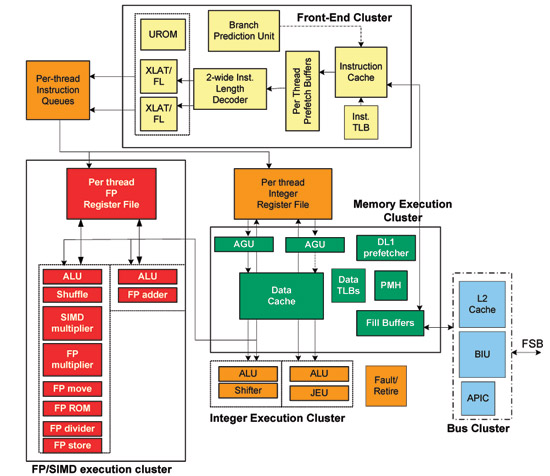
Intel's Atom processor core
While ARM and its licensees played off Atom as not being remotely threatening, all of them knew that it was only a matter of time. Publicly they reasserted ARM’s dominance in the market. Four billion ARM chips shipped last year alone. Intel sold on the order of tens of millions of Atoms. But privately, the wheels were in motion.
ARM inked a deal with Globalfoundries, AMD’s manufacturing arm, to bring ARM based SoCs to the fab. This gives ARM the sort of modern manufacturing it needs to compete with Intel. The second thing that’s changed is ARM licensees are now much more eager to talk about their architectures and what makes them special.
ARM offers two licensing arrangements to its partners: a processor license or an architecture license. A processor license allows the partner to take an ARM designed core and implement it in their SoC. An architecture license allows the partner to take an ARM instruction set and use it in their own processor. The former is easier to implement, while the latter allows the licensee the ability to optimize the architecture for its specific needs.
The Palm Pre - Powered by ARM
Companies like Samsung and TI hold ARM processor licenses. The Cortex A8 used in the iPhone 3GS (Samsung) and the Palm Pre (TI) is licensed directly from ARM. Marvell however has been an ARM architecture licensee for the past 5 years.
It’s an ARMADA
Marvell is introducing a fleet of new SoCs (system on a chip) and the brand is called ARMADA. Get it?
Marvell is introducing four series of ARMADA and their target markets are below:
| SoC | Market |
| ARMADA 100 Series | eBook Readers, digital photo frames, portable NAV devices, etc... |
| ARMADA 500 Series | MIDs, netbooks |
| ARMADA 600 Series | Smartphones, MIDs |
| ARMADA 1000 Series | Blu-ray players, TVs, set-top boxes |
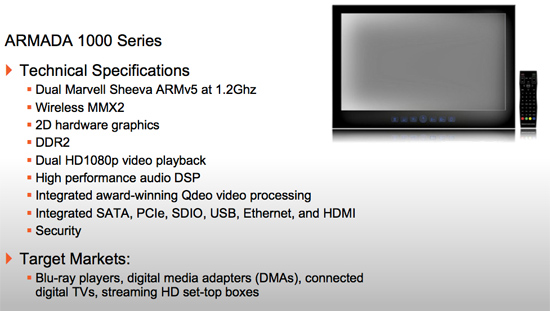
These are SoCs so they’ve got CPU, GPU, I/O and networking all included on a single chip. The entire ARMADA line is built on TSMC’s 55nm process. The 100 is super low performance, useful in eBook readers, digital photo frames, IP cameras, etc... The 1000 is a multi-core version of the 100 with additional blocks designed for Blu-ray players, digital TVs and HD set-top boxes.
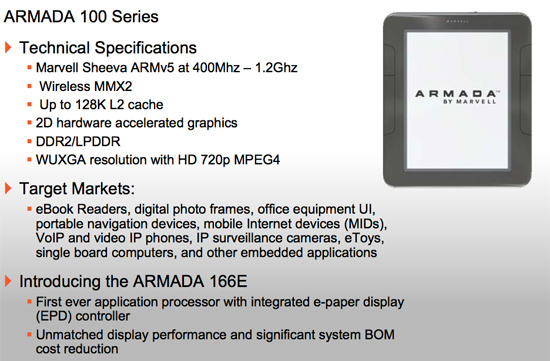
Both the 100 and 1000 are based on Marvell’s Sheeva PJ1 ARM core. This core uses the ARMv5 instruction set like the ARM9 processor, but performance-wise it should be comparable to an ARM11 implementation.
It’s a single issue in-order core with data forwarding support. The core is a hybrid between the original Marvell CPU team and the XScale CPU team that Marvell acquired in 2006. The pipeline depth is between 5 and 8 stages depending on the instruction group.
The core has two separate ALUs (simple single cycle and complex two cycle), a load/store unit and a multiply unit. The ARMv5 instruction set doesn’t explicitly require floating point so there’s a separate coprocessor for all fp operations. Integer SIMD is handled through a separate Wireless MMX2 unit.
Marvell wouldn’t reveal die sizes but indicated that the PJ1 is comparable to ARM11 based designs in both size and power characteristics.
The more interesting SoCs are in the ARMADA 500 and 600 families. They use the Sheeva PJ4 core, Marvell’s answer to the Cortex A8.
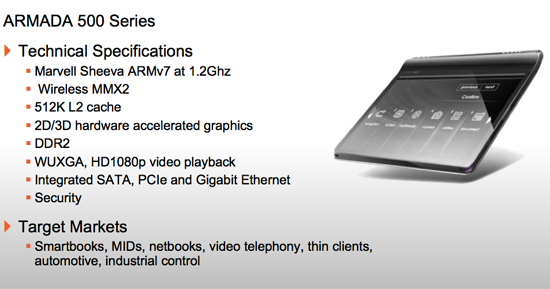
The ARM Cortex A8 is an in-order, dual issue microprocessor with a 13-stage integer pipeline clocked at around 600 - 800MHz today. Marvell’s PJ4 core implements the same ARMv7 instruction set, but the architecture is much different. It’s still an in-order, dual issue core but the integer pipeline is 6 - 9 stages depending on the instruction.
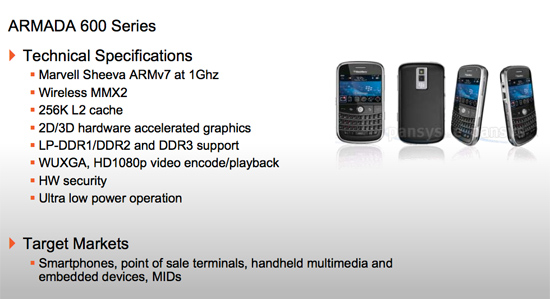
The shorter pipeline apparently doesn’t come at the expense of clock speed. Through the use of some custom logic Marvell is able to deliver clock speeds greater than 1GHz.
Both L1 and L2 caches are supported, just like the Cortex A8.
The biggest issue I can see with Marvell’s PJ4 is that it doesn’t support ARM’s NEON SIMDfp instruction set. Marvell argues that Wireless MMX2 penetration is higher than NEON. Given the limited use of Cortex A8 in the market today, I don’t see a lack of NEON compatibility as a major issue for now but it could be one down the road depending on developer uptake.
On paper the PJ4 would appear to have much higher IPC and clock speed than the Cortex A8. Marvell was unwilling to share any power or performance data at this time, so it remains to be seen exactly how well Marvell’s architecture competes in the real world but on paper, at a high level, it looks good.


 Facebook
 Twitter
 RSS
RSS


26 Comments
View All Comments
nofumble62 - Friday, October 30, 2009 - link
Reading on a 5 inch screen is just suck. I used my kid's Ipod Touch, and it killed my eyes. The younger generation will all wear glass by 20. Brainwash your kids to be the Eye doctor.RinksCustoms - Wednesday, October 21, 2009 - link
While Parallax's 8 Core microcontroller (the Propeller P8X32A) has been out since '06 with each of its internal processors each having dedicated video hardware, it's been limited to the code it could run. But looking back at it now, looks like the industry either came to the same logical conclusion OR seen a little peek of what a small company from CA could do with their very own architecture. Although the Propeller cant run like an x86 chip, it can interface with standard keyboard/mouse and output standard video composite, s-video, broadcast (analog), or VGA while doing other functions, i have seen its limitations, and it usually comes down to two things, not enough i/o pins and on board memory.But we see where this idea is leading with onboard video and PCIe controllers being integrated on new and next gen intel CPU's
iwodo - Monday, October 19, 2009 - link
I was hoping Marvell would make a faster SoC for NAS. Current implementation could not fully utilize the Gigabit Bandwidth.While Intel Atom has been performing much better, although at the cost of Power.
PandaBear - Monday, October 19, 2009 - link
I just have to say the author of the article is so misinformed about ARM.It is not intended to be a General Purposed PC processor and the main market is embedded device inside ASIC. Some of these ASIC have multiple ARM inside.
The benefit of ARM is small code size and power consumption, processing power density, rather than absolute power.
You can build an ARM CPU inside an ASIC and together they cost 14 cents or less. Try that with atom and see how much it cost.
Marvell's main market has been doing well for a long time: power efficient ASIC for hard drives, networking, and other market. It is not really a direct competitor with Intel. The deal with Global Foundry is just like with any other foundry.
ProDigit - Tuesday, October 20, 2009 - link
With Atom VS ARM I meant the ARM which is focused on netbooks, not the other ones.I'm active a lot on netbook forums,and perhaps forget to mention I'm talking about them.
I'm less interested in a MID device, because I believe it does not have a level of comfortability to type, and their screensize is terrible too!
I don't know why many manufacturers are trying to cramp the whole PC experience in a cellphone!
All I can say to that is that it's surely not comfortable, small keyboard, too small screen (can't even see a regular google search page, without having to go for the mobile one), processing power is too slow to successfully display flash movies or other movies, and their battery life is often too low to spend 2 hours on the internet,at speeds similar to a 56k modem or 112kbps ISDN connection.
Those are my thoughts about the matter;I prefer a cellphone for calling only, with an agenda, and alarm clock. The rest is added cost and bagage to me!
Then a netbook for all the standard tasks like internet, and small apps.
But that's besides the point of the article.
I honestly see no future in this MID market. It's a gadget market people will grow tired of very soon I believe.
Unless one device does it all with respectable battery life, like being an MP3/WMA/OGG player, with built in camera, and act as a cellphone, while keeping a 7day battery charge, many of these gadgets will be considered luxuries not needed.
And especially the excitement factor of a crippled Internet on the go on a cell's screen is pretty low I'd say!
strikeback03 - Tuesday, October 20, 2009 - link
See, I'd say MIDs are more useful than netbooks. A netbook is too big to fit in any pocket, which means I would need some type of a bag, and at that point I'd just go for a more powerful ultraportable that could also function as a real laptop. I don't try to use the internet on my phone for watching videos or other things I do on a real computer, it is for quickly looking stuff up on the go. What I would like to see is far better battery life though, I can easily kill the battery in my Diamond with a decent amount of texting plus random other usage in a day.Affectionate-Bed-980 - Monday, October 19, 2009 - link
I don't think Anand's that clueless about the mobile market, but a lot of users here are PC enthusiasts as am I. However I've followed the mobile market for years be it the Symbian, WinMo, and now iPhone, Palm, BB scene.Too many people go OMG INTEL's ATOM is the next big thing. However it was Intel's attempt to scale down Centrino/Core architecture into netbooks. It's not for the mobile arena just yet. ARM is building up meanwhile and NVidia has demoed Tegra + GeForce doing amazing things. Netbooks might be able to be powered by Cortex A9s soon enough.
Anand's focus on a CPU this time is very good. I don't like it when he jumps into analyzing the mobile market, especially from a US iPhone fanboi perspective. It really distorts things.
The0ne - Monday, October 19, 2009 - link
I have to agree that ARM is not a direct competitor at this point in time. However, if Intel penetrates more of ARMs market there would be little doubt that it is in direct competition even if the hardware is different. I don't see this happening anytime soon as well. We use ARM in our products for the reasons you've describe. Cost and code size. You really can't beat that :)Next year should be fun with the technology :D Can't wait!
Voo - Monday, October 19, 2009 - link
We all know, that Intel at least in the long term wants to penetrate the smartphone market (and similar things like ebooks as well?) and I'm rather sure that the ARM chips in a iphone or palm pre cost more than 14 cents.Sure that's only a fraction of the whole market, but I'd think it's rather lucrative..
Voo - Monday, October 19, 2009 - link
We really need a edit function..Can someone explain to me, why the codesize should be smaller with a smaller instruction set than a larger one? I'd think it should be the other way round, but I'm clearly not the expert here.