



Intel X38 Tango - Is High FSB Overclocking Worth It?
by Rajinder Gill on February 26, 2008 3:30 AM EST- Posted in
- CPUs
Dancin' with the Devil
Just about every review site has taken a unique approach to motherboard testing at one time or another, especially when it comes to overclocking. Over the last few months, we have taken a slightly different approach with the performance-oriented motherboards by offering additional technical information and a few BIOS guides to help end-users set up the ever more complicated BIOS functions that are available on today's boards. Our primary directive is to ensure everything we achieve in the cozy confines of the labs is fully repeatable with the same off-the-shelf retail components and settings.
The basic test criteria we use when overclocking the Intel enthusiast boards is setting FSB speeds in the 400-465FSB region. We ensure tRD is set as low as possible while keeping component voltages to a minimum level for stable long-term use. This type of overclocking might not sound very sexy - Patrick Swayze would dump us fast for not doing the Argentine tango with high FSB rates. However, our recent forays into dissecting DDR2 and DDR3-based motherboard overclocking have shown that tRD (Read Delay) is the most important tunable BIOS option available to the overclocker when seeking measureable performance improvements when overclocking Core 2 processors.
Those who wish to increase their insight or review just what the Northbridge strap setting and tRD are, how they both work, and why we are enamored with these settings are advised to read this article first and parse through this one for additional background information. Most overclockers are thoroughly aware that increasing processor voltage is required to allow speed scaling, but may fail to realize that raising MCH voltage is necessary when using a higher processor multiplier. The primary reason is to cope with the additional data throughput via the chipset busses as FSB levels rise.
Early implementations of the P965 chipset allowed FSB scaling to reach levels that were unheard of (in conjunction with the Core 2 Duo) by increasing the overall chipset latency at certain FSB points. Quite often, the deficit in chipset latencies at higher FSB speeds was enough to nullify a processor core speed increase of 100Mhz or more - meaning that a higher FSB overclock would trail the performance of a lower CPU speed using a lower FSB and higher CPU multiplier (due to Northbridge strap latency changes). It was not until the P965 was about to be replaced by the P35 that we finally began to see the release of high performance 965 boards - namely the Abit Quad GT and the DFI P965-S "Dark". These boards locked the 1066 Northbridge strap, while allowing Front Side Bus speeds near or above 500FSB that retained linear performance scaling to some degree.
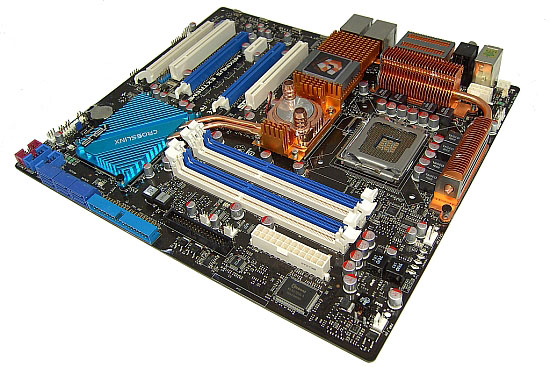
To date, we have noticed that properly tuned Intel P35/X38/X48 chipsets also feature near linear performance scaling as FSB speeds rise. In fact, although NB strap changes are available manually, the straps really do nothing at this point but allow the use of different memory dividers. We are finding that increases in Northbridge voltages between a 6x and 7x multiplier may not be huge if even needed, but when we step over to the 8x multiplier (at equivalent settings) we have noticed a major jump is usually required in VMCH to hold the applied overclock "stable".
This is true even on the latest top-end motherboards featuring the X38/X48 chipsets. Therefore, using an 8X or 9X multiplier to show a high FSB holds more merit to the board and CPU capabilities than using a 6X multiplier to show off a board's high FSB capabilities. If a board can achieve a high stable FSB with a higher multiplier, it makes sense that a lower multiplier will have no problem achieving the same or greater FSB speeds.
For the seasoned overclocker nothing we have said above is anything new or groundbreaking. Our main goal though is to remain realistic for our readers, so that we show what is really possible rather than something that can only be held together with chewing gum and sticky tape for 5 minutes for that impressive SuperPi 1M screenshot.


 Facebook
 Twitter
 RSS
RSS


15 Comments
View All Comments
AndyKH - Thursday, February 28, 2008 - link
When reading the article, I didn't find any info on how you adjusted tRD. I thought such adjustments weren't available in the BIOS except for certain X48 boards from ASUS (unless you resorted to FSB strap settings that might limit memory ratios). Is this setting beginning to show up on X38 boards as well?Rajinder Gill - Thursday, February 28, 2008 - link
There is a full BIOS guide for this board here (part of the full review).. 'Transaction Booster' is the function.http://www.anandtech.com/mb/showdoc.aspx?i=3172&am...">http://www.anandtech.com/mb/showdoc.aspx?i=3172&am...
regards
Raja
Aurhinius - Thursday, February 28, 2008 - link
I'd be interested to see something like this done with a Max formula board. Takes the X38 and pairs it with DDR2 rather than DDR3 which is still out of sensible reach for most people due to price.Then you can compare memory performance and settings on the same chipset with the two types of memory. Throw a quad in to the mix as well.
It's also going to illuminate any benefits (if there are any) of moving to an X48 platform from an X38.
Keep up the great work. These articles are a world apart from anything else I have seen and has people thinking how they evaluate their systems at all levels of experience.
Well done!
Rajinder Gill - Thursday, February 28, 2008 - link
A DDR2 version will be incoming, as well as X48 asap. We have a few reviews to get done first, but will try to incorporate this form of testing into them..regards
Raja
Zak - Wednesday, February 27, 2008 - link
Nicely written indeed but I gave up on overclocking, the real life benefits are not worth the effort. My 3GHz C2D runs at 3.6GHz easily with Tuniq Tower. Do I notice any difference in games? Photoshop? Nope. I used to get more excited about o/clocking I guess it passed with age:) Good luck to everyone though:)Z.
Nickel020 - Tuesday, February 26, 2008 - link
I quite like the recent articles, that kind of quality infos & analysis is very rare.I also liked the inclusion of some real world benchmarks, although the tRD article was great, I was missing some benchmarks demonstrating the real world effects.
Only thing is that DDR3 is still not an issue for most people, but the article is still well worth reading since since it explains underlying factors that affect performance.
menting - Tuesday, February 26, 2008 - link
the author questions why some memory manufacturers sell CAS9 DDR3-1900 as "performance memory" even though it means it has pitiful cas latency. The reason is that "performance" cannot be judged by cas latency alone. Sure with a low latency you can get a burst of data quicker, but with back to back reads on a memory, a higher clock speed is better. So it all depends how you want to look at it and how applications make use of the memory.Rajinder Gill - Tuesday, February 26, 2008 - link
Hi,I would still rather buy performance parts that scale to Cas 7 at ddr 1800 than Cas 9 at DDR 1900+. The FSB/tRD and VMCH requirements just don't make intelligent sense. Then we have the 2N command rate to play with when we begin to scale much past DR-1900. I would call it a lose-lose situation.
regards
Raja
Griswold - Tuesday, February 26, 2008 - link
Disco Stu likes the style of this article!Samus - Tuesday, February 26, 2008 - link
An unusually written article if I've ever seen one ;)