



Overclocking Intel's New 45nm QX9650: The Rules Have Changed
by Kris Boughton on December 19, 2007 2:00 AM EST- Posted in
- CPUs
Introduction
Intel has once again re-energized the overclocking community with the recent release of the Core 2 Extreme QX9650 quad-core processor, the first of many new mobile, desktop, and server CPUs fabricated using their radically new 45nm process technology. Early results have highlighted Intel's extremely conservative approach in assigning processor power specifications and because of this, users looking to push their systems beyond rated speeds are finding they have a lot more headroom than normally expected. Our overclocking trials have met with great success, as exploiting this processor's hidden performance margin is easier than ever imagined.
The last seven generations of Intel processors have utilized traditional metal oxide semiconductor (MOS) materials, namely silicon dioxide (SiO2) and other polysilicates. This has spanned a period starting with the Pentium, originally built on 0.6 micron (600nm) node technology, all the way to Core 2 Duo/Quad parts built on 65nm. However, for the first time in over 40 years, Intel has significantly changed some of the basic components used in transistor fabrication. Hafnium dioxide (HfO2) has replaced SiO2 as the gate dielectric material, along with other carefully chosen new metals, for use in the formation of gate electrodes in both PMOS and NMOS transistors. These new materials, along with the right process recipe, have cut gate leakage by a factor of more than 10x while simultaneously delivering an astonishing 30% decrease in transistor switching energy. The result is a cooler running, more energy efficient, and high-performance processing powerhouse.
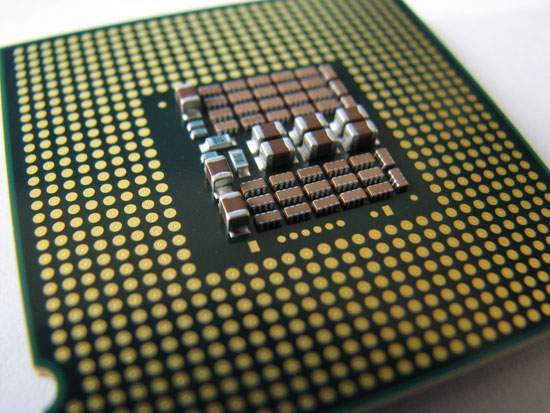
Intel's Core 2 Extreme QX9650 in the classic LGA775 package
Moving to a smaller node process technology allows for the potential of two things to happen. The first is the ability to make smaller production dies, reducing manufacturing costs, and ultimately making products more affordable to the consumer. Alternatively, designers can take advantage of the increased transistor density made possible by the new process and develop next-generation solutions that pack even more transistors into the same space as before. Smaller transistors also allow Intel to take advantage of lower switching energies up to a limit. This is true until smaller and smaller transistor gate dielectric boundary layers create conditions in which power leakage - even with the transistors in the "off" state - become excessive. From this point on something will have to change if Moore's "Law" is going to continue.
With much fanfare, Intel released the highly anticipated Core 2 Extreme QX9650 Processor just a few shorts weeks ago, knowing that the high price would be little more than a speed bump for high-performance enthusiasts. More practical-minded users will have to wait until early 2008 before experiencing the mainstream release. Naturally, we wasted no time in bringing you this first-hand look at the QX9650's expansive overclocking potential. Although our experience has not been entirely without problems - we will cover the good and bad later in more detail - we must commend Intel on the development of another great product. Without a doubt, the QX9650 has taken its rightful place in the winner's circle.
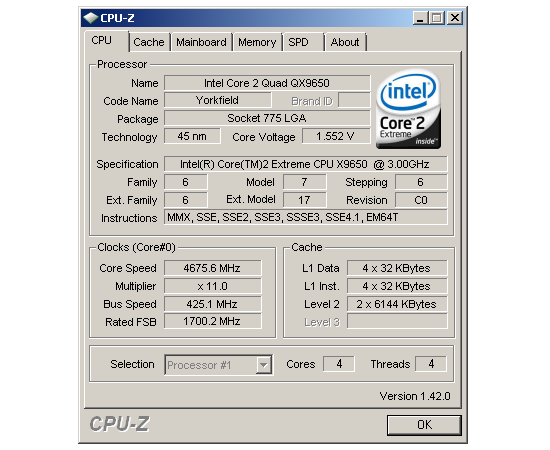
Our maximum overclock on water is nothing short of impressive
Until now, achieving this level of overclock with water-cooling alone was unheard of and we find ourselves feeling punch drunk with the speed. Indeed, finding applications that make practical use of this ridiculous amount of processing power is exceedingly difficult - few programs these days efficiently utilize two cores, let alone four. Obviously, scenarios that make intelligent use of the QX9650's exceptional parallel processing capabilities stand to benefit the most. Good examples are video (and to a lesser extent audio) editing, rendering, ray tracing, 3D modeling, DivX/Xvid encoding operations, and of course gaming (when properly coded and without GPU limitations).
We hope our in-depth look at QX9650 overclocking will provide new information even for those who have been into the overclocking scene for some time. Others, looking for the right opportunity to try their hand at voiding their processor's warranty, should find just about everything they need get started down the long path towards an overclocking addiction. Strap on your heatsinks, tweak your voltages, and join us as we see exactly what Penryn and 45nm brings to the overclocking party.


 Facebook
 Twitter
 RSS
RSS


56 Comments
View All Comments
mariedeguzman - Friday, June 19, 2009 - link
Thanks for this post, this is a great article and a good help to those who need advices about this post.Markfw900 - Thursday, January 10, 2008 - link
My Gigabyte P35-DQ6 does have what you say is voffset, but is has NO vdroop from idle to load. I believe this is because it has a far superior power delivery system. I don't have an instrument to tell me any differences that may happen in nano-seconds on the voltage, but overall, it never seems to change. This would be consistant with a high quality board. So why do you say its a feature ? I can see how a mfg may undervolt to not go over recommended vcore for non-overclocked cpu's, but if I didn't overclock, my board wouldn't have vdroop either.Its just cheap motherboards, not a "feature". If I am wrong, please test a DQ6 and show the results.
LaGUNaMAN - Saturday, January 5, 2008 - link
One of the best tech articles I've read in awhile. (^^,)isvaljek - Tuesday, January 1, 2008 - link
"typically, even the worst "performance" memory can handle CAS3 when running at about DDR2-800, CAS4 to about DDR2-1075, and CAS5 for anything higher."Are they for real?
mindless1 - Monday, December 31, 2007 - link
Considering the heat produced I can't see a justification for the idea of drastic shifts in the cooling industry. Realistically there aren't THAT many overclockers using water cooling at all and current (including older) processors having lower power consumption were what brought the cooling industry to what it is today.You may say past some point the heat isn't the factor, but you still need a decent heatsink up until that point. 100W of heat for example is a non-trivial level even though some past parts have exceeded that.
mindless1 - Monday, December 31, 2007 - link
What I really meant to say is that it's not just a matter of getting rid of the heat but doing so without the system sounding like it has a leaf blower hidden inside, and for that many lesser heatsinks just don't cut it.mindless1 - Monday, December 31, 2007 - link
What I really meant to say is that it's not just a matter of getting rid of the heat but doing so without the system sounding like it has a leaf blower hidden inside and for that many lesser heatsinks just don't cut it.mindless1 - Monday, December 31, 2007 - link
What I really meant to say is that it's not just a matter of getting rid of the heat but doing so without the system sounding like it has a leaf-blower hidden inside and for that many lesser heatsinks just don't cut it.SilthDraeth - Friday, December 21, 2007 - link
And their TDP measurement is the same as it has always been, maximum draw.Yes ACP is a marketing tool. So what. MHZ is a marketing tool as well, and still has real world benefits. Same as ACP.
wordsworm - Thursday, December 20, 2007 - link
Best damned article I've seen out of AT in a long time. Bravo.