



The Nehalem Preview: Intel Does It Again
by Anand Lal Shimpi on June 5, 2008 12:05 AM EST- Posted in
- CPUs
Not One Nehalem, but Two
Nehalem itself is very stable but it has only been in Taiwanese motherboard manufacturer hands for a relatively short while now, so the only truly mature motherboards are made by Intel. Unfortunately since Intel didn't sanction our little Nehalem excursion, we were left with little more than access to some early X58 based motherboards in Taiwan. Thankfully we had two setups to play with, each for a very limited time.
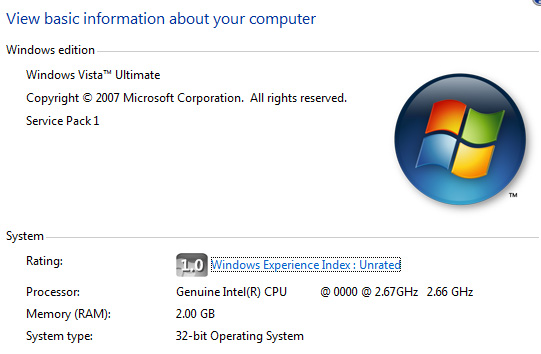
We had access to a 2.66GHz Nehalem for the longest time, unfortunately the motherboard it was paired with had some serious issues with memory performance. Not only was there no difference between single and triple channel memory configurations, memory latency was high. We know this was a board specific issue since our second Nehalem platform didn't exhibit any issues. Unfortunately we didn't have access to the more mature platform for very long at all, meaning the majority of our tests had to be run on the first setup (never fear, Nehalem is fast enough that it didn't end up mattering).
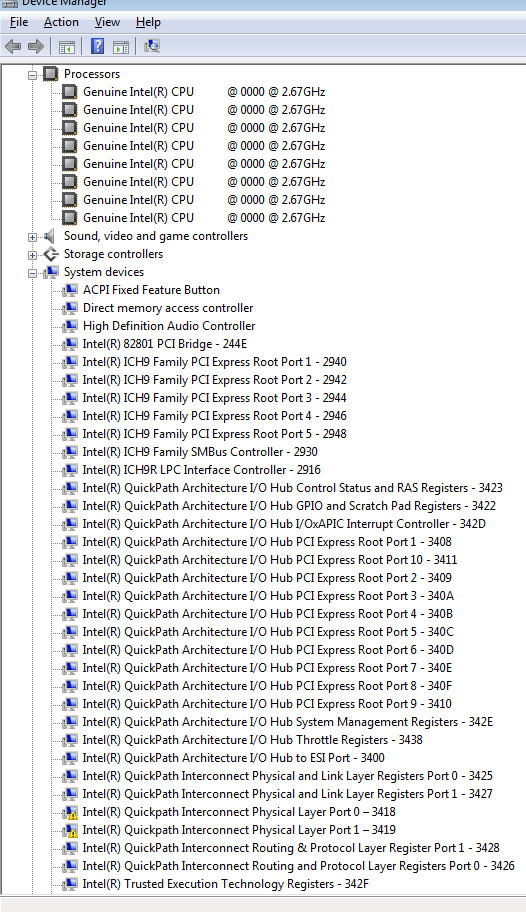
The second issue we ran into was a PCI Express problem that kept us from running any meaningful GPU benchmarks. We've been told that it'll take the motherboard guys about a month to work out these kinks, but that's why you shouldn't expect to see a full performance evaluation of Nehalem in the near term.
The CPUs are quite mature and are running extremely cool (surprisingly cool actually), their clock speeds are being artificially limited by Intel in order to avoid putting all cards on the table at this time. We saw a similar approach with the very first Penryn samples which were all locked at 2.66GHz. The Intel X58 chipset we used in our testing on the other hand got quite hot.
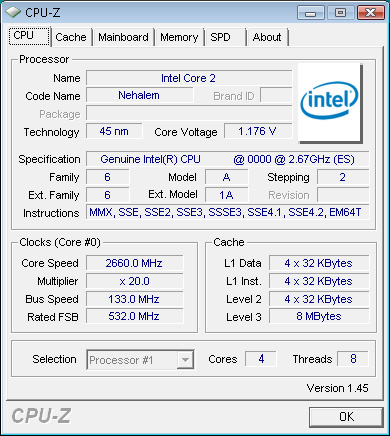
Nehalem no longer has a conventional FSB, its clock speed is derived from a multiplier of an external clock frequency - in this case 133MHz. Expect all Nehalem chips to come out in frequencies that are multiples of 133MHz.
Thankfully we don't want a thorough look at Nehalem today, we'll save that for the launch - what we do want is to whet our appetite. We want to know if Intel can pull it off a second time.


 Facebook
 Twitter
 RSS
RSS


108 Comments
View All Comments
weihlmus - Friday, September 5, 2008 - link
is it just me or does lga1366 bear more than apassing resemblance to amd's logo...if only they could have crammed it into 1337 pins - "nehalem - the 1337 chip"
Proteusza - Friday, July 11, 2008 - link
I see that on the Daily Tech main page, the headline for this article now reads:"June 5, 2008
Post date on AnandTech's Nehalem preview, before it was ripped and republished on Tom's Hardware"
Does anyone know what happened? I cant find the same article on Tomshardware, I presume they took it down.
xsilver - Friday, June 20, 2008 - link
10 pages of comments and not one about the future of overclocking?No more FSB = no more overclocking??????
Enthusiasts might jump ship if overclocking usually brings 20% extra performance, all amd have to do is come within 10% on performance and below on price?
Akabeth - Thursday, June 19, 2008 - link
JebuzzzThis pretty much makes it pointless to purchase any high tier mobo and quad core today... It will be eclipsed in 6 months time...
Some of the numbers here make me wonder, "Are you f*cking kidding me?"
JumpingJack - Friday, June 13, 2008 - link
Anand, you could clear up some confusion if you could specify the version of windows you ran. The screen shots of some of your benchmarks show 64-bit Vista, yet your scores are inline with 32-bit Vista.... it makes a difference.JumpingJack - Friday, June 13, 2008 - link
Nevermind, page 2 shows 32-bit Vista... makes sense now. You should becareful when posting stock photos, the Cinbench reflects 64-bit.barnierubble - Sunday, June 8, 2008 - link
It appears to me that the Tick Tock cycle diagram is wrong.Conroe shooked the world in the second half of 2006, Penryn came in the second half of 2007, now 2008 we have Nehalem on the horizon set for the second half of this year.
Now that is 2 years between new architectures with the intermediate year bringing a shrink derivative.
That is not what the diagram shows; bracketing shrink derivative and new architecture in a 2 year cycle is clearly not fitting the reality.
mbf - Saturday, June 7, 2008 - link
Will the new IMC support ECC RAM? And if so, what are the odds the consumer versions will too? I've had a bit of bad luck with memory errors in the past. Since then I swear by ECC memory, even though it costs me a bit of performance. :)Natima - Saturday, June 7, 2008 - link
I just thought I'd point out that the Bloomfield chip reviewed (to be released in H2 2008) will infact dominate the gamer/high-end market.http://en.wikipedia.org/wiki/Nehalem_(microarchite...">http://en.wikipedia.org/wiki/Nehalem_(microarchite...
The smaller sockets will be for what I like to call... "office PC's".
And the larger socket for high-end servers.
A majority of custom PC builders will be able to buy & use Nehalems by the end of the year. Hoorah!
Natima - Saturday, June 7, 2008 - link
The article semi-implied that chips for the PC enthusiast would not be out until mid-2009. Just wanted to clarify this for people.