



The Ivy Bridge Preview: Core i7 3770K Tested
by Anand Lal Shimpi on March 6, 2012 8:16 PM EST- Posted in
- CPUs
- Intel
- Core i7
- Ivy Bridge
Note: This preview was not sanctioned or supported by Intel in any way.
I still remember hearing about Intel's tick-tock cadence and not having much faith that the company could pull it off. Granted Intel hasn't given us a new chip every 12 months on the dot, but more or less there's something new every year. Every year we either get a new architecture on an established process node (tock), or a derivative architecture on a new process node (tick). The table below summarizes what we've seen since Intel adopted the strategy:
| Intel's Tick-Tock Cadence | |||||
| Microarchitecture | Process Node | Tick or Tock | Release Year | ||
| Conroe/Merom | 65nm | Tock | 2006 | ||
| Penryn | 45nm | Tick | 2007 | ||
| Nehalem | 45nm | Tock | 2008 | ||
| Westmere | 32nm | Tick | 2010 | ||
| Sandy Bridge | 32nm | Tock | 2011 | ||
| Ivy Bridge | 22nm | Tick | 2012 | ||
| Haswell | 22nm | Tock | 2013 | ||
Last year was a big one. Sandy Bridge brought a Conroe-like increase in performance across the board thanks to a massive re-plumbing of Intel's out-of-order execution engine and other significant changes to the microarchitecture. If you remember Conroe (the first Core 2 architecture), what followed it was a relatively mild upgrade called Penryn that gave you a little bit in the way of performance and dropped power consumption at the same time.
Ivy Bridge, the tick that follows Sandy Bridge, would typically be just that: a mild upgrade that inched performance ahead while dropping power consumption. Intel's microprocessor ticks are usually very conservative on the architecture side, which limits the performance improvement. Being less risky on the architecture allows Intel to focus more on working out the kinks in its next process node, in turn delivering some amount of tangible power reduction.
Where Ivy Bridge shakes things up is on the graphics side. For years Intel has been able to ship substandard graphics in its chipsets based on the principle that only gamers needed real GPUs and Windows ran just fine on integrated graphics. Over the past decade that philosophy required adjustment. First it was HD video decode acceleration, then GPU accelerated user interfaces and, more recently, GPU computing applications. Intel eventually committed to taking GPU performance (and driver quality) seriously, setting out on a path to significantly improve its GPUs.
As Ivy is a tick in Intel's cadence, we shouldn't see much of a performance improvement. On the CPU side that's mostly true. You can expect a 5 - 15% increase in performance for the same price as a Sandy Bridge CPU today. A continued desire to be aggressive on the GPU front however puts Intel in a tough spot. Moving to a new manufacturing process, especially one as dramatically different as Intel's 22nm 3D tri-gate node isn't easy. Any additional complexity outside of the new process simply puts schedule at risk. That being said, its GPUs continue to lag significantly behind AMD and more importantly, they still aren't fast enough by customer standards.
Apple has been pushing Intel for faster graphics for years, having no issues with including discrete GPUs across its lineup or even prioritizing GPU over CPU upgrades. Intel's exclusivity agreement with Apple expired around Nehalem, meaning every design win can easily be lost if the fit isn't right.
With Haswell, Intel will finally deliver what Apple and other customers have been asking for on the GPU front. Until then Intel had to do something to move performance forward. A simple tick wouldn't cut it.
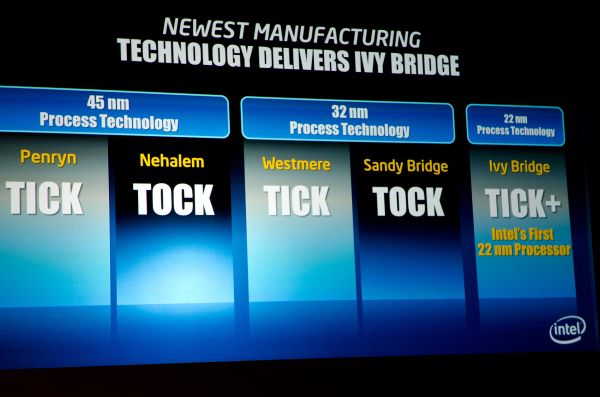
Intel calls Ivy Bridge a tick+. While CPU performance steps forward, GPU performance sees a more significant improvement - in the 20 - 50% range. The magnitude of improvement on the GPU side is more consistent with what you'd expect from a tock. The combination of a CPU tick and a GPU tock is how Intel arrives at the tick+ naming. I'm personally curious to see how this unfolds going forward. Will GPU and CPUs go through alternating tocks or will Intel try to synchronize them? Do we see innovation on one side slow down as the other increases? Does tick-tock remain on a two year cadence now that there are two fairly different architectures that need updating? These are questions I don't know that we'll see answers to until after Haswell. For now, let's focus on Ivy Bridge.


 Facebook
 Twitter
 RSS
RSS


195 Comments
View All Comments
Valitri - Saturday, April 14, 2012 - link
"there's also the question of which one (CPU or GPU) approaches "good enough" first."I was worried that my A6 3420 laptop would feel sluggish in windows and general tasks, especially compared to my 2500k desktop system. However, I've been very surprised and think it works just fine in windows.
I was also very impressed that the iGPU lets me play most newer games comfortably. I was able to OC my A6 3420 on my Samsung 3 series to 2.0ghz. It runs Crysis 2 on low at 1366x768 in the 25-30 fps range. Now to me that is not really playable, but I was surprised it could even run it. Other games like SC2, Arkam Asylum, CSS, WOW, have all ran like a champ. Most of them even on medium settings!
So I think if you want a cheap laptop (mine was $399), and you want the ability to play some games while still doing general tasks well, we have already hit that "good enough" stage on the CPU department. It will be interesting to see if Windows 8/Metro does anything to change this.
p05esto - Monday, April 23, 2012 - link
You are dead wrong. I need fast CPU for my work but need or care about the gpu. You realize people do more than game, right.SquirrelPunch - Monday, April 23, 2012 - link
Could not disagree more.In fact the majority of power users do not need a powerful GPU, just lots of RAM and fast CPU.
Graphics designers: All 2D mostly, do not need powerful GPU.
Video Editors: Same as above.
Software developers (not games): same as above
Standard CAD: No intensive 3D models involved.
Most also don't care for multi-monitor setups, or the 2x that HD series will let you use.
klmccaughey - Monday, April 23, 2012 - link
Intel needs another Larrabee. It keeps cobbling together these graphics cores, which are always well short of the mark. Either Larrabee 2 or licence from Nvidia, but something has to be done about it in the long (possible mid) term. It makes perfect sense and, to me anyway, has the air of inevitability about it.Why not take the plunge?
MarkJohnson - Tuesday, August 21, 2012 - link
I find it odd the AMD A8-3870K was left out of the power consumption section, but is in the others.I ran a quick test and my kill-a-watt meter read 126Watts max x264 HD v5.0.1 which bests all of them
It also idles at 34.5 watts which blows them all away by a very large margin. The best is double what the AMD A8-3870K idles.