



Samsung Galaxy Nexus & Ice Cream Sandwich Review
by Brian Klug & Anand Lal Shimpi on January 18, 2012 1:34 PM ESTGoogle employs more than 20,000 people worldwide and the number of them working on Android are in the single digit percentage range. Google's business is search, but it has always had aspirations of more. Android isn't just a chance to capitalize on mobile search for Google, it's also an opportunity to grab power in the next era of personal computing. If you believe that smartphones will eventually replace mainstream PCs, who wouldn't want to be to smartphones what Microsoft was to PCs in the early 1990s?
Previous versions of Android have been cautious, evolutionary steps along a path to being a more open/flexible alternative to iOS. Starting with Honeycomb (Android 3.0) however, Google began to step out of the shadow of its competitors and really start to define Android as a mobile computing platform. Honeycomb was limited to tablets but its successor, Ice Cream Sandwich (Android 4.0), would bring unification to Android across both tablets and smartphones.
Today we look at both ICS and its launch vehicle, Google's Galaxy Nexus.
The Android vs. iOS Debate
It's very clear to me now more than ever that Apple and Google have completely different goals with their mobile OS strategies. Excluding the unclear strategy behind Chrome OS, Android is pretty much Google's primary operating system. The unified tablet/smartphone strategy behind Ice Cream Sandwich makes sense because for Google to succeed in the OS business it needs to deploy Android on everything from smartphones to notebooks. We've already seen the strengths in having a smartphone platform with a strong app ecosystem. Things become even more appealing if you have a phone, tablet and PC that all run the same OS and apps. As Android is Google's one-size-fits-all operating system, it needs to have a broader and slightly more ambitious focus than iOS otherwise it risks losing the race in the long run.
Apple is in a different position. It already has a successful desktop/notebook OS that is continuing to grow. While iOS has been a runaway success for Apple, the Mac OS X platform is a solid option for any user who needs more than their iPhone or iPad can provide. The two OSes may converge or at least borrow heavily from one another, but in the interim they can remain independent. If you need more of a computing experience Apple is happy to sell you a Mac. If you want the it-just-works appliance experience in your phone or tablet, Apple has a whole bunch of iPhone/iPad configurations to offer you.
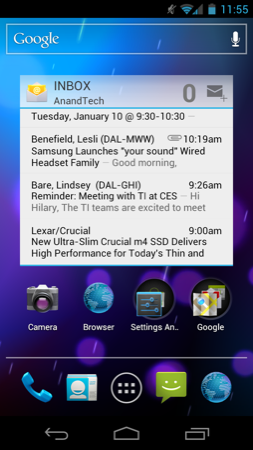
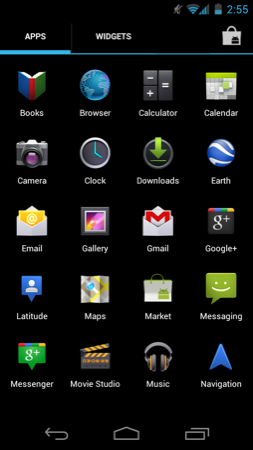
ICS isn't a step towards iOS. If anything it proves that Google is committed to its own trajectory. Android is an OS that, although more closed than many would like, still allows more flexibility than iOS. You can sideload apps not purchased in the Market. The file system isn't completely hidden from you. You can even override the default zoom level on web pages. Apple and Google both pour tons of time and research into figuring out the best way to do something. And, to be honest, I feel like Apple generally does a better job of "getting it" for the very mainstream consumer. Rather than attempt to make the perfect mold however, Google gives you one that's a bit more flexible.
I've said this before but I do believe that Apple is trying to deliver more of an appliance experience, whereas Google is providing you with a modern take on a traditional computing experience. If the appliance is a smartphone, then both approaches are equally capable - it's just a matter of personal preference.
What's new in ICS really falls into one of three categories:
- Improvements in UI frame rate due to OpenGL ES rendering (non-skia) path
- UI tweaks
- New features
Nowhere in this list is a fundamental change in the way Android works. I feel that this is a very important point to understand and likely the cause for lots of disagreement when it comes to just how impressive (or not) ICS is.
ICS is smoother, more polished and has its own set of new features that make it a significant step forward for Android. What ICS is not however is an outright clone of iOS. If you prefer the iOS experience to Android, ICS will do nothing to change your opinion. If all you were missing from Android was a smoother UI, then its fourth major release should be almost everything you could ask for.


 Facebook
 Twitter
 RSS
RSS


185 Comments
View All Comments
Insomniator - Wednesday, January 18, 2012 - link
I wonder if the Rezound's Adreno 220 will help with the delays using the ICS buttons.tipoo - Wednesday, January 18, 2012 - link
The chip in this one generally benchmarks right after the Mali 400, the fastest GPU in an Android phone right now. Its probably a software thing, not hardware.Insomniator - Wednesday, January 18, 2012 - link
According to anand's own benchmarks (can't find much else on the 220) the SGX540 is significantly slower...http://www.anandtech.com/show/4243/dual-core-snapd...
tipoo - Wednesday, January 18, 2012 - link
I know, but its still one of the faster GPU's out there. I don't see why the GPU would be a limitation on just the function buttons while the rest of the UI is buttery smooth.tipoo - Wednesday, January 18, 2012 - link
Also, one of the comments below ours show Android 4.03 being faster and almost eliminating that lag, so it was a software thing.doobydoo - Thursday, January 19, 2012 - link
Fair enough - it may have been a software thing.Nevertheless, it's a software thing which doesn't happen on the faster GPU of the Samsung Galaxy S2. So I'd say it's a bit of both.
zorxd - Friday, January 20, 2012 - link
Is the iPhone 4 with the slow SGX535 lagging? If not, how can it be a hardware thing?zorxd - Wednesday, January 18, 2012 - link
You are comparing a 1GHz TI OMAP4 SGX540 to a 1.5 GHz Snapdragon S3 Adreno 220.The CPU alone can explain the difference between the Optimus 3D (31 fps) and the qualcom developement platform (37-38 fps).
As you can see, single core devices using the SGX540 are even slower.
At a given CPU clock speed (let say the common 1.2 GHz) I think the SGX540 is faster than the Adreno 220.
jeremyshaw - Wednesday, January 18, 2012 - link
Different architecture. Snapdragon at 1.5GHz is probably a smidgen slower than Cortex-A9 at 1.2GHz. Remember Snapdragon as an amped-up Cortex A8.french toast - Wednesday, January 18, 2012 - link
Scorpion is not an amped up A8, they are not related in any way other than the v7 ISA.The adreno 220 is way more powerfull than a 540, the problem with it was the poor bandwidth and the terrible drivers qualcomm released it with, it you check out the scores of the samsung galaxy s2 skyrocket with those new drivers it is much faster.