



Gigabyte's i-RAM: Affordable Solid State Storage
by Anand Lal Shimpi on July 25, 2005 3:50 PM EST- Posted in
- Storage
For years now, motherboard manufacturers have been struggling to find other markets to branch out to, in an attempt to diversify themselves, preparing for inevitable consolidation in the market. Every year at Computex, we'd hear more and more about how the motherboard business was getting tougher and we'd see more and more non-motherboard products from these manufacturers. For the most part, the non-motherboard products weren't anything special. Everyone went into making servers, then multimedia products, then cases, networking, security, water cooling; the list goes on and on.
This year's Computex wasn't very different, except for one thing. When Gigabyte showed us their collection of goodies for the new year, we were actually quite interested in one of them. And after we posted an article about it, we found that quite a few of you were very interested in it too. Gigabyte's i-RAM was an immediate success and it wasn't so much that the product was a success, but it was the idea that piqued everyone's interests.
Pretty much every time a faster CPU is released, we always hear from a group of users who are marveled by the rate at which CPUs get faster, but loathe the sluggish rate that storage evolves. We've been stuck with hard disks for decades now, and although the thought of eventually migrating to solid state storage has always been there, it's always been so very distant. These days, you can easily get a multi-gigabyte solid state drive if you're willing to spend the tens of thousands of dollars it costs to get one; prices actually vary from the low $1000s to the $100K range for solid state devices, obviously making them impractical for desktop users.
The performance benefits of solid state storage have always been tempting. With no moving parts, reliability is improved tremendously, and at the same time, random accesses are no longer limited by slow and difficult to position read/write heads. While sequential transfer rates have improved tremendously over the past 5 years, thanks to ever increasing platter densities among other improvements, it is the incredibly high latency that makes random accesses very expensive from a performance standpoint for conventional hard disks. A huge reduction in random access latency and increase in peak bandwidth are clear performance advantages to solid state storage, but until now, they both came at a very high price.
The other issue with solid state storage is that DRAM is volatile, meaning that as soon as power is removed from the drive, all of your data would be lost. More expensive solutions get around this by using a combination of a battery backup as well as a hard disk that keeps a backup of all data written to the solid state drive, just in case the battery or main power should fail.
Recognizing the allure of solid state storage, especially to performance-conscious enthusiast users, Gigabyte went about creating the first affordable solid state storage device, and they called it i-RAM.
Through some custom logic, the i-RAM works and acts just like a regular SATA hard drive. But how much of a performance increase is there for desktop users? And is the i-RAM worth its still fairly high cost of entry? We've spent the past week trying to find out...
This year's Computex wasn't very different, except for one thing. When Gigabyte showed us their collection of goodies for the new year, we were actually quite interested in one of them. And after we posted an article about it, we found that quite a few of you were very interested in it too. Gigabyte's i-RAM was an immediate success and it wasn't so much that the product was a success, but it was the idea that piqued everyone's interests.
Pretty much every time a faster CPU is released, we always hear from a group of users who are marveled by the rate at which CPUs get faster, but loathe the sluggish rate that storage evolves. We've been stuck with hard disks for decades now, and although the thought of eventually migrating to solid state storage has always been there, it's always been so very distant. These days, you can easily get a multi-gigabyte solid state drive if you're willing to spend the tens of thousands of dollars it costs to get one; prices actually vary from the low $1000s to the $100K range for solid state devices, obviously making them impractical for desktop users.
The performance benefits of solid state storage have always been tempting. With no moving parts, reliability is improved tremendously, and at the same time, random accesses are no longer limited by slow and difficult to position read/write heads. While sequential transfer rates have improved tremendously over the past 5 years, thanks to ever increasing platter densities among other improvements, it is the incredibly high latency that makes random accesses very expensive from a performance standpoint for conventional hard disks. A huge reduction in random access latency and increase in peak bandwidth are clear performance advantages to solid state storage, but until now, they both came at a very high price.
The other issue with solid state storage is that DRAM is volatile, meaning that as soon as power is removed from the drive, all of your data would be lost. More expensive solutions get around this by using a combination of a battery backup as well as a hard disk that keeps a backup of all data written to the solid state drive, just in case the battery or main power should fail.
Recognizing the allure of solid state storage, especially to performance-conscious enthusiast users, Gigabyte went about creating the first affordable solid state storage device, and they called it i-RAM.
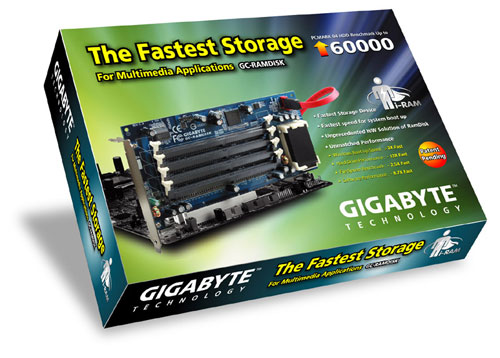
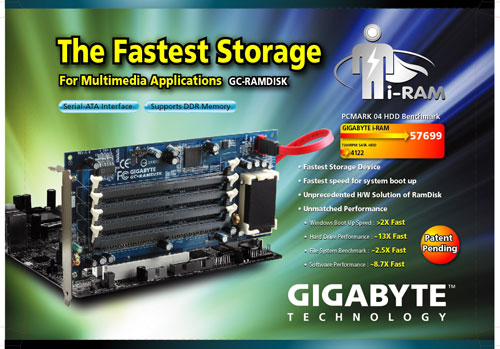
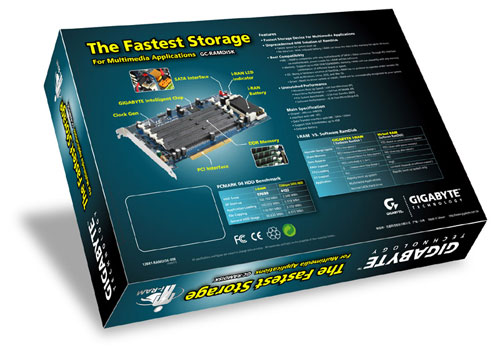
Through some custom logic, the i-RAM works and acts just like a regular SATA hard drive. But how much of a performance increase is there for desktop users? And is the i-RAM worth its still fairly high cost of entry? We've spent the past week trying to find out...


 Facebook
 Twitter
 RSS
RSS


133 Comments
View All Comments
pieq3dot14 - Tuesday, July 26, 2005 - link
I'd like to see how this would change the overall latency of a system. I have a pretty nice home studio, and I can see using this as a boot drive, and then recording off to a raid array. With all the random accesses coming from the solid state drive, and only sequencial going to the raid, I'd think the latencies would drop significantly. Could be pretty handy, even extending the life of older systems.bwall04 - Tuesday, July 26, 2005 - link
Anand, first of all great review, it's nice to see some numbers on this.Would it be possible to bench a few tests again with 2GB of system memory? I can vouch that 2GB makes a noticeable difference when loading any game. I realize that you were going for an "enthusiast" level machine but games like HL2, Doom3,and Battlefield 2 has started a push with the high end to upgrade to either 2x1GB or 4x512MB.
racolvin - Tuesday, July 26, 2005 - link
Could they perhaps have gone with a full-size card and then oriented the DIMM slots perpendicular to the mobo? I had something like that ages ago in an Amiga that worked well from a size perspective. It might get them to 8Gb :)somu - Tuesday, July 26, 2005 - link
cost of this unit was increased 3 times.then it went from sata2 to sata.
Real life performance is not as gd as i expected, when i first heard i was excited to see them working on removing the bottleneck but going from 13 second load time to 10 second doesnt warrant the cost of the 150 card and 4 gb ram.
shaw - Tuesday, July 26, 2005 - link
#1 4GB space = poop#2 Still bottlenecked by the SATA bus
I just hope this is the beginning of a bright future, but for now I'm not impressed one bit.
IvanAndreevich - Tuesday, July 26, 2005 - link
How about a Raid0 test with 2 of these cards :)JNo - Tuesday, July 26, 2005 - link
How about Read the Frickin Article?audiophi1e - Tuesday, July 26, 2005 - link
I think the more useful implementation is to have the RAM pre-installed onto the drive. And I'm not talking RAM sticks. I'm talking about these guys at Gigabyte contacting Samsung, Micron, or Crucial to directly supply the chips and directly solder them onto 5.25" plates. I think in the space of a 5.25" bay, you can fit 2 of these said plates. It won't be hard to think that they'd be able to fit 15GB of RAM in a 5.25" drive's space.Then with the remaining space, mount a MUCH larger battery. Have the battery be able to last DAYS, not hours. This will set people a little more at ease. It will sure make me feel better. (and no, this 5.25" ramdrive will not be using a molex connector. Simply put in a dummy PCI card to allow the 5.25" to draw power from it)
The fatal flaw in their product design is that most people simply won't have that many RAM sticks laying around to make this thing useful. Why not supply the RAM, and in the process increase the possible size from 4GB, to something much more useful. If we already know that only 'power users' with little budget restraints will buy this, then just supply it the way we know they want it: Big.
Zebo - Tuesday, July 26, 2005 - link
Yeah one really needs about 15-20G to make this a livable reality. And that would cost about 3K and about 4K if they did it right i.e. ultra SCSI or even PCIe interface.Sindar - Tuesday, July 26, 2005 - link
If they got real serrious tunned it up with on pcb ddr3. Made it something like a ZIF socket thing. Gave it a direct bus to the chip, changed the memorie contoler to let it throtle wide open. Wrote drivers, OSes to just use it. It might be like a really fast bios set up for the OS. At first it could be like an extra, but as costs came down maybe it would be intergrated into the motherboard. Humm nearly alomst instant boot up...it's a dream, even if it's only mine!