



ABS Canyon 695 - Hummer H2 meets Anodized Aluminum
by Gary Key on December 12, 2008 12:00 PM EST- Posted in
- Gary's First Looks
After our first receipt of Core i7 processors and boards, we realized quickly that 24/7 stable overclocks past 4GHz were going to require excellent air cooling products, but more than likely liquid cooling or TEC systems. Considering the upper end boards are capable of 3x SLI or Crossfire and have at least 8 SATA ports, it became obvious that we were going to need a different case for enthusiast level motherboard testing.
We still perform all our motherboard tests in an actual case to ensure ease of installation, peripheral locations, and to gage thermal performance under real use conditions among other items of interest; something you typically will not experience on an open test platform. Another consideration to consider is that we load up most of the storage ports during testing to ensure the various controllers work together properly so we need plenty of drive ports available. The reason being is that compatibility in this area has just fallen apart as of late as more and more controller chipsets are added to the high-end motherboards.
The additional drives, multiple video cards, and other peripherals being installed require a lot of power, so we utilize 1000W+ power supplies. These power supplies usually end up being slightly longer than the units we test in the midrange systems and require a case design with additional room. That said, we started looking at new cases for our test beds and found several that we really like. In fact, there are almost too many choices and we really had a difficult time in choosing cases for each our product sectors.
We have new uATX cases from Zalman and SilverStone, mid-range cases from Antec and Thermaltake, along with high-end cases from Cooler Master and Lian Li. One case caught our eye as we browsed through the various sites and it comes from ABS. The ABS Canyon 695 is one of the more interesting cases to make it into our labs in a long time. It might not have the same kind of Wow factor that one experiences when first seeing the Antec Skeleton, a custom painted Cooler Master case, or one of the esoteric Thermaltake designs, but it is a case that will definitely start a conversation.
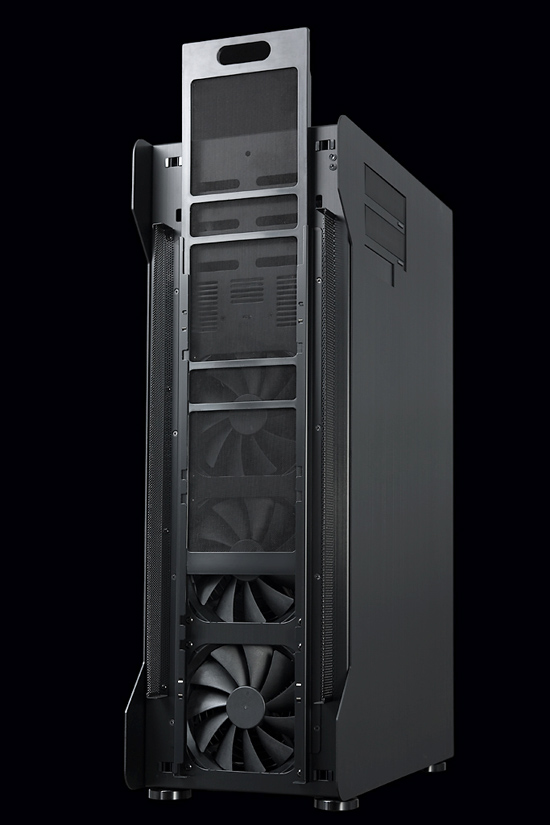
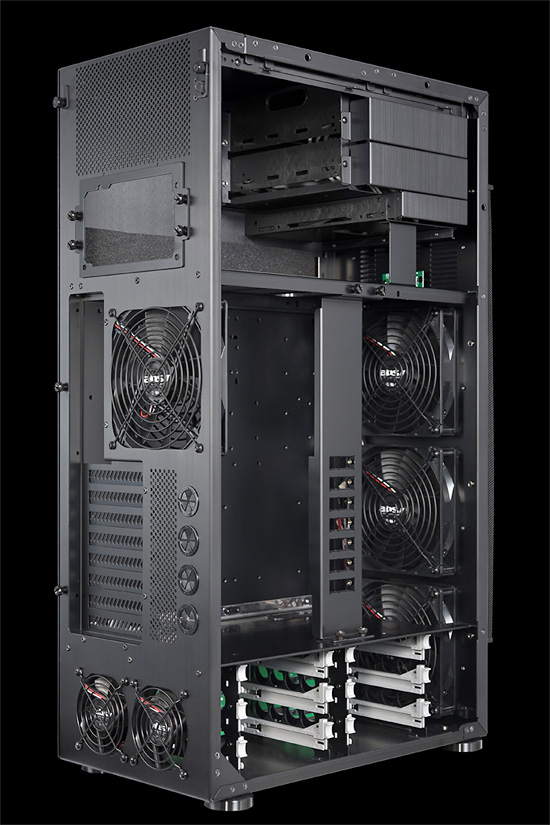
We will be taking an in-depth look at this case shortly. In the meantime, if you were wondering what to get the computer enthusiast who already has just about everything then we suggest you seriously consider this case as a gift this holiday season. At an $599 MSRP (various deals are available to reduce the price), it certainly would be a luxury gift and for a lot of us the price of this case exceeds the cost of our systems already. However, ABS is not marketing this as a case for everyone, instead the target market is the very high-end enthusiast who utilizes their system in a variety of ways ranging from serious gaming to a home based server. Ignoring the marketing speak, it turns out that it makes for a perfect test bed platform.
This case addressed all of our needs for high-end component testing by providing a pull-down motherboard tray for quick installation or removal, three separate cooling/component compartments, plenty of airflow, easy setup for our base water cooling or TEC products, and hot-swap SATA capabilities along with a bevy of drive openings. Nice touches include a front air-filtering system, three speed fan controller for the four 140mm fans, sound insulation on the side covers, pre-drilled holes for liquid tubes, anti-vibration technology throughout the case, tool-less peripheral installation, optical drives can be configured for right or left side operation, and media ports on top of the case.
The case is handcrafted from black anodized aluminum and although it is a massive case, it is surprisingly light weight for the most part without giving up any structural integrity. We have a had a blast using this case for our X58 testing and think ABS just about nailed the design and usability aspects. We were worried about airflow with the front three 140mm fans pushing more air than the single rear 140mm fan, dual 80mm fans, and power supply could exhaust, but it turns out that by running the rear 140mm fan at a speed step higher than the front fans that all was well in the thermal and acoustic departments. Overall, considering all of the components installed during 3x SLI/CF testing, we had no problem with noise considering the case was sitting next to us during testing.
About the only things we could nitpick after using the case for the past few weeks was the lack of wheels for a case this size, lack of fan control for the 80mm fans, and better vibration dampening for the hard drive bays. We never really had a problem with acoustics and loading out six hard drives, but we could imagine the plastic rails loosening up just a little over time, especially if you hot swapped drives on a regular basis.
Oh yes, the price is certainly out of reach for many but we have seen $100 rebates or $250 off price schemes when purchased with certain i7 processors. However, we would not be surprised if this case ended up in the Neiman Marcus holiday season catalog. But if you can afford it, we strongly recommend this case. Just consider it an investment for the next few years or as a gift from a very generous Santa Claus.


 Facebook
 Twitter
 RSS
RSS


17 Comments
View All Comments
kondor999 - Monday, December 15, 2008 - link
My Antec 1200 has, IMHO, better balanced and more effective cooling for the tri-sli (3 GTX280's) setup I'm running. I actually looked at this case on Newegg, but concluded that it would be best utilized for water cooling (a route I didn't want to pursue).And if you want water cooling, then Koolance makes some wonderful cases with professionally integrated water cooling for the same price.
If you want more room, then a box-type case like the Ascension from Mountainmods.com would be vastly superior in terms of both ventilation and size.
All in all, there are much better alternatives at this price point.
tonjohn - Monday, December 15, 2008 - link
Yeah, I was noticing this as well.http://www.lian-li.com/v2/en/microsite4/x2000.html...">http://www.lian-li.com/v2/en/microsite4/x2000.html...
erple2 - Monday, December 15, 2008 - link
I don't understand what the hubbub is about manual fan controls. It seems completely counter to what the whole point of a fan is - provide cooling. Therefore, there should be a thermistor that automatically adjusts fan speed based on need, not some esoteric idea that someone thinks that they might like to have.Manual Fan controls are just plain ... dumb. You either need more cooling because it's too hot, or you don't need extra cooling. Let an automatic thermistor control that.
I hate the fact that I have to manually control the fan speeds on my case - I'd MUCH rather have the case "sense" (or better yet, the fan itself) when more go is needed based on temperature readings, rather than have to reach around the back of the case and click a switch from "inadequate cooling, but nearly silent" to "too much cooling and tornado-like noise".
If you're setting your fan speed based on perceived noise, then you're wasting your time, and potentially causing harm to internal components.
strikeback03 - Monday, December 15, 2008 - link
Who sets the thermistor value? Is it preset at the factory? Or can the user adjust it to suit their needs?For the price of this case I'd think an automated fan controller should be included, which allows profiles to be set and saved for running the fans
The Tuniq Tower on my system here at work cools the same with the fan anywhere between about 1400RPM and where it tops out at around 2100RPM. The difference in noise is large between those two settings though, so of course I leave it set at 1400.
HollyDOL - Monday, December 15, 2008 - link
Tbh for this price range I'd expect to be able to set up fan start-up temperature and fan full-throttle temperature. Can make such a simple device for like 5-7Euro on my knees.HollyDOL - Monday, December 15, 2008 - link
Sincerely I doubt lack of HDD dampening would be a problem here. If the buyers can afford this kind of case it's very likely they pet their SSDs inside instead of classical discs.Welshtrog - Sunday, December 14, 2008 - link
Two problems as far as I am concerned, The side entry for the optical drives - thats crazy, and no control for the 80 cm fansWelshtrog - Sunday, December 14, 2008 - link
First Look it is definately lian-li but two problems as far as I am concerned. The side entry Optical drives and no control on the 80mm fansDano97 - Sunday, December 14, 2008 - link
This is a re-branded Lian-Li. ABS confirmed this in response to a Newegg review. I have had this case for a couple of weeks now, and the only thing I don't like is the fact that is hard to route cables behind the Mobo tray. If you do, expect to see a little bowing of the panel. If they had added about 1/8-1/4 of an inch to the width they could have solved this issue, or if they had cut a channel in the acoustic foam that would have worked. personally I like the side mount optical drives, and the rest of the case is great. Tall as all get out so make sure, if your putting it under a desk, that you measure first.Zak - Saturday, December 13, 2008 - link
The top compartment should be narrow enough just to accommodate 2 5.25" drives and a PS and have a 14cm fan above the PS. Then the bottom compartment could be higher to fit 8 HDs and have 14cm fans on both sides. Also, side vents would be a good option. Oh, and I do dislike the side mounted optical drives idea:(Z.