



ATI Radeon HD 4850 Preview: AMD Delivers Performance for the Masses
by Anand Lal Shimpi & Derek Wilson on June 19, 2008 5:00 PM EST- Posted in
- GPUs
Power, Thermals, Noise and Die Size
The Radeon HD 4850 is a single slot design, but the card itself gets very hot. At idle the card is mostly silent, but like the GeForce GTX 280 you can hear this thing once the fan spins up. It's definitely not as loud as the GTX 280, but it's not silent under full load.
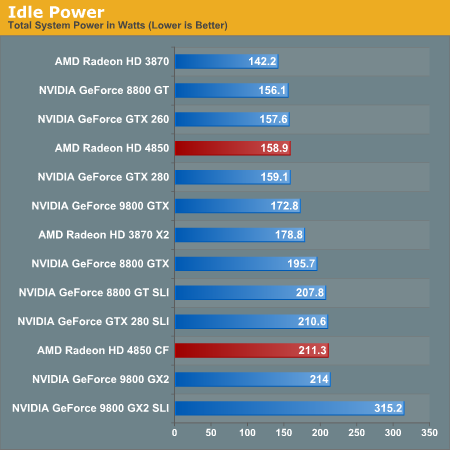
The Radeon HD 4850 draws a bit less power than its closest competitor, the GeForce 9800 GTX.
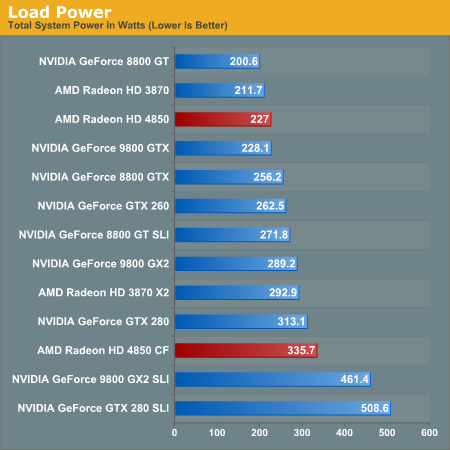
With two 4850s paired up in CrossFire, we once again ran into issues with our power supply. Our 1000W OCZ EliteXStream wasn't always enough for the dual-GPU setup and in Call of Duty 4 our system rebooted in the middle of our test at 2560 x 1600. Thankfully OCZ sent us a PC Power & Cooling Turbo Cool 1200W unit that is certified for use with GeForce GTX 280 SLI, and if it works on that beast, it had better work with a pair of 4850s in CrossFire.
The PCP&C unit is quite loud as we mentioned in our review, but it got the job done, we were able to run all of our benchmarks without a hiccup after swapping power supplies. Despite AMD's small-GPU strategy, power consumption on multi-GPU configurations is still just as much of a problem as it is for NVIDIA.
The Test
| Test Setup | |
| CPU | Intel Core 2 Extreme
QX9770 @ 3.20GHz |
| Motherboard | EVGA nForce 790i SLI Intel DX48BT2 |
| Video Cards | ATI Radeon HD 4850 ATI Radeon HD 3870 X2 ATI Radeon HD 3870 NVIDIA GeForce 9800 GTX NVIDIA GeForce 9800 GX2 NVIDIA GeForce 8800 GTX NVIDIA GeForce 8800 GT NVIDIA GeForce GTX 280 NVIDIA GeForce GTX 260 |
| Video Drivers | Catalyst Catalyst 8.5 ForceWare 177.34 (for GT200) ForceWare 175.16 (everything else) |
| Hard Drive | Seagate 7200.9 120GB 8MB 7200RPM |
| RAM | 4 x 1GB Corsair DDR3-1333 7-7-7-20 |
| Operating System | Windows Vista Ultimate
64-bit SP1 |
| PSU | PC Power & Cooling Turbo Cool 1200W |


 Facebook
 Twitter
 RSS
RSS


114 Comments
View All Comments
pwnedbygary - Sunday, July 6, 2008 - link
This card is absolutely a BEAST at folding. Now that standford U. has released the GPU2 Client for XP/2003 (im running it on Vista however) it can complete a 10,000,000 piece workunit in about 2-3 hours. I'd like to see the PS3 do THAT hehe.Heres a screenshot: http://i47.photobucket.com/albums/f198/pwnedbygary...">http://i47.photobucket.com/albums/f198/pwnedbygary...
marone - Tuesday, June 24, 2008 - link
ATI to Nvidia: Im at ur base, ste@ling your customersMatrixfan - Tuesday, June 24, 2008 - link
Hello! Please excuse me if it is obvious, but what kind of fps figures are in the test? Do these figures represent minimum or average fps numpers?flexy - Monday, June 23, 2008 - link
truly, truly amazing. A high-end card which you can get or $149 at BB.NV..eat this. I applaud AMD this time after some years of disappointment since we didnt see anything exciting after 9700/9800...but this card will be a killer. Price/Performance is actually unreal.
jamstan - Monday, June 23, 2008 - link
I find it odd that a 1000watt OCZ power supply wasn't big enough when the manufacturers only recommend a 550watt PSU for 2 4850s in CF? Sounds like that 1000watt PSU has a bad rail or something.HOOfan 1 - Monday, June 23, 2008 - link
It is complete HOGWASH.As I stated elsewhere, the card can pull NO MORE THAN 75W from the PCI-E socket and NO MORE THAN 75W from its single 6pin PCI-E connector. Two of them can draw no more than 300 Watts. The OCZ EliteXstream uses a single 12V rail so there can be no excuses of over current shutting the PSU down. The PSU is also good for another 660Watts of 12V power....that could power a few peltiers and tons of fans and Harddrives.
It is sad to think that some people will read this article and actually believe they need a $200+ 1200W PSU to run dual HD4650, when a $100 Corsair VX550 would do.
solog - Monday, June 23, 2008 - link
Why would the manufacturers claim 550W if it were nowhere near enough? Derek Wilson stated that the load draw wasn't stressing the cpu, ram and hard drive. But if you factor those in they still aren't anywhere close to 1000 watts (or the 1200 watts that they claim is really needed to run it!)Maybe someone else should redo the power consumption test with different power supplies, including 550W units that are known to be functional. Anyone else see any review that claims anything like this?
BigDaddyCF - Monday, June 23, 2008 - link
Yes you could sat that"While it is true that two RV770s can outperform a single GT200 in many cases, you could also make the argument that two GT200s could outperform anything that AMD could possibly concoct."
However concocting that dual GT200 solution will cost you
$640 x 2 = $1280
that's what I'd call the lunatic fringe of gamers, and it has to be a small portion of the market.
jhb116 - Sunday, June 22, 2008 - link
For the official review - can we get the real sound numbers? Also - with the power - is the 4850's power saving features enabled?I'm also looking for this type of info when you get the GTX+ review(s). Is any further info on the Hybridpower features - last time I read - it seemed this feature wasn't working?
Could be game changing for either competitor if they got this type of feature to work. I'm willing to sacrifice a bit of performance to keep my system somewhat green during downtime/web surfing.
Bobattack - Sunday, June 22, 2008 - link
While this is a preview of the 4850 and I'm sure a lot of us can't wait to see how well the 4870 will compare. The test scores don't match up between THIS review (June 19) and the GTX 280 review (June 18) but your hardware stats are exactly the same.Bioshock 1920x1200
Card 08.18 08.19 (ATI 4850 preview)
GTX 260 69.0 50.4
9800GTX 64.6 42.3
ATI 3870 64.6 41.0
But I looked at the chart again and noticed the problem while typing this.
The WRONG screen res. is in the grid! (Also some numbers don't match from the BASIC chart to the detailed multi res chart)
So you have 1280x1024/ 1600x1200 / 1920x1200, which wrong.
It should be 1600x1200 / 1920x1200 / 2560 x 1600!
Its a preview, and it was kind of last minute, so its understandable.