



Nintendo's Development Secrets, Cloud Gaming & new Killer NIC - GDC '09
by Anand Lal Shimpi & Derek Wilson on March 26, 2009 12:00 AM EST- Posted in
- Trade Shows
This is my first GDC. It’s the Game Developers Conference. I’m not a game developer, but I’m not a regular developer either and I go to the Intel Developers Forum all the time. When Derek went last year he said that there was just too much show, and that next time he’d want me to come to help out. I obliged. Trips out to California always end up being useful in one way or another.

As with all conferences, this one started with a keynote. And not just any keynote. The 2009 Game Developers Conference started with a keynote from the president of Nintendo: Saturo Iwata.

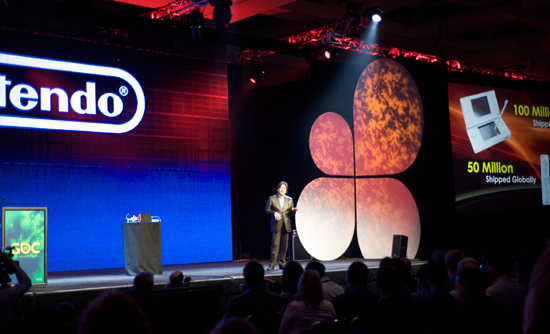
Iwata on stage
I’d never been to a Nintendo keynote before, nor had I ever heard Iwata speak. He spoke with a very mild lisp but was very calm, collected and confident in his delivery. I don’t really know how else to describe it other than that he spoke the way you’d expect the president of Nintendo to speak.
Nintendo has had a huge impact on the video game business in the US and around the world, largely due to the success of the Wii. The Wii is extremely popular, but Iwata really put it in perspective. Nintendo has shipped over 50 million Wii consoles since its launch in 2006. That’s the fastest ramp rate of any console. The Wii Balance Board, the peripheral that comes with Wii Fit, has sold around 15 million units. That in itself is nearly as many units shipped as Sony’s PlayStation 3.
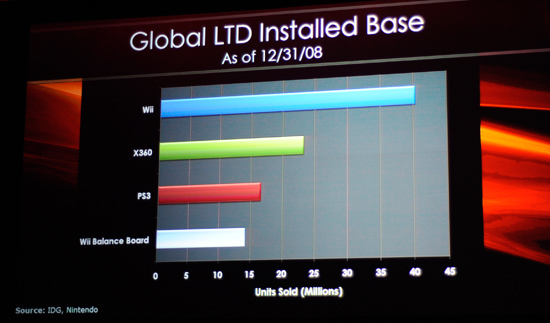
Over 40M consoles shipped by the end of last year. 50 million total since then.
The graph below shows total US video game market growth for an eight year period starting in 2001. The bars represent total video game hardware, software and accessory sales for each year in the US alone.
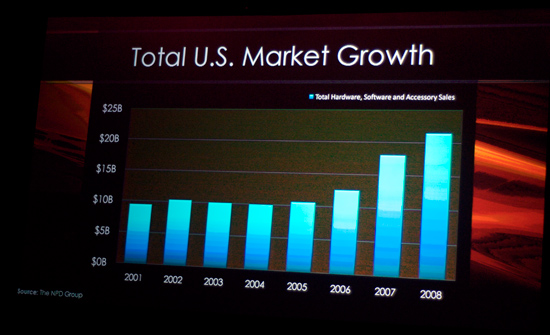
In 2008 the US video game industry broke $20B. That’s pretty impressive. Now look at what percentage of that growth was solely because of Nintendo:
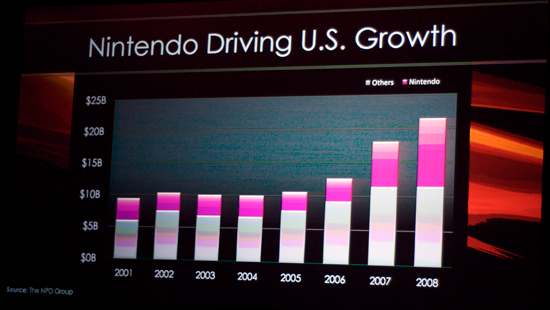
The pink sections of the bars are Nintendo related sales alone
Nintendo accounted for nearly $12B of the $22B US video game industry in 2008. There’s no other way to put it, Nintendo is single handedly driving growth in the US game industry - largely due to the Wii.
The trend is the same in the UK, Germany and France:
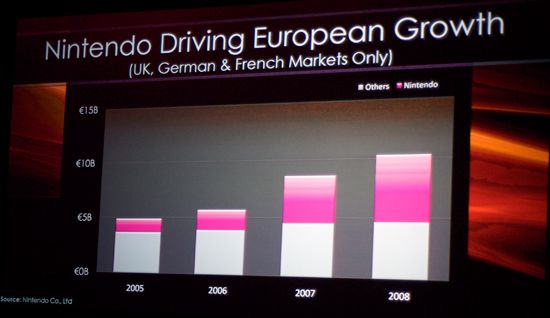
Around half of all video game related sales in those countries last year was because of Nintendo. The numbers are just ridiculous. Cute cuddly video game characters aside, Nintendo is as colossal of a market force as companies like Intel, Microsoft and Google in their respective industries. Nintendo’s size in itself shouldn’t be surprising, but when characterized in terms of the entire video game market it’s shocking.
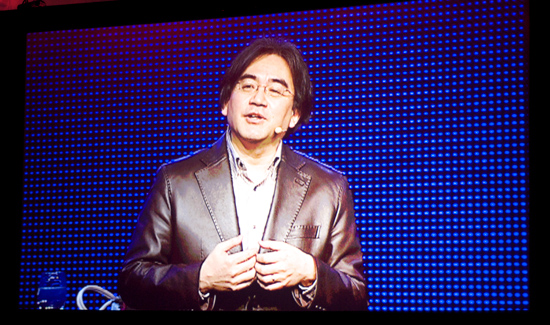
This next part was cool. Iwata took us through how goes about designing games. For those of you who don’t know, Miyamoto is the creator of Mario, Zelda, Pikmin, Nintendogs and some of Nintendo’s other extremely popular franchises. Given that Iwata was speaking to an audience of game developers, choosing to speak about Miyamoto’s approach to game design made a lot of sense. But to me, it was just awesome to hear about how someone who is great at his craft goes about his work. I love stories like that.
Let’s get started.


 Facebook
 Twitter
 RSS
RSS


38 Comments
View All Comments
0roo0roo - Saturday, March 28, 2009 - link
i think its the same kind of idea as the network pc larry elison tried to push in the past. remember a while back he said that pc's wouldn't need harddrives, just boot through the net!! money saved!i think this is about as pointless as that. it moves the burden onto an expensive use of bandwidth, and people that have such lag free high bandwidth connections don't need help with buying video cards. they are selling a second rate experience in an environment of so many alternatives for entertainment. its just easier to get a console if you dont want to play the pc upgrade game.
nubie - Friday, March 27, 2009 - link
[quote]...or on the OnLive "console" hardware; basically a video encoder, ethernet and a USB port.[/quote]I am assuming that you meant a video decoder?
Kroneborge - Friday, March 27, 2009 - link
I don't know, I'm really not a fan of cloud computing, and don't think I would like cloud gaming either. There's something to be said for owning your own stuff, and not being totally dependent on a 3rd party provider.zayfmaro - Friday, March 27, 2009 - link
All of your comments talking about lag and latency have nothing to do with the concept of cloud gaming in and of itself. The idea of cloud gaming is revolutionary. Although we are lacking the internet bandwidth to enjoy such concepts as multiplayer cloud gaming, as soon as we find a better medium for high speed internet or better yet, a different loss-less compression technology, the ability to play any game through the internet will surely take off. Sure the quality won't be as good, but saving hundreds of dollars on computer hardware, and not having to upgrade my video card to play the latest games is so worth a few chopped frames and some latency. Most computer users don't get the best video cards on the market anyway its just not worth the price/performance ratio. Overall, if everyone has the same latency, then the latency itself is non-existent. I'm very excited for this technology and can't wait to see other uses of cloud computing.bobobeastie - Friday, March 27, 2009 - link
"This next part was cool. Iwata took us through how goes about designing games"That typo caused confusion for me for the first couple of pages. I just assumed it was supposed to be he that is missing, because it would seem difficult to skip someones name. It was not clear if Iwata was talking about Miyamoto or if Iwata was Miyamoto's first name. If I understand it correctly they had Iwata kissing Miyamoto's ass on stage, figuratively that is?
Wolfpup - Friday, March 27, 2009 - link
All the stuff with Miyamoto SOUNDS good, but what's the point? Does Nintendo actually do any game development now? I can't remember any original titles last year that were GAMES.tejas84 - Friday, March 27, 2009 - link
This company Onlive has the gall to try and screw Microsoft,Sony, Nvidia, Intel and ATI and they think they can get away with it. Hmm I don't think so... I don't see these companies sitting down and taking this. More hardware is sold via current methods than by this method and this project threatens too many big corporationsBesides what is this ??Communist North Korea where my gaming has to be done on a server collecting all my information ;spoonfed to me cos I'm too thick to buy a mid range PC or console and hook it up? People in this world still value tangible goods you know and where would all the folding@home be done?
I thought in freedom loving America that you all love the ability to do things your way and not be ruled by a server which dictates the games pricing, and lack of mods, settings etc etc
As far as Folding@home is concerned...Oh thats right I need to hire out a Cray Supercomputer server from Onlive costing $X thousands rather than using my GPUs and CPUs... This is about tangible versus nothingness and PC users are not going to give up their hardware for this shite. Maybe Mac fanboys would love this and some console gamers but PC enthusiasts know this is a load of baloney.
ISPs in the US and Europe cannot handle this service effectively due to aggresive traffic shaping and this is the physical and real life reason why this will fail.
iwodo - Friday, March 27, 2009 - link
Personlly i think it is a good idea, at least Slow, or not fast paced Action RPG, slow paced games, turn based games, RTS, turn paced, etc....It would be great for Mac too.
arturnowp - Thursday, March 26, 2009 - link
I'm just wondering if OnLive has something to do with AMD Fusion Cloud computing with is schedule for end of 2009. OnLive didn't invent new CPUs and GPU system afterall...arturnowp - Friday, March 27, 2009 - link
I've just found out that AMD is behind OTOY, a competitor to OnLive. I just wanted to say please stop comlaining. It OnLive turn out to be over advertised nobody will use it, end of problem.