



Apple's Move to x86: More Questions Answered
by Anand Lal Shimpi on June 7, 2005 4:55 AM EST- Posted in
- Trade Shows
So, which Intel CPUs will Apple be using?
Steve Jobs stated that they'd be shipping Intel based Macs by June 2006, so let's consult the handy Intel roadmaps and see what will be available by June 2006.
On the desktop side, two new 65nm cores will be introduced in Q1 2006 - well before Apple's June 2006 deadline: the dual core Presler and the single core Cedar Mill processors.
We saw Presler running at last year's Fall IDF, albeit only at 2.0GHz. When Presler makes its debut early next year, it will be clocked at 2.8GHz at the low end and 3.4 - 3.6GHz at the high end. The chip will also feature a 2MB L2 cache per core and we're guessing that a number of architectural enhancements didn't make their way into Prescott. As is the case with the current Pentium D, Presler will not have Hyper Threading enabled by default, although the Extreme Edition based on Presler may have HT enabled.
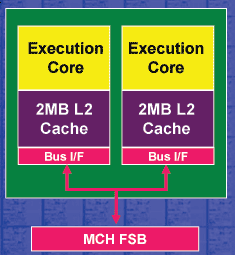
Intel's Presler, most likely the first high end Powermac candidate for Apple next year.
With Intel's dual core processors, Apple can effectively offer the same TLP as their current dual processor G5s with only a single CPU socket in next year's Intel solutions. If you've ever looked at the cooling solutions required for Apple's 2.5GHz or 2.7GHz G5 systems, being able to cut that down by a half would definitely help lighten up and reduce the cost of producing/shipping their machines. One advantage that the G5 does currently have is that its die is extremely small, measuring only 66 mm2 compared to the 206 mm2 Pentium D die. The move to 65nm will help Intel, but the G5 definitely has a size advantage. However, with Intel's volumes, it is unlikely that the die size advantage will translate into any pricing advantage for the PowerPC chips over Intel's solutions for Apple.
The most excitement appears to be around Apple's ability to get their hands on the Pentium M next year - not to mention that in Q1 2006, Intel will begin shipping Yonah, their first dual core Pentium M processor. In our review of the PowerBook G4, we talked about the bulk of the unit and how it would be nice to get something smaller. Well, with the Pentium M, Apple will be able to produce a truly thin and truly light PowerBook without sacrificing performance.
But, let's not get caught up in the next year alone. Clearly, Apple is interested in the long haul, as you don't make this sort of a commitment without looking at the 5-, 10- and 15-year futures for your partner. Presler and Cedar Mill weren't the cores that won Apple over; it is Intel's Platform 2015 vision, the NetBurst successor and their ability to learn from their mistakes with the Pentium 4 that are what won Apple over. As many of you have pointed out, Apple may very well just skip over the NetBurst generation of desktop processors and initially begin the switch to Yonah on the mobile side - arguably where Apple needs a refresh the most. Then, in line with Intel's roadmap, introduce Intel's replacement architecture for NetBurst later in 2006 or by the middle of 2007.
Why not AMD? Much of Apple's success is due to marketing and branding, not necessarily technological leadership. That should sound a lot like Intel these days, whose processors essentially lag behind AMD in terms of technology, but outsell AMD by huge margins, thanks to strong marketing and branding. The Intel brand is much stronger than AMD's, and that is the sort of partner that Apple is interested in.
The ability to supply Apple's volumes isn't a huge deal, as many have pointed out. AMD could most definitely handle Apple's volumes. Intel's pricing to Apple is most likely far more attractive than anything AMD could put together, however, and when existing as a premium PC manufacturer is already quite difficult, any breaks on CPU pricing that you can get are definitely worth it.
So, why not support both AMD and Intel? Apple may in the future, although it is highly unlikely anytime soon - especially given whatever sort of pricing arrangement that Apple and Intel have worked out. Right now, Apple has no intentions of confusing their marketplace. Let the transition from PPC to x86 take place, and then worry about Apple supporting AMD. If Intel does indeed embrace an on-die memory controller and a Hyper Transport-like interface by 2007 in a cooler running architecture, the demand for Apple to support AMD may in fact diminish.
Intel needs a partner like Apple. For the longest time, Intel has been promising usage models and concept PCs that we all wanted, but would never surface. PC vendors focused on producing the cheapest system possible, while dealing with backwards compatibility and standards compliance with a huge install base - effectively, making change difficult. Look at how long it has taken us to transition away from the Parallel and Serial ports on PC motherboards or the move to SATA drives. With Apple, Intel finally has a partner that is willing to adapt to change at a much more rapid pace and one that can implement new technologies extremely quickly, thanks to a small, agile user base.
The Apple/Intel relationship will definitely change the dynamics of many business relationships spanning the entire PC industry. The question is no longer "if...", but rather "how...".


 Facebook
 Twitter
 RSS
RSS


56 Comments
View All Comments
Tripper - Sunday, June 12, 2005 - link
For an entirely different POV than my own previous comment see http://www.pbs.org/cringely/pulpit/pulpit20050609.... as to why Microsoft my be the real loser. I can only hope.yanon - Thursday, June 9, 2005 - link
Here comes a challenger to MS. Initially, Apple OS market share will still be small. There will be more and more software developers offering Apple version of their software in the future since the hardware platform will be essentially the same for either OS'sIn time, Apple OS market share will grow. MS being smart at killing competition will probably stop developing Apple version of MS Office to slow Apple's penetration into the coporate world. Needless to say, 2008-2012 will be a very interesting time for computing world.
Tripper - Wednesday, June 8, 2005 - link
"If AMD collapses, Intel would immedately go back to it's good old days of 1990-1998 of $500 CPUs...this is the nail in Apples coffin. $400 Dells' will kill them."I competely agree with Zebo's #5 post, this move threatens to isolate AMD even further and surely will spell the death of Apple. Why buy an Apple, even if it comes in under $1000, when cheapee Dell's are available? There was an argument that Mac's were better that their Wintel cousins, but you can't make that claim anymore. Apple survived because it was unique, yet now they have traded that commodity away. And what guarantee's does Jobs have that all their vendors will jump on the new platform for a mere $1000? It will be interesting to see how many of these developer packages they sell, and how fast too.
IMO Apple's only hope is to become a software company offering their OS and other warez as a counter-point to Microsoft. If OSX were compatible with AMD I'd purchase it over Windows, as long as they don't try to imitate Longhorn.s long as they don't try to imitate Longhorn.
nserra - Wednesday, June 8, 2005 - link
#50 Very simple.Apple goes for Intel because it can provide them all they need.
Products from Intel are "bad" for the market because if all comes from the same manufacture means less competition, less differential products (all cost the same, do the same, look the same).
And it's all about marketing. On that post all your questions are answered. And it doesn’t have nothing to do we this subject.
Pandaren - Wednesday, June 8, 2005 - link
#51 - If you look at Apple's OS X for Intel documentation, you'll find that the overwhelming focus is on IA-32 and not x64. Apple probably can and will use Yonah because: (1) it'll take awhile to get x64 OS X working (2) lower end consumer machines don't need or can't physically fit more than 4GB of memory. For a Mac Mini or iBook, an IA-32 rather than an x64 processor is just fine.mczak - Wednesday, June 8, 2005 - link
To #47, I think you're correct that Anandtech is very wrong. However, I'm a bit puzzled: I highly doubt Apple would bother with the "old" x86, that would just mean they need to transition to x86_64 shortly afterwards. But, Yonah is supposed to not have EMT64, and its successor Merom (with EMT64) will not appear before late 2006.As for the power-efficiency, indeed the 65nm Netburst cores (single-core cedar mill / dual-core presler) are supposed to be not doing too well. But the successor to them (conroe) are rumoured to run VERY cool (should also appear late 2006).
I'm pretty sure all powermacs will use dual-core cpus, after all at that time "normal" PCs will pretty much all be dual-core except the Celeron-class ones.
So in fact I can't see what cpus apple wants to use before late 2006 - and their transitioning is beginning in june 2006. The only half-way decent box I can see at that time-frame would be a imac with a single-core cedar mill (which is rumoured to not have a too high power consumption), but notebooks are out until late 2006/2007, unless apple reconsiders and chooses a amd turion64 for that...
ceefka - Wednesday, June 8, 2005 - link
Won't virtualization lift all barriers and make OS-X run on an AMD platform as well? If they can tweak OS-X and an x86 Intel to run OS-X now, that possibility will surely come in the future even without any hacking.I can see why Apple marries Intel, though there's a lot of technological reasons why it could have been AMD too.
#44 Intel still wins video and audio benchies over AMD. It just depends what software you run.
All in all this is kinda sad. Apple ceases to be the oddball, square peg in the round hole called Personal Computers. You could cynically say that future Apples are tweaked Intel boxes, no more, no less.
#42 Interesting, AMD should work with ULi on laptops. Just how does this relate to the article?
Vesperan - Tuesday, June 7, 2005 - link
I dont think Ive read what I consider another factor in Apple choosing Intel (and not mentioning Amd).Namely, had Apple gone for Amd and announced how wonderful they were - how likely would an Apple + Intel partnership be after that? Apple would be shooting themselves in the foot if they mentioned or partnered with Amd in this enterprise.
I cant wait to see how well Apple goes on x86, I think its a great decision in the medium-long term.
T8000 - Tuesday, June 7, 2005 - link
I think Apple is going to call the Intel generation the G6.They can do this, because the G names just represent Apple branding. IBM has only 3 digit model numbers for their PPC CPU's.
Pandaren - Tuesday, June 7, 2005 - link
Anandtech's conclusions are unlikely to be correct. When CNET first broke the story, it said that Apple intended to move the lower end consumer machines (iBook, Mac Mini) to x86 first. The 65nm netburst chips are probably not good candidates for small form factor PCs and notebooks that don't need much cooling.The more likely scenario is Yonah in iBook and Mac Mini, and Merom/Conroe in the PowerBook and PowerMac when it comes out in late 2006.