Latest Posts
Previewing AMD's Brazos, Part 1: More Details on Zacate/Ontario and Fusion
by Anand Lal Shimpi on 11/9/2010

I hate to keep things from you all, but last week I was diligently working in a room at AMD’s new campus in Austin, Texas. You see, AMD wanted to give us more time with the Brazos/Zacate platform we tested at IDF ahead of its official launch. It’s too early for production worthy OEM systems and AMD wasn’t too keen on these reference platforms leaving its offices so it did the next best thing: fly us out to test the systems on AMD’s campus.

The rules were simple. We couldn’t run anything that would harm the system, but other than that we were free to bring whatever we wanted and test however we wanted. AMD dropped by our private room to check to see if we needed anything but other than that, it was all hands off.


The Brazos test platform

While I’d love to share performance data with you today, I can’t. You’ll have to wait another week or so for that. What AMD is allowing us to talk about are the specific configurations AMD’s first Fusion APUs will ship in and general impressions from the testing. 

Read on!

AMD's Zacate APU Performance Update
by Anand Lal Shimpi on 9/15/2010

It’s 12:43AM and I just got back into my hotel room. I spent the past few hours in AMD’s suite a block from IDF trying to get to the bottom of an issue we discovered in our post on AMD’s Zacate GPU performance numbers earlier this week.

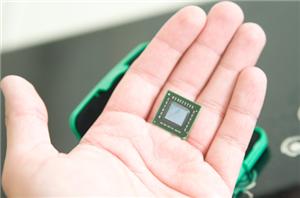
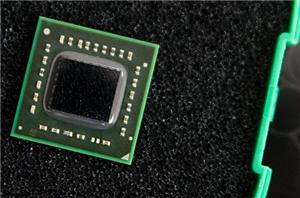
Let’s recap. Zacate is AMD’s 18W APU aimed at the mainstream notebook market (~$500 notebooks). The APU features a pair of Bobcat cores and a Cedar-class AMD DX11 GPU. Spending some time with the physical Zacate package, it seems to have a single 64-bit DDR3 memory interface ala Atom. Unlike Atom however, both the Bobcat cores and the DX11 GPU should be relatively high performance.

Earlier this week, AMD showed us the first public demonstration of Zacate. In its suite were two systems: a Zacate test platform and a Core i5-M 520 notebook from a major OEM. Both systems were configured with 4GB of memory and were running the 64-bit version of Windows 7 Premium.


AMD's Zacate

The first demo we saw on Monday was the system running City of Heroes. In CoH Zacate managed to reach frame rates around 2x of what we saw on the Core i5-M 520. AMD also ran through a number of IE9 performance tests including the Psychadelic HTML5 benchmark and the Amazon Shelf test. In both of those tests, the Zacate platform was significantly faster than the Core i5-M 520. And it was those IE9 tests that seemed suspect.


The Zacate test platform

I didn’t think much of it at first, but Zacate managed a ~10x performance advantage in the IE9 Psychadelic benchmark. While Zacate should have a higher performance GPU, it shouldn’t be that much faster. Something was amiss.

I borrowed a Core i5 notebook from Intel (we are at IDF after all) and ran the same tests on it. The performance was much better than what I saw in AMD’s suite. I went back to AMD to find out exactly what was going on.

AMD Benchmarks Zacate APU
by Anand Lal Shimpi on 9/13/2010

Update: We've spent more time with Zacate and have some more accurate performance comparisons here.

It's tradition for AMD to have an off-site meeting place during IDF week and this year is no exception. I headed over to AMD's suite to talk about servers, desktops and the imminent mobile Fusion launches. We've talked about AMD's three new microprocessors in great detail before. Bulldozer is targeted at the high end desktop and server markets, due out sometime in 2011 (sampling in Q4). Llano will arrive at the end of Q2 2011 and feature multiple 32nm Phenom II derived cores paired with a very beefy AMD DX11 GPU. What I'm most excited about however is the parts that will begin shipping in Q4 2010: Zacate for mainstream notebooks (18W TDP) and Ontario for netbooks (9W TDP).

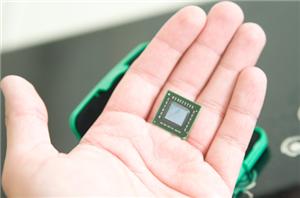
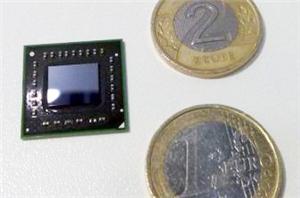
Both APUs will have a pair of low-power Bobcat cores and an AMD DX11 GPU. AMD isn't publicly confirming how many cores the GPU side will have but both will share the same die manufactured on TSMC's 40nm process. The package is extremely compact:

AMD let us have some benchmarking time with an early Zacate platform. For a low end/mainstream notebook platform, the GPU performance looks very good. Read on.

AMD Reveals Competitive Fusion APU TDPs: 9W for netbooks, 18W for notebooks
by Anand Lal Shimpi on 9/7/2010

After the ATI acquisition AMD announced it would be creating a new category of microprocessors that featured integrated ATI GPUs. AMD called these hybrid CPU/GPUs Accelerated Processing Units (APUs) and it branded the entire APU strategy: Fusion.

The first Fusion project we heard about was Llano for mainstream notebooks/desktops. Llano will integrate a 32nm derivative of the current Phenom II architecture with a relatively capable DirectX 11 AMD GPU. Llano isn't due out until sometime in 2011 so details are still light. However, AMD just released some details on its lower end Fusion APUs that will begin shipping in Q4 2010 (OEM system availability in Q1 2011).

Bobcat is the CPU core. Last month we went in depth on its architecture. In short, Bobcat is an out-of-order alternative to Intel's Atom that has the potential to offer significantly higher performance. But since we're talking about APUs, Bobcat is only a part of the equation.

AMD will be shipping two Bobcat based APUs in Q4: Ontario and Zacate. Both APUs implement two Bobcat cores and a DX11 AMD GPU with an undisclosed number of cores. Ontario is aimed at netbooks/nettops while Zacate can be used in ultra thins and value notebooks/desktops.

Today at IFA in Berlin AMD announced the Ontario and Zacate TDPs as well as shared a photo of a low power AMD Fusion APU (possibly Ontario?). The Ontario APU is rated at 9W, while Zacate is rated at 18W.

Read on for more analysis of AMD's announcement.

Latest from AnandTech