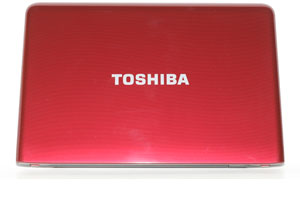
We've looked at AMD's slightly older Tigris platform in the form of their M300 and M600 processors. While performance of those parts was better than previous AMD designs, Intel still maintained a healthy lead in performance and battery life. That wasn't too surprising, and the far more pertinent question is what the new Danube and Nile parts bring to the table. Having taken Nile for a spin and come away impressed, courtesy of the Toshiba T235D, we're now moving up to Danube. AMD again shipped us a recently launched Toshiba A660D notebook, which aims squarely at the midrange performance notebook market.
Sporting the first quad-core mobile AMD processor we've ever tested in the form of the Phenom II P920, the A660D should offer quite a bit more performance in heavily threaded workloads—though the low 1.6GHz base clock speed means dual-core parts should still be faster in lightly threaded tasks. Coupled with the P920 processor are AMD's HD 4250 IGP and HD 5650 discrete graphics, with switching technology providing the optimal choice of performance or battery life depending on if you have the AC adapter connected. Beyond the above, the A660D also provides an update to Toshiba's Satellite design, with a thinner chassis and less gloss. Does the A660D join the T235D as an AMD laptop we can recommend? That's what we're here to investigate.
We've been looking forward to testing AMD's Nile Ultrathin platform since the first press releases went out. It's no secret that AMD's mobile offerings have trailed in performance and battery life for quite a while; in fact, pricing has been just about the only area where AMD could compete with Intel's mobile juggernaut. Nile—as well as the higher performing Danube platform—are supposed to increase performance by up to 38% in some cases while also boosting battery life. AMD claims some models will offer as much as 7.5 hours of mobility, which is a far cry from the sub-5 hour mark set by the old Congo platform. Does the Nile platform live up to the hype? Is there finally a reasonable alternative to Intel's CULV and ULV offerings?
AMD sent us a Toshiba T235D to let us see for ourselves, and frankly this is the first AMD laptop that I can recommend without a whole bunch of caveats. It's not going to be everything to everyone, but for the intended market there's plenty to like. The HD 4225 IGP is significantly better than Intel's old CULV with GMA 4500MHD, and roughly on the same level as the newer Intel HD Graphics found in Arrandale ULV. While Intel still has the outright CPU performance crown, there's also pricing to consider. So join us as we show how AMD's mobile offerings just got a much-needed kick in the pants.