



Nehalem EX
Yesterday, Intel announced that their flagship server processor, the Xeon Nehalem-EX, is being succeeded by the Xeon Westmere-EX, a process-shrinking " tick" in Intel's terminology. By shrinking Intel's largest Xeon to 32nm, the best Westmere-EX Xeon is now clocked 6% higher (2.4GHz versus 2.26GHz), gets two extra cores (10 versus 8) and has a 30MB L3 (instead of 24MB). As is typical for a tick, the core improvements are rather subtle. The only tangible improvement should be the improved memory controller that is capable of extracting up to 20% more bandwidth out of the same DIMMs. The Nehalem-EX was the first quad-socket Xeon that was not starved by memory bandwidth, and we expect that the Westmere-EX will perform very well in bandwidth limited HPC applications. Read...
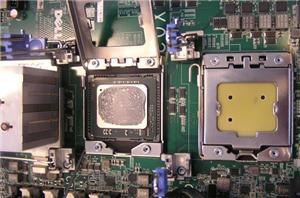
High-End x86: The Nehalem EX Xeon 7500 and Dell R810
We received Dell's latest R810 server for review, coupled with the Intel Xeon X7560. The R810 supports two or four octal-core Intel Xeon Nehalem EX processors, with the potential...
23 by Johan De Gelas on 4/12/2010
 Facebook
 Twitter
 RSS
RSS


