A year ago whenever I'd request an SSD for review I'd usually get a 128GB drive built using 3x nm 4GB 2-bit MLC NAND die. These days the standard review capacity is twice that as most drives ship with 25nm NAND, using 8GB die. Seeing a bunch of scores for 240GB+ drives however is frustrating to all involved. At these capacities you're almost always looking at two die per NAND device, which has significant performance benefits due to interleaving. Most SSD controllers have eight NAND channels and with sixteen NAND deviecs with two die per device that's four NAND die that the controller can interleave access between for each channel. The 128GB drives by comparison halve the number of NAND, which only allows the controller to interleave requests among two die.

How read interleaving works on a single channel
Not only are these 240GB+ drives the best case performance you'd see from a particular SSD, they are also very expensive. At around $2/GB you're looking at over $500 for a high end 240GB+ SSD. I've spent the past few weeks gathering modern SSDs with 128GB of NAND on-board to provide a look at a more balanced point in the price/capacity spectrum.
| Mid-Range 2011 SSD Roundup | ||||||||
| Specs (6Gbps) | Corsair P3 128GB | Crucial RealSSD C300 128GB | Intel SSD 320 160GB | Intel SSD 510 120GB | OCZ Agility 3 120GB | OCZ Vertex 3 120GB | ||
| Controller | Marvell 6Gbps | Marvell 6Gbps | Intel 3Gbps | Marvell 6Gbps | SF-2281 | SF-2281 | ||
| Raw NAND Capacity | 128GB | 128GB | 176GB | 128GB | 128GB | 128GB | ||
| Spare Area | ~6.9% | ~6.9% | ~15.3% | ~12.7% | ~12.7% | ~12.7% | ||
| User Capacity | 119.2GB | 119.2GB | 149.0GB | 111.8GB | 111.8GB | 111.8GB | ||
| Number of NAND Devices | 8 | 16 | 12 | 16 | 16 | 16 | ||
| Number of die per Device | 4 | 2 | 1 - 2 | 2 | 1 | 1 | ||
| NAND Type | 32nm Toggle | 34nm ONFI 2.0 | 25nm ONFI 2.1 | 34nm ONFI 1.0 | 25nm ONFI 2.1 | 25nm ONFI 2.1 | ||
| Street Price | $229.99 | $234.99 | $304.99 | $284.49 | $242.04 | $252.99 | ||
| Cost Per GB | $1.797 | $1.836 | $1.906 | $2.222 | $1.891 | $1.976 | ||
Read on for our roundup of 120GB drives.
As a matter of course we tend to spend a lot of time focusing on the gaming potential of the hardware we review. Boutique desktops get a lot of love, and it's always interesting to see just how much power you can pack in a portable solution. Many users simply don't game, yet they still need a powerful machine for other tasks like video or photo editing. In the world of Intel's first-generation Core i7 line, that meant getting a notebook with a battery eating graphics card you just didn't need. Sandy Bridge changes all that with integrated graphics suitable enough for most tasks, and today, CyberPower has offered us a notebook targeted to a slightly different segment than usual: the IGP-powered, 1080p and quad-core-wielding Xplorer X6-9100.
We've already looked at both dual-core and quad-core Sandy Bridge laptops with IGP graphics, but how does this laptop stack up in other important metrics like battery life, design, and build quality? Read on to find out.
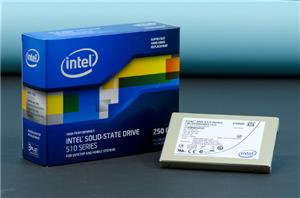
It's been a long time coming but we finally have Intel's third generation SSD. Codenamed Elmcrest, this is not only the first 6Gbps SSD from Intel but it's also the first Intel drive to use a 3rd party controller. Why would Intel turn elsewhere for a controller design? And more importantly, how does it compare to the 2nd generation SandForce drives like the Vertex 3?
Read on to find out!