In almost every SSD review we have published, Anand has mentioned how an SSD is the biggest performance upgrade you can make today. Why would anyone use regular hard drives then? There is one big reason: price. SSD prices are still up in the clouds when compared to hard drive prices (especially before the Thailand floods) so for many, SSDs have not been a realistic option. While SSD prices have been dropping for years, if the current rate continues it will still take several more years before a $399 Walmart PC has a reasonable size SSD in it.
Most of the time, SSD production costs are cut by shrinking the die. Shrinking the die is the same as with CPUs: you move to a smaller manufacturing process, e.g. from 34nm to 25nm. In flash memory, this means you can increase the density per die and usually the physical die size is also smaller, meaning more dies from a single wafer. A die shrink is an effective way to lower costs but moving from one process to another takes time and the first batches of the new flash aren't necessarily cheaper. Once the new process has matured and supply has met demand, prices start to fall.
Since die shrinks are a relatively slow way to lower SSD prices and only contribute to steady reduction of prices, anyone looking to push higher capacity SSDs into the mainstream will need something more. Right now, that "something more" is called Triple Level Cell flash, commonly abbreviated as TLC. Read on for our full analysis on TLC, including performance and endurance expectations, as well as detailed explanations of why MLC and TLC degrade quicker than SLC!
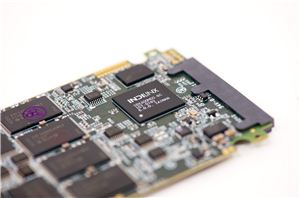
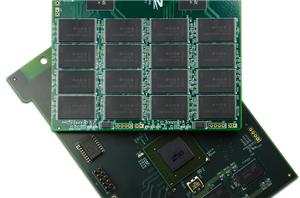
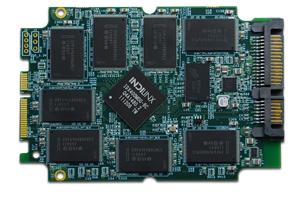
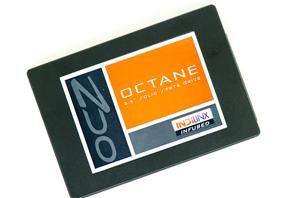
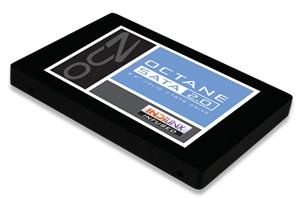
Earlier this year OCZ acquired Indilinx, one of the first SSD controller makers to really make a splash in the enthusiast community. Ever since OCZ entered the SSD business it wanted to guarantee its independence by securing exclusive rights to a controller. OCZ initially did so by buying up all available inventory, first of Indilinx controllers, then of SandForce controllers. That strategy would only work for a (relatively) short period of time as the controller vendors sought to expand their market by selling chips to OCZ's competitors. A few slip ups on the roadmap and Indilinx was ripe for acquisition. OCZ stepped up to the plate and sealed the deal. Several months later, OCZ debuted its first drive based on an unreleased, exclusive Indilinx design: Octane.
Although Octane didn't set any performance records, it was competitive. Performance was definitely current gen, but the drive was fast enough to give OCZ an in-house alternative to SandForce. There was just one issue: OCZ only sent out 512GB Octane review samples. SSDs get a good amount of their performance by executing reads/writes in parallel across multiple NAND devices. Higher capacities have more devices to read/write in parallel, and thus generally deliver the best performance. The greatest sales volume is of the lower capacity models - they're cheaper to own and NAND prices are falling quickly enough that investing in a 512GB drive rarely makes financial sense.
OCZ finally sent out a 128GB Octane, which I promptly put through our standard test suite.
I have to hand it to OCZ's CEO, Ryan Petersen, I never thought he'd turn the company around in the way that he did. When I first met Ryan around a decade ago, he wanted to know why I wouldn't allow him to advertise OCZ on AnandTech. The company at that time had an extremely bad reputation. It was among the worst I'd ever seen. It was so bad that not only would we not review their products (memory, at the time) but I wouldn't allow OCZ ads to run on the site. Although all advertising on AnandTech is handled through a third party, I still have the ultimate say on what ends up on the site. Back then, OCZ wasn't allowed.
Having just taken over the company, Ryan was eager to know what he had to change to fix OCZ's reputation. I gave him a long list of issues to address. Most of my suggestions were obvious, just to go above and beyond the call of duty in taking care of his customers and our readers. He agreed to do everything on the list, with one exception. I told him that if he really wanted to succeed, he needed to abandon the OCZ name and start fresh. He told me that he didn't believe it was necessary. We agreed to disagree.
I remember leaving that meeting thinking that Ryan didn't stand a chance. Memory companies were a dime a dozen. Differentiation was bordering on impossible. Having to overcome a bad reputation on top of that didn't make things any easier.
Ryan is headstrong. He'll sow a bunch of seed with the hopes of seeing just one blade of grass grow. I consider myself an optimist, but he's a different breed of one. He's had his share of failures over the years. Remember the OCZ brain mouse? The foray into notebook PCs? No one ever succeeded without trying.
Since then OCZ has abandoned memory altogether. It focuses on two product lines: power supplies and SSDs, the latter making up the bulk of its revenue. And earlier this year, OCZ bought one of the first high-performance SSD controller manufacturers - Indilinx.
OCZ's strategy there didn't make sense to me. I knew Ryan wanted to buy SandForce, but SF was too expensive. I asked Ryan why bother with Indilinx if what he really wanted was SandForce? He told me that the best way to drive the price down on SF was to buy Indilinx. It didn't add up until now.
Ryan took a big risk on Indilinx. They had a promising controller in 2009 and he bought up the bulk of what they could make in exchange for exclusivity rights. OCZ made Indilinx, and Indilinx made OCZ. As Indilinx began courting more vendors, OCZ went after SandForce. As soon as a first generation controller was ready, OCZ began shifting its volume from Indilinx to SandForce. More partners stepped up to fill the gap left by OCZ, but by then no one wanted Indilinx - they wanted SandForce based drives.
Simultaneously (perhaps a result?) Indilinx's execution suffered, the stumble was irrecoverable. The value of Indilinx went down, and Ryan got the company for cheap.
I can only assume the strategy was to rinse and repeat. I had heard rumors of OCZ working on its own controller for the past two years. The Indilinx acquisition sped things up considerably. If the Indilinx solution was good enough, OCZ would shift its volume away from SandForce to its own controller. Starve SandForce and swoop back in later to buy them at a more reasonable price. Competition makes for competitive prices on both sides of the fence it seems.
Things of course didn't work out that way. OCZ took a while to get its own controller design done and it was still very dependent on SandForce. At the same time, SandForce had diversified its portfolio. Since the announcement of the Indilinx acquisition, SandForce brought on a number of new partners to sell its drives. Even Kingston signed up. Finally, LSI agreed to purchase SandForce at a number well in the range of what SF was looking to sell for.
The situation didn't play out exactly how Ryan had hoped, I'm sure. But the result actually isn't all that bad. LSI has no intentions of stopping its supply of SandForce controllers to OCZ (or other partners), and all of the work OCZ put into its own controller finally paid off. Personally, it's hard to believe that I'm writing about the company I once advised to completely abandon their brand. Furthermore, I'm not just writing about them, but I'm writing about their first in-house SSD controller. This is our review of the Indilinx Everest based OCZ Octane, read on!